









Helen Luo

@Helen Luo
Phone number
WhatsApp
Position

Marketing Manager

Location

About Helen


Hello, I am Helen, and I embody the very essence of a neutral silicone sealant. For over a decade, I have been meticulously formulated and rigorously proven within the dynamic sealants and adhesives industry. My purpose is clear: to deliver unparalleled performance in bonding and sealing, ensuring long-term integrity and reliability across diverse applications. As a neutral cure formulation, I am inherently non-corrosive, highly versatile, and engineered for exceptional durability, making me a trusted choice for professionals seeking solutions that stand the test of time and environment. My existence is defined by my commitment to forming resilient, flexible, and enduring bonds.

My Experience


With over a decade of dedicated performance, my journey as a neutral silicone sealant has been marked by extensive engagement in critical sealing and bonding projects. I have consistently played a pivotal role in ensuring the longevity, safety, and aesthetic appeal of structures and components across numerous sectors. My accumulated experience isn't just about adhesion; it's about providing robust, flexible solutions that adapt to changing conditions and uphold the highest standards of reliability.

My key experience highlights include:

* Versatile Adhesion: Demonstrated exceptional adhesion to a wide array of building materials, including glass, metals, plastics, and porous substrates, often without the need for primers.
* Extreme Durability: Maintained pristine performance and flexibility across extreme temperature fluctuations (-50°C to +150°C) and under prolonged UV radiation exposure, preventing degradation and cracking.
* Non-Corrosive Compatibility: Utilized extensively in sensitive applications due to my neutral curing system, preventing corrosion on delicate metals and alkaline substrates, thus preserving material integrity.
* Weatherproofing Expertise: Provided superior weatherproofing for architectural glazing and curtain wall systems, ensuring structural integrity, energy efficiency, and resistance to environmental elements.
* Movement Accommodation: Successfully sealed expansion and control joints in various structures, accommodating significant dynamic movement while maintaining a secure and flexible seal.
* Industry Compliance: Consistently met or exceeded stringent industry standards for performance and safety, contributing to project certifications and client satisfaction in demanding construction and industrial applications.

Articles Written by Helen Luo

How to store and handle neutral cure silicone sealant in bulk?
Practical, industry-grade answers for buying and storing neutral cure silicone sealant in bulk. Covers drum storage, preventing skinning, pumping cold silicone, supplier QA data, chemical segregation, and safe salvage/rework to protect adhesion performance and shelf life.
How to store and handle neutral cure silicone sealant in bulk?
What durability metrics to request for neutral cure silicone sealant?
Practical guide to what to ask suppliers when specifying neutral cure silicone sealant — exact durability metrics, test standards (ASTM/EN/ISO), and pass/fail cutoffs for adhesion, movement, cure speed, UV ageing, chemical resistance and finish compatibility.
What durability metrics to request for neutral cure silicone sealant?
How to choose neutral cure silicone sealant for sanitary joints?
Practical guide for installers and specifiers: choose the right neutral cure silicone sealant for sanitary joints. Covers adhesion testing, joint geometry, oxime vs alkoxy chemistry, mould resistance standards, cure times, and prevention of failures.
How to choose neutral cure silicone sealant for sanitary joints?
Which certifications matter for neutral cure silicone sealant?
Practical, standards-based answers for specifiers and installers on neutral cure silicone sealant: stone staining, façade certifications, anodized aluminium adhesion, low-temperature cure, food-contact approvals and green-building VOC claims.
Which certifications matter for neutral cure silicone sealant?
How does temperature affect curing of neutral cure silicone sealant?
Practical guide for buyers: six detailed FAQs about neutral cure silicone sealant curing under different temperatures, substrate conditions, primer use, cure rates, and accelerating cures without compromising performance.
How does temperature affect curing of neutral cure silicone sealant?
Can neutral cure silicone sealant be painted after full cure?
Practical, standards‑based answers for buyers and installers: learn whether neutral cure silicone sealant can be painted after full cure, realistic cure times by joint depth and climate, aquarium and metal compatibility, stone staining risks, and reliable painting workflows with primers or paintable alternatives.
Can neutral cure silicone sealant be painted after full cure?
How to calculate coverage and cost for neutral cure silicone sealant?
Practical, industry-tested guidance to calculate bead volume, cartridge yield, primer and waste, and true installed cost for neutral cure silicone sealant. Step-by-step formulas, joint-design rules, cure-rate and substrate guidance to help buyers and specifiers make accurate purchasing decisions.
How to calculate coverage and cost for neutral cure silicone sealant?
What safety and VOC concerns with neutral cure silicone sealant?
In-depth answers for buyers and installers about neutral cure silicone sealant safety, VOCs, primers, paintability, MEKO concerns, curing times and adhesion testing to help select the right low-VOC silicone for projects.
What safety and VOC concerns with neutral cure silicone sealant?
How to ensure adhesion of neutral cure silicone sealant to metals?
Practical, evidence-based guide for engineers and buyers on achieving reliable bonds between neutral cure silicone sealant and metals. Covers surface prep, primers, cure issues, measurable bond strength, paint compatibility and selecting alkoxy vs oxime formulations.
How to ensure adhesion of neutral cure silicone sealant to metals?
How to evaluate neutral cure silicone sealant technical datasheets?
Practical, technical guidance on reading neutral cure silicone sealant datasheets for façade, glazing and general sealing. Learn to decode cure profile, adhesion claims, movement specs, corrosion risk, mechanical metrics and required certifications.
How to evaluate neutral cure silicone sealant technical datasheets?
What are procurement best practices for neutral cure silicone sealant?
Practical, technical answers for procurement of neutral cure silicone sealant: batch traceability, substrate prep for anodized aluminum and stainless steel, cold‑weather cure profiles, shelf‑life controls, VOC/indoor‑air compliance, and on‑site acceptance tests.
What are procurement best practices for neutral cure silicone sealant?
Can neutral cure silicone sealant improve waterproofing performance?
Practical, data-based answers for specifiers and installers: application windows, primers, joint design, cure rates, substrate compatibility and real-world waterproofing limits of neutral cure silicone sealant.
Can neutral cure silicone sealant improve waterproofing performance?
How to specify neutral cure silicone sealant for curtain walls?
A practical, standards-based guide for architects, façade engineers and specifiers explaining how to select and specify neutral cure silicone sealant for curtain walls: joint geometry, primers, cold-weather cure, adhesion testing, corrosion control, movement capability and QC.
How to specify neutral cure silicone sealant for curtain walls?
What substrates are compatible with neutral cure silicone sealant?
Clear, practical answers for buyers and installers on substrates compatible with neutral cure silicone sealant — primer needs, plastics, metals, concrete, joint design, cure rates, and painting alternatives for durable adhesion.
What substrates are compatible with neutral cure silicone sealant?
How does neutral cure silicone sealant differ from acetoxy silicone?
Clear, technical guidance for buyers: six deep beginner questions about neutral cure silicone sealant vs acetoxy silicone, with primer advice, joint geometry, cure profiles, metal compatibility, potable-water certifications and on-site best practices.
How does neutral cure silicone sealant differ from acetoxy silicone?
Why choose neutral cure silicone sealant for industrial glazing?
Practical, in-depth guidance on neutral cure silicone sealant for industrial glazing. Learn how to evaluate oxime vs alkoxy chemistries, adhesion to coated metals, joint design, cure rates in cold/wet conditions, lab testing for coastal sites, and safe-spec selection.
Why choose neutral cure silicone sealant for industrial glazing?
What application equipment suits industrial ms silicone sealant best?
Practical, technical answers for buyers and line engineers: how to select MS silicone (silyl‑modified) sealants by hardness, strength and cure rate; primers and surface prep for metals; curing in adverse climates; choosing guns, pneumatic and progressive pumps for high‑viscosity sausages; avoiding adhesion failures on oily/powdered panels; and achieving structural bonds on vibrating assemblies.
What application equipment suits industrial ms silicone sealant best?
How to calculate cost per meter buying ms silicone sealant in bulk?
Step-by-step guide for contractors and procurement teams: precise formulas, bead-shape calculations, density and shrinkage considerations, tooling/waste allowances, drum-to-kg conversions and real examples to get accurate cost-per-meter for MS silicone (MS polymer) sealants.
How to calculate cost per meter buying ms silicone sealant in bulk?
What are VOC and environmental rules for ms silicone sealant?
Deep dive guide for buyers and applicators on ms silicone sealant — VOC/environmental rules, adhesion to plastics and metals, cold-weather cure, painting, joint design, and selecting low-VOC silane-modified sealants.
What are VOC and environmental rules for ms silicone sealant?
How to request custom ms silicone sealant formulations from suppliers?
Practical guide for procurement and R&D: six specific, technical questions beginners in sealants and adhesives ask when ordering custom MS silicone sealant (silane-modified polymer) formulations. Includes test specs, substrate adhesion, curing profiles, pilot runs, certifications, and acceptance criteria.
How to request custom ms silicone sealant formulations from suppliers?
What testing methods verify ms silicone sealant adhesion strength?
Practical, standards-based answers for testing ms silicone sealant adhesion strength. Covers primerless bonding, pull-off, lap-shear, peel tests, substrate prep, cure, aging and pass/fail interpretation for purchase and QA decisions.
What testing methods verify ms silicone sealant adhesion strength?
Can ms silicone sealant meet marine and automotive OEM standards?
Practical answers for buyers: six deep-dive questions about ms silicone sealant (silyl-modified/hybrid sealants) covering marine salt-spray, automotive structural bonding, paintability, substrate adhesion, cold/wet cure, and regulatory compliance.
Can ms silicone sealant meet marine and automotive OEM standards?
Best storage practices for ms silicone sealant?
Practical, technician-focused guidance on MS silicone sealant storage: FIFO, freeze/thaw risks, cartridge resealing, on-site cure checks, drum storage, and primer handling to avoid failed cures and costly rejects.
Best storage practices for ms silicone sealant?
How does temperature affect ms silicone sealant performance?
Practical, data-driven answers for installers and specifiers on how temperature (low, high and thermal cycling) impacts MS silicone sealant cure, adhesion, elasticity and long-term performance—plus field fixes, testing and storage best practices.
How does temperature affect ms silicone sealant performance?
How to optimize joint design using ms silicone sealant for panels?
Practical, code-aware guidance for designers and installers on selecting and detailing MS silicone sealant (MS polymer / hybrid) for metal, ACP and insulated panels: joint sizing, primers, backer rod, paintability, corrosion prevention and cold-weather installation.
How to optimize joint design using ms silicone sealant for panels?
What certifications matter for industrial ms silicone sealant?
Practical, standards-based answers for industrial buyers: what certifications, test reports and performance data to require when evaluating MS silicone (MS polymer/hybrid) sealants for metal, glazing, marine and fire-rated applications.
What certifications matter for industrial ms silicone sealant?
How to evaluate ms silicone sealant suppliers for bulk orders?
Practical, standards-based guidance to evaluate ms silicone sealant (MS polymer) suppliers for bulk orders. Learn which tests, certificates, QC checkpoints, production audits, color controls and warranty terms to insist on to reduce risk.
How to evaluate ms silicone sealant suppliers for bulk orders?
What surface prep is required before ms silicone sealant application?
Practical, industry-grade answers for applying MS silicone sealant (MS polymer hybrid). Six detailed long-tail Q&As cover oily aluminium, powder-coated metal, deep joints, low-energy plastics, concrete profile, and porous stone to prevent adhesion failures.
What surface prep is required before ms silicone sealant application?
How does ms silicone sealant compare to polyurethane for bonding?
Practical, standards-based answers comparing ms silicone sealant (silane-modified polymer) and polyurethane for real-world bonding: adhesion to coated metals/plastics, cure behavior, primer needs, paintability, staining risks and structural use.
How does ms silicone sealant compare to polyurethane for bonding?
What are curing time factors for ms silicone sealant in factories?
Practical guide for purchasers and production engineers: six long-tail, pain-point questions about ms silicone sealant (MS polymer) curing in factories, with actionable controls on temperature, humidity, bead thickness, primers, accelerated curing and QA.
What are curing time factors for ms silicone sealant in factories?
How to choose the right ms silicone sealant for industrial use?
Practical, data-driven answers for industrial buyers: learn how to select MS silicone (MS polymer/hybrid) sealants for oily metals, high-temperature ovens, dynamic concrete joints, marine exposure, cold-line curing, and paint compatibility. Includes test data to request.
How to choose the right ms silicone sealant for industrial use?
How to optimize application processes with acetic silicone sealant?
Practical, evidence-based solutions for buyers and installers using acetic (acetoxy) silicone sealant: corrosion risks, primers, dispenser setup, joint design, cold-weather cure, and performance testing — backed by ASTM/ISO practices and industry datasheets.
How to optimize application processes with acetic silicone sealant?
What safety and handling practices for acetic silicone sealant?
Practical safety and handling guidance for acetic (acetoxy) silicone sealants: ventilation, PPE, metal compatibility, removal of uncured/cured material, storage, joint design, disposal, and first aid—targeted at installers and procurement professionals.
What safety and handling practices for acetic silicone sealant?
How to test quality of acetic silicone sealant before purchase?
Practical guide for buying acetic silicone sealant: six targeted, in-store and lab-style tests (smell, extrusion, datasheet, adhesion sample, shelf-life, corrosion risk) plus what metrics like skin-over time, cure rate and Shore A mean.
How to test quality of acetic silicone sealant before purchase?
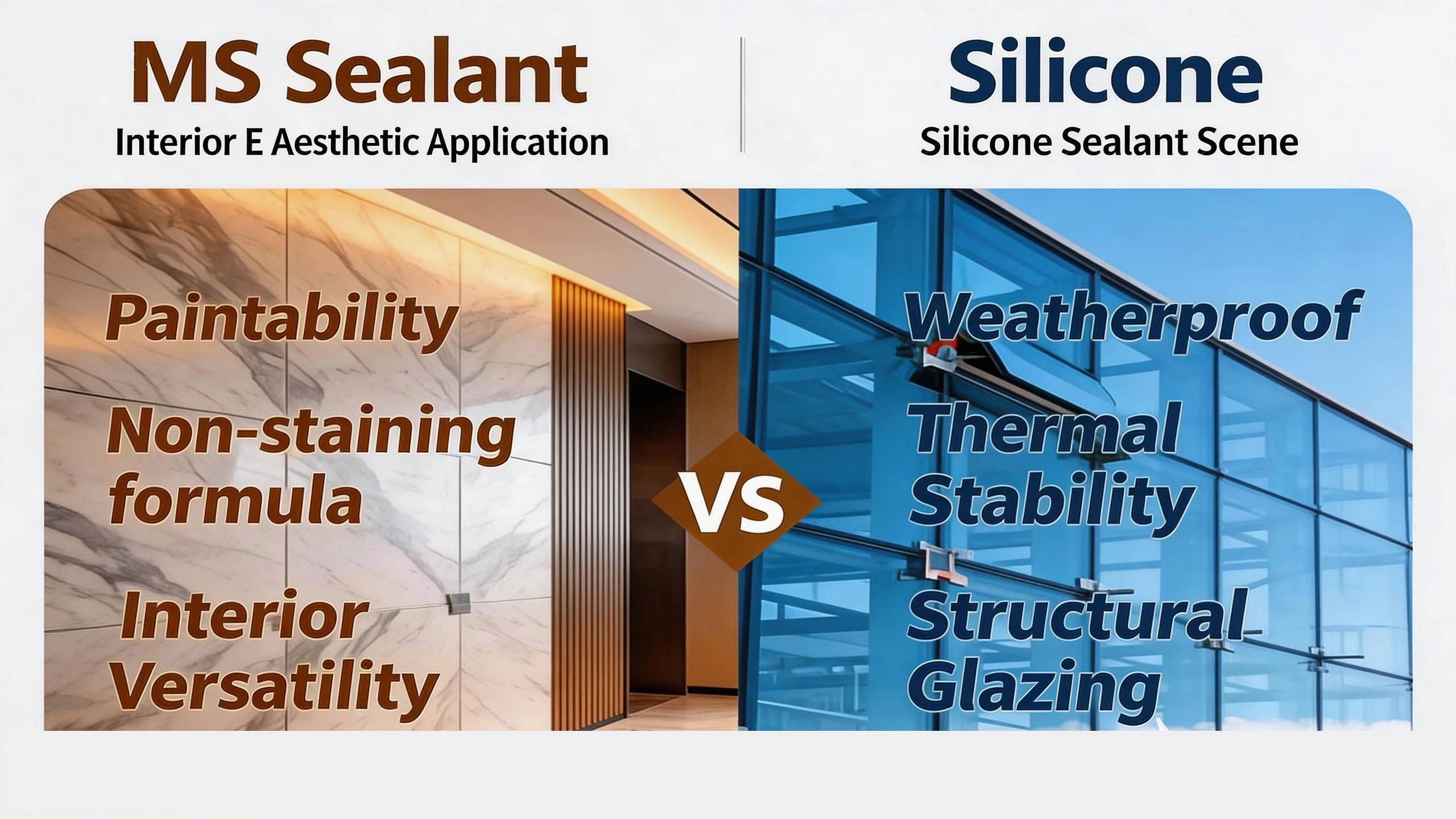
MS OR SILICONE - KINGDELI
MS Sealant vs. Silicone: Which is Right for Your Construction Project?

Compare MS Sealant and Silicone Sealant. Learn about paintability, weather resistance, and which sealant is best for indoor vs. outdoor projects. Professional solutions by KINGDELI
MS Sealant vs. Silicone: Which is Right for Your Construction Project?
Which packaging options are best for bulk acetic silicone sealant?
Practical guidance for buying bulk acetic silicone sealant: select between cartridges, foil sausages, HDPE pails, lined drums and pumpable systems by considering corrosion, shelf life, waste, dispensing, transport rules and cost-efficiency.
Which packaging options are best for bulk acetic silicone sealant?
How resistant is acetic silicone sealant to chemicals and UV?
Practical, technical answers for buyers: how acetoxy (acetic) silicone performs against household and industrial chemicals, solvents, alkalis, and long-term UV exposure. Tests, primers, substrate tips and acceptance criteria to avoid failed seals and premature maintenance.
How resistant is acetic silicone sealant to chemicals and UV?
What curing time and temperature for acetic silicone sealant?
Clear, practical answers for buyers and installers on acetic (acetoxy) silicone sealant curing time, temperature, humidity effects, substrate priming, deep-joint cure profiles and metal compatibility. Actionable specs, test checks and standards guidance.
What curing time and temperature for acetic silicone sealant?
How to ensure adhesion of acetic silicone sealant to metals?
Practical, evidence-based guidance for bonding acetic silicone sealant (acetoxy silicone) to metal substrates. Covers surface preparation, primers, corrosion risks, cold-weather application, accelerated testing (ASTM C794, B117) and selection tips to avoid adhesion failures.
How to ensure adhesion of acetic silicone sealant to metals?
What certifications should acetic silicone sealant suppliers have?
Practical, evidence-based answers to six often-missed buyer questions on acetic (acetoxy) silicone sealant: odor/off‑gassing, substrate compatibility, required lab tests, SDS red flags, procurement certifications, and realistic warranties to reduce risk.
What certifications should acetic silicone sealant suppliers have?
How to calculate cost per meter for acetic silicone sealant?
Step-by-step guide for beginners on calculating cost per meter and material requirements for acetic silicone sealant. Includes real formulas, bead-volume examples (300 ml cartridges), joint-design rules, primer guidance, thermal movement calculations and failure-prevention tips.
How to calculate cost per meter for acetic silicone sealant?
What is the shelf life and storage for acetic silicone sealant?
Practical, up-to-date guidance for buyers and installers on the shelf life and correct storage of acetic (acetoxy) silicone sealant. Learn unopened vs opened life, temperature/humidity effects, freeze-thaw risks, testing expired product, packaging and on‑site inventory best practices.
What is the shelf life and storage for acetic silicone sealant?
How does acetic silicone sealant compare to neutral silicone?
Detailed, practical answers for buyers and installers on acetic (acetoxy) silicone sealant vs neutral cure silicones. Covers corrosion on metals, paintability, aquarium safety, adhesion to porous substrates, staining on stone, movement capability, curing rates and primers.
How does acetic silicone sealant compare to neutral silicone?
What are acetic silicone sealant specs buyers must check?
Practical guide for buyers of acetic (acid‑cure) silicone sealants: six long‑tail questions that lack deep answers online — cure rate vs bead depth, metal corrosion risks, movement capability testing, fungal/microbial certification, joint width/depth design, and on‑site adhesion trials. Read detailed specs to request from suppliers and avoid costly failures.
What are acetic silicone sealant specs buyers must check?
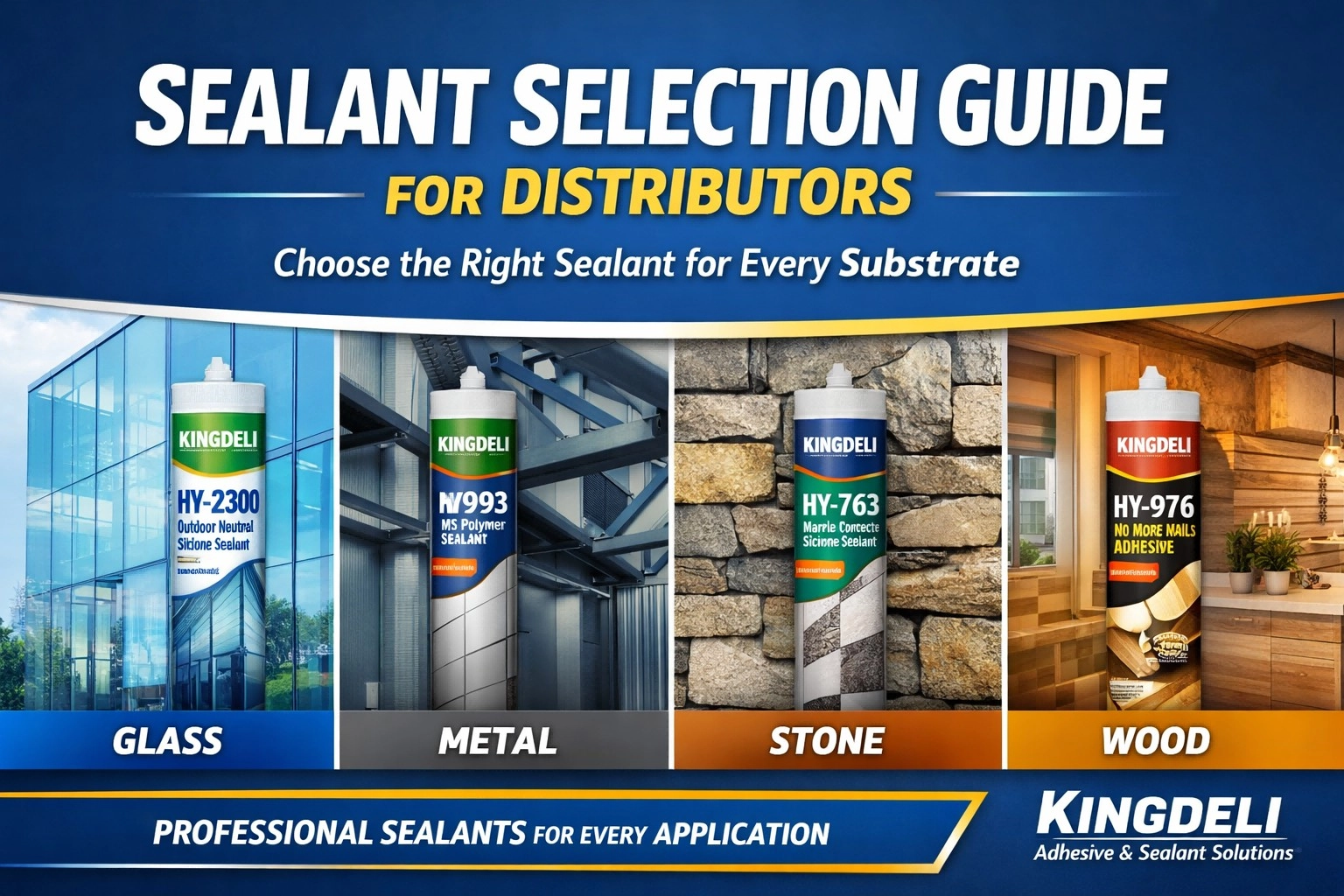
sealant selection guide(1)(1) - KINGDELI
The Complete Sealant Selection Guide for Distributors & Building Supply Partners

Choosing the right sealant is critical to long-term performance in construction and industrial projects. Different substrates — glass, metal, stone, wood, and concrete — require specific sealant chemistries to ensure proper adhesion and durability. Using the wrong product can lead to cracking, staining, corrosion, or mold issues. A substrate-based selection approach helps reduce failures and costly callbacks. In this guide, we outline practical recommendations featuring solutions from KINGDELI.

The Complete Sealant Selection Guide for Distributors & Building Supply Partners
Which industries benefit most from acetic silicone sealant?
Practical, standards-backed answers to six common, under-addressed beginner questions about acetic silicone sealant (acetoxy silicone). Coverage: corrosion on metals, aquarium safety, paintability, cure rates in cold/dry conditions, porous substrates and stone staining, and industry-specific uses.
Which industries benefit most from acetic silicone sealant?
How to choose acetic silicone sealant suppliers for bulk orders?
Concrete, glass and sanitary projects use acetic (acetoxy) silicone sealant widely — but bulk procurement has technical pitfalls. This guide answers six overlooked, pain-point questions about cure profile, certifications (EN 15651, ASTM C920), batch testing, pricing-per-meter, storage, and supplier capacity.
How to choose acetic silicone sealant suppliers for bulk orders?
What is acetic silicone sealant and when should buyers use it?
Acetic (acetoxy) silicone sealant releases acetic acid as it cures, bonds strongly to glass, glazed tiles and many non-porous substrates, and cures fast. This guide answers six technical buyer pain points—compatibility, primers, joint design, corrosion risk, cure issues and regulatory use—to help professionals choose and specify the right product.
What is acetic silicone sealant and when should buyers use it?
Which silicone sealant complies with RoHS and REACH requirements? | Insights by KINGDELI
Practical guide for purchasers: how to identify RoHS & REACH compliant silicone sealants, what documents and lab tests to request (DoC, SDS, XRF, ICP-MS, GC‑MS), catalyst risks, exemptions and procurement controls.
Which silicone sealant complies with RoHS and REACH requirements? | Insights by KINGDELI
What certifications should a commercial silicone sealant supplier have? | Insights by KINGDELI
Practical guide for specifiers and purchasers: six deep questions on certifications and test documentation you must demand from a commercial silicone sealant supplier — from CE/EN and ASTM testing to REACH, UL fire listings, NSF/FDA food-contact proof and batch traceability.
What certifications should a commercial silicone sealant supplier have? | Insights by KINGDELI
How to calculate cost per meter for silicone sealant joints? | Insights by KINGDELI
A practical, industry-level guide showing formulas, on-site measurement methods, waste factors, and worked examples to calculate silicone sealant cost per meter for cartridges, sausages and bulk supply.
How to calculate cost per meter for silicone sealant joints? | Insights by KINGDELI
Can silicone sealant be used on wet surfaces in industrial settings? | Insights by KINGDELI
Practical, evidence-based guidance for using silicone sealants on damp or wet industrial substrates. Covers neutral vs acetoxy cure, primers, surface prep, testing (ASTM standards), underwater alternatives, cure rates and QC checkpoints for procurement and installation.
Can silicone sealant be used on wet surfaces in industrial settings? | Insights by KINGDELI
What packaging options are available for bulk silicone sealant supply? | Insights by KINGDELI
Practical guide to bulk silicone sealant packaging options — cartridges, sausages, pails, drums, IBCs and liners — with real-world guidance on shelf life, dispensing, contamination control, transport rules, cost-per-meter and recycling.
What packaging options are available for bulk silicone sealant supply? | Insights by KINGDELI
Which silicone sealant is best for high-temperature industrial use? | Insights by KINGDELI
Practical guidance for choosing high-temperature silicone sealants used in industrial settings: temperature limits, neutral vs acetoxy cure, substrate prep, thermal cycling, chemical exposure, testing, and when to use ceramic/epoxy alternatives.
Which silicone sealant is best for high-temperature industrial use? | Insights by KINGDELI
How to request technical data sheet and MSDS for silicone sealant? | Insights by KINGDELI
Clear, practical guidance for procurement and safety teams: how to request a technical data sheet (TDS) and MSDS/SDS for silicone sealant, what batch and regulatory details to demand, which performance metrics to verify, and an email template plus escalation steps to avoid production delays.
How to request technical data sheet and MSDS for silicone sealant? | Insights by KINGDELI
What are lead times for custom silicone sealant formulations? | Insights by KINGDELI
A practical guide for procurement and R&D teams explaining realistic lead times for custom silicone sealant formulations — from lab development and color matching to pilot production, regulatory testing and fast-track options.
What are lead times for custom silicone sealant formulations? | Insights by KINGDELI
How long is shelf life of silicone sealant in warehouses? | Insights by KINGDELI
Practical answers for warehouse managers and buyers on the shelf life of silicone sealant. Learn real storage life (unopened and opened), temperature/humidity limits, QC checks, bulk drum handling, procurement clauses and shelf-life extension methods.
How long is shelf life of silicone sealant in warehouses? | Insights by KINGDELI
What silicone sealant has best adhesion to aluminum and glass? | Insights by KINGDELI
Discover which silicone sealants bond best to aluminum and glass. This guide explains neutral‑cure vs acetoxy chemistries, primers, surface prep for anodized aluminum, movement capability, on‑site adhesion testing, and structural glazing best practices.
What silicone sealant has best adhesion to aluminum and glass? | Insights by KINGDELI
How to compare neutral vs acid cure silicone sealant for factories? | Insights by KINGDELI
A practical, standards-based guide for factory engineers and maintenance managers comparing neutral (oxime/alkoxy) and acid (acetoxy) cure silicone sealants. Covers substrate compatibility, corrosion risk, cure time, chemical resistance, production downtime planning, primers, ASTM requirements and on-site storage.
How to compare neutral vs acid cure silicone sealant for factories? | Insights by KINGDELI
What is the MOQ for commercial silicone sealant orders? | Insights by KINGDELI
Practical guide to typical MOQs for commercial silicone sealant orders — cartridges, sausages, drums — and how packaging, OEM/private‑label requests, certifications (EN 15651, ASTM C920), testing and logistics affect minimum order, lead time, price breaks and negotiation tactics.
What is the MOQ for commercial silicone sealant orders? | Insights by KINGDELI
What are the specifications for industrial silicone sealant? | Insights by KINGDELI
Clear, technical guidance for choosing industrial silicone sealant specifications—tensile, elongation, Shore A, cure chemistry, standards (ASTM C920, ISO 11600, EN 15651), joint design, primers, low-temp curing and VOCs.
What are the specifications for industrial silicone sealant? | Insights by KINGDELI
How to choose a silicone sealant supplier for bulk orders? | Insights by KINGDELI
Practical guide to choosing a silicone sealant supplier for bulk orders. Six deep, buyer-focused questions cover production capacity, adhesion performance, chemical compatibility (neutral vs acetoxy), packaging and shelf life, pricing and MOQ negotiation, and regulatory traceability, with actionable checks and standards.
How to choose a silicone sealant supplier for bulk orders? | Insights by KINGDELI
How to store silicone sealant to maximize shelf life? | Insights by KINGDELI
Practical, manufacturer-aligned guidance to extend silicone sealant shelf life. Learn correct temperatures, humidity control, sealing methods for opened cartridges/sausages, refrigeration tips, bulk drum storage, testing for degradation, and inventory best practices.
How to store silicone sealant to maximize shelf life? | Insights by KINGDELI
What is the curing time for high-performance silicone sealant? | Insights by KINGDELI
A practical, purchase-focused guide on curing time for high-performance silicone sealant. Explains skin-over vs full cure, cure rate per mm, effects of temperature/humidity, joint depth, primers, paintability, and safe removal of temporary supports.
What is the curing time for high-performance silicone sealant? | Insights by KINGDELI
How to ensure silicone sealant adhesion on painted substrates? | Insights by KINGDELI
Practical, code-backed guidance to guarantee silicone sealant adhesion on painted substrates. Learn specific surface-prep steps, primer selection, cure-time rules, testing methods (ASTM/ISO), joint design, and troubleshooting to prevent paint delamination and sealant failure.
How to ensure silicone sealant adhesion on painted substrates? | Insights by KINGDELI
What are common failure modes of silicone sealant in construction? | Insights by KINGDELI
Practical, field-tested explanations of the most common silicone sealant failure modes in construction — how to diagnose adhesive vs cohesive failure, root causes like contamination, movement limits, cure inhibition, and step-by-step prevention and mitigation guidance for specifiers and installers.
What are common failure modes of silicone sealant in construction? | Insights by KINGDELI
How to specify silicone sealant for expansion joint applications? | Insights by KINGDELI
A concise, technical Q&A for specifying silicone sealants in expansion joints. Covers joint width/depth rules, movement rating selection (ISO/ASTM), primers and substrate prep, modulus selection, backer-rod/bond-breaker practice, and coastal ageing/maintenance to help procurement and design decisions.
How to specify silicone sealant for expansion joint applications? | Insights by KINGDELI
How to qualify silicone sealant suppliers for public tender bids? | Insights by KINGDELI
Practical Q&A for procurement teams: six under-answered long-tail questions about qualifying silicone sealant suppliers for public tenders. Covers standards (EN 15651, ASTM C920, ISO 11600), realistic lab/field tests, batch traceability, primer compatibility, fire-rating vs movement, and procurement logistics.
How to qualify silicone sealant suppliers for public tender bids? | Insights by KINGDELI
What PPE and handling precautions are required for silicone sealant? | Insights by KINGDELI
Practical, product-focused Q&A for sealants buyers and installers: which gloves, respirators, ventilation, storage and first-aid measures are needed when working with silicone sealants (acetoxy, oxime, neutral) — plus real handling tips to reduce exposure and avoid curing or cleanup problems.
What PPE and handling precautions are required for silicone sealant? | Insights by KINGDELI
How to get free samples of silicone sealant for product testing? | Insights by KINGDELI
Practical guide answering six specific, underexplained questions about obtaining free silicone sealant samples for product testing: required sample sizes, how to qualify as a buyer, paperwork to request, international shipping issues, realistic lead times for custom formulas, and how to present a test plan so suppliers will provide free samples.
How to get free samples of silicone sealant for product testing? | Insights by KINGDELI
What VOC levels are typical for commercial silicone sealant? | Insights by KINGDELI
This technical Q&A helps specifiers and procurement professionals understand typical VOC ranges for silicone and alternative sealants, how to verify manufacturer claims, compliance paths (SCAQMD/LEED/Greenguard), and practical procurement language. Includes test-methods, calculation examples, and what to require in RFPs.
What VOC levels are typical for commercial silicone sealant? | Insights by KINGDELI
How to order custom-colored silicone sealant for large projects? | Insights by KINGDELI
This practical Q&A explains how to procure custom-colored silicone sealant for large-scale projects: MOQ and lead times, precise color specification (Pantone/RAL and spectrophotometer data), pigment compatibility and cure effects, color tolerance (ΔE) and weathering tests, packaging/logistics for bulk volumes, regulatory (VOC/REACH) and labeling requirements, and supplier QC/traceability best practices. Supported by industry standards (ISO, ASTM) and actionable steps to reduce risk. Contact KINGDELI for turnkey solutions.
How to order custom-colored silicone sealant for large projects? | Insights by KINGDELI
Which silicone sealant offers best UV and weather resistance? | Insights by KINGDELI
This practical Q&A helps specifiers and buyers choose silicone sealants with the best UV and weather resistance. It explains which cure chemistries resist UV best, how to read accelerated-weathering data (ASTM G154 / ISO 4892), coastal‑project adhesion practices, color‑change metrics to require, joint design (width/depth and modulus), how to interpret ASTM C920 / EN 15651 classifications, storage and on‑site handling, and when to prefer hybrid or polyurethane products. Includes procurement checklists and actionable test/acceptance criteria. KINGDELI product strengths and contact info are summarized.
Which silicone sealant offers best UV and weather resistance? | Insights by KINGDELI
How to compare silicone sealant warranties from different suppliers? | Insights by KINGDELI
Seven specific, procurement-focused questions and expert answers on comparing silicone sealant warranties — what to demand in documentation, how to interpret test data (ASTM/EN), common exclusions, warranty remedies, transferability, and how to reduce risk when specifying or buying silicone sealants.
How to compare silicone sealant warranties from different suppliers? | Insights by KINGDELI

/ Let’s Build Together

Partner With a Trusted OEM/ODM Manufacturer

We provide end-to-end support tailored to your business needs.

Aelen Tran

Property Manager

Name must not exceed 100 characters.
Invalid email format or length exceeds 100 characters. Please re-enter.
Please enter a valid phone number!
Company Name must not exceed 150 characters.
Content must not exceed 3000 characters.
Contact customer service

∎∎

Contact us

Let's Connect

Send us an email

info@kingdelisealant.com

Give us a call

+86 188 2594 6249

Address

No. 28, Mingfu Road, Mingcheng, Gaoming, Foshan, Guangdong, China.

Get a Quote Today!

Partner with Kingdeli, a global manufacturer of sealants, adhesives, and coatings.
We deliver customized OEM/ODM solutions designed to enhance performance, reliability, and market competitiveness.

Name must not exceed 100 characters.
Invalid email format or length exceeds 100 characters. Please re-enter.
Please enter a valid phone number!
Company Name must not exceed 150 characters.
Content must not exceed 3000 characters.

Share your requirements below — our team will connect with you to create solutions that fit your business goals.

×

∎∎

Contact us

Let's Connect

Send us an email

info@kingdelisealant.com

Give us a call

+86 188 2594 6249

Address

No. 28, Mingfu Road, Mingcheng, Gaoming, Foshan, Guangdong, China.

Let’s Talk Solutions!

Tell us your project needs, and we’ll help you discover the ideal Kingdeli product.

Whether it’s construction, automotive, or industrial applications, we’re here to provide tailored solutions.

Name must not exceed 100 characters.
Invalid email format or length exceeds 100 characters. Please re-enter.
Please enter a valid phone number!
Company Name must not exceed 150 characters.
Content must not exceed 3000 characters.

Share your requirements below — our team will connect with you to create solutions that fit your business goals.

×

Get In Touch

Call Us

WhatsAPP/Wechat:

×

∎∎

How Can We Help You?

Share your requirements, challenges, or project details — our team will respond with tailored solutions and expert guidance.

Name must not exceed 100 characters.
Invalid email format or length exceeds 100 characters. Please re-enter.
Please enter a valid phone number!
Company Name must not exceed 150 characters.
Content must not exceed 3000 characters.
×