











What testing methods verify ms silicone sealant adhesion strength?
MS Silicone Sealant: Which Tests Verify Adhesion Strength?
This guide answers six specific, beginner-to-intermediate questions about verifying the adhesion strength of ms silicone sealant (MS polymer / neutral-cure hybrid sealants). It blends standards-based test selection, specimen preparation, test parameters and how to interpret failures so you can make informed purchase and QA decisions for glazing, facades, metal bonding, painted substrates, plastics and concrete.
1) How do I design a pull-off test protocol to measure ms silicone sealant adhesion to painted aluminum panels?
Why this matters: Painted or powder-coated aluminum is common in curtain wall, signage and cladding. Paint adhesion or surface contamination often determines the measured bond strength — not the sealant itself. A clear, repeatable pull-off protocol isolates the sealant–substrate interface so you can judge primer needs and lifetime performance.
Recommended procedure (practical, standards-based):- Standard: use ASTM D4541 (pull-off adhesion) principles and adapt for sealants. ISO equivalents (adhesion pull-off) may also be used for some labs.- Substrate prep: clean a 50 x 50 mm area with isopropyl or mineral spirits to remove oils, then abrade lightly with P180–P240 grit if the paint is smooth. Do not over-abrade through the paint unless you intend to test paint-to-metal adhesion.- Dolly selection: use aluminum or steel dollies 20–25 mm diameter, glued with a certified dolly adhesive specified by the test method. Ensure the bonding adhesive cures fully per the adhesive manufacturer before testing.- Thickness & bead geometry: apply ms silicone sealant to a joint thickness representative of field conditions (typically 3–6 mm) or a standardized 5 mm thickness using a spacer. Cure time: test at 7, 14 and 28 days to capture progressive cure; many MS polymers reach >90% of strength by 7–14 days but full cure can take 28 days depending on thickness and humidity.- Environmental conditioning: test at room condition (23 ± 2 °C, 50% RH) and after accelerated aging cycles (UV exposure per ISO 4892 or 1000–2000 h; thermal cycling -20/+60 °C for 50–100 cycles) to see degradation or paint delamination.- Acceptance criteria: look for cohesive failure within the cured sealant or substrate failure (paint lifting from metal). Adhesive failure (clean dolly interface or clean paint under sealant) indicates insufficient adhesion. For painted substrates, a good commercial target is predominantly cohesive failures or mixed mode with >50% cohesive area on at least 3 of 5 replicates.- Reporting: provide mean pull-off strength (MPa or psi), standard deviation, type of failure (adhesive, cohesive, substrate), cure time, humidity, temperature and surface prep details.
Notes: ms silicone sealant marketed as primerless still depends on paint formulation and surface energy. If paint fails before the sealant, the paint system—not the sealant—controls durability. Request manufacturer TDS and compatibility data for painted substrates before committing to primerless claims.
2) What is the best way to compare lap-shear versus 90° peel tests for assessing ms silicone sealant adhesion to plastics (PE, PP, PET)?
Why this matters: Low-energy plastics like polyethylene (PE) and polypropylene (PP) challenge adhesion. Buyers need to know which test predicts real-life peel or shear loads for bonded joints.
Test selection guidance:- 90° peel test (ASTM C794 style or ISO-equivalent peel methods) simulates thin-film delamination and is highly sensitive to surface energy and primer presence. Use this when your joint is subject to peel forces (e.g., taped joints, overlapping skins). Typical specimen: 25 mm wide bonded strip, peel at 90° at 50–300 mm/min, report peak and average peel force (N/mm).- Lap-shear test (ASTM D1002 or ISO 4587-style) evaluates shear load capacity for overlapping joints and shows how elastic sealants distribute load under shear. Use a single-lap joint with controlled bondline thickness (e.g., 2–5 mm) and test at 1–10 mm/min on a universal testing machine (UTM). Report maximum shear stress (MPa) and displacement at failure.
Practical approach for plastics: because MS polymer sealants are elastic and often intended for movement accommodation rather than structural bonding, run both tests:- Start with a 90° peel: if peel force is near zero without primer, the joint will delaminate in service. If peel values improve dramatically with primer, record percent improvement.- Run lap-shear to quantify shear capacity, but do not expect adhesives-level strengths. Compare to expected service loads with a suitable safety factor (e.g., 3–5x for non-structural joints).
Surface activation options for PE/PP: flame treatment, corona discharge, plasma, or a manufacturer-recommended adhesion promoter (primer). Always test the specific plastic grade and surface finish. Use at least 5 replicates per condition and report failure modes; cohesive failure in the sealant indicates acceptable bonding for many sealing applications.
3) How do I set pass/fail criteria and sample sizes for field QA tests of ms silicone sealant adhesion?
Why this matters: Many procurement teams accept sealant deliveries without a clear QA plan. A minimal statistically sound test plan avoids costly rework later.
Recommended QA protocol:- Sample size: a minimum of 3 specimens per condition is common for development testing; for acceptance QA on-site use 5 specimens per lot/condition. For critical structural or warranty applications, increase to 7–10 samples.- Statistical approach: report mean, standard deviation and coefficient of variation. Use a one-sided acceptance limit (e.g., mean ≥ specified minimum and no single result below a rejection threshold). For example, require mean pull-off strength ≥ X MPa and all specimens ≥ (X - 20%). Tailor thresholds to service expectations and movement capability.- Failure-mode criterion: require predominantly cohesive failures (>50% cohesive area) or substrate failure for paints where the paint is known robustly to outlast the sealant. Adhesive failure is a reject unless a primer will be used.- Cure and conditioning: specify cure time (7/14/28 days), and if environmental conditioning is required (freeze–thaw, salt spray, UV). For facade work request 28-day conditioned results plus thermal cycling to mimic diurnal cycles.- Documentation: record batch numbers, lot, ambient conditions during application, surface prep, sealant bead geometry and tooling method. This traceability is essential for E-E-A-T level claims and warranty disputes.
Tip: incorporate a small field-lab setup (portable pull-off adhesion tester and 90° peel rig) so you can validate in-situ adhesion without shipping many samples.
4) Which accelerated aging protocols best correlate with long-term ms silicone sealant adhesion loss on exterior façades?
Why this matters: Buyers need confidence that primerless ms silicone sealant bonds won't deteriorate after years of UV, moisture and thermal cycling.
Best-practice accelerated aging battery:- UV/condensation: ASTM G154 style cycles (UV-B 313 lamps, 8 h UV at 60 °C + 4 h condensation at 50 °C) for 1000–2000 h to evaluate UV resistance and surface chalking effects.- Thermal cycling: subject bonded panels to -20 °C to +60 °C cycles (50–200 cycles) to simulate diurnal and seasonal expansion differences between substrates and sealant.- Moisture/freeze–thaw: 10–50 freeze–thaw cycles with water immersion to test hydrolytic breakdown and adhesion loss.- Salt spray: for coastal environments, add ISO 9227/NSS exposures combined with thermal cycling for 300–1000 h.
Correlation guidance:- Compare conditioned specimens to unconditioned baselines using the same test (pull-off, peel or lap shear). Look for changes in mean strength and failure mode. A shift from cohesive to adhesive failure indicates loss of adhesion due to environmental stressors.- Acceptance criteria: industry practice often targets <20–30% reduction in bond strength after accelerated exposure for long-life sealants; however, exact criteria depend on service life expectations and safety factors in design.
Notes: No accelerated test perfectly duplicates decades of real-world weathering. Use a combination of accelerated tests, field-exposed mock-ups and manufacturer long-term data (TDS, field case studies) to build a credible prediction.
5) How to test and verify primerless ms silicone sealant adhesion on damp or green concrete?
Why this matters: Construction schedules often require sealing joints on damp concrete. MS polymer seals are sold as moisture-tolerant, but bond strength can vary widely depending on surface moisture, porosity and curing stage of concrete.
Practical verification steps:- Baseline: perform lab trials with concrete cured 7, 14, and 28 days and compare to “green” (48–72 h) concrete samples. Measure surface moisture content with a calcium chloride test (ASTM F1869) or a surface moisture meter to quantify conditions.- Surface prep: broom to remove laitance, lightly sand or shot-blast if laitance is present, and remove loose particles. For green concrete, mechanical cleaning can expose aggregates and improve anchorage.- Adhesion test: use pull-off (ASTM D4541) and/or tensile adhesion (ASTM C1135) after standardized cure (7/14/28 days). Examine failure surfaces: cohesive failure in the concrete vs adhesive failure at interface.- Primer strategy: if adhesion is inconsistent on damp or green concrete, test a moisture-compatible primer recommended by the ms silicone supplier. Compare results with and without primer under the same moisture conditions.
Acceptance advice: if tests on green/damp concrete show consistent cohesive failure in the sealant or concrete, primerless application may be acceptable. If tests show substrate pull-out (concrete failure) in places and adhesive failure in others, investigate surface variability and favor priming or delayed application for warranty-sensitive work.
6) For structural or semi-structural bonding, what testing demonstrates whether ms silicone sealant is appropriate versus a polyurethane or structural adhesive?
Why this matters: MS polymer sealants are elastic and often marketed for flexible joints, but buyers sometimes consider them for semi-structural bonding. Choosing the wrong product can cause failure under sustained loads.
Evaluation checklist and tests:- Define load case: steady shear, peel, peel-to-shear ratio, creep under sustained load, dynamic loads, and expected joint movement amplitude (movement capability % per ISO 11600 classification).- Tensile/creep testing: measure tensile strength and long-term creep at service temperature using a UTM. Use ASTM D412-style methods for tensile properties of cured sealant and perform creep tests at relevant stress levels for 100–1000 h to see time-dependent deformation.- Lap-shear to failure: use single-lap shear tests to quantify short-term strength. Structural adhesives will show higher shear strengths and lower deformation than ms silicone sealants.- Fatigue & dynamic testing: for cyclic loads, run fatigue testing to failure or a defined number of cycles at expected amplitude; elastic sealants can relax and creep under repetitive loads.- Fracture mechanics and safety factor: for load-bearing joins, design with an appropriate safety factor (commonly 3–5×) and consider adhesive modulus, bondline thickness and environmental effects.
Decision rules: use ms silicone sealant for flexible, non-loadbearing sealing where movement accommodation, UV and weather resistance, and paintability are required. For structural bonding with sustained loads or where low deflection is required, choose structural adhesives (epoxy/polyurethane structural adhesives) that have higher shear strength and lower creep. If you must use an elastic MS polymer for semi-structural applications, require validated long-term creep and fatigue data under the actual service conditions before acceptance.
Concluding summary: Advantages of ms silicone sealant and final recommendations
MS silicone sealants (MS polymer/neutral cure hybrids) offer strong adhesion to a wide range of substrates, good UV and weathering resistance, low odor, paintability, low shrinkage and primerless adhesion in many applications. They accommodate joint movement well and cure without acidic by-products, making them compatible with many metals, painted surfaces and composites. For procurement and QA: always request manufacturer TDS/MSDS, run substrate-specific adhesion tests (pull-off, peel, lap shear) with realistic cure and aging, and set clear pass/fail metrics including failure-mode criteria and sample size. Where in-service loads include sustained shear or structural demands, validate creep and fatigue performance or choose a structural adhesive instead.
If you need standardized test plans, on-site pull-off or peel testing, or a quotation for ms silicone sealant and technical support, contact us for a quote at www.kingdelisealant.com or email info@kingdeliadhesive.com. We can supply TDS, application guidance and lab testing services tailored to your substrate and exposure conditions.
OEM vs. Branded Acetic Silicone Sealant: What’s Best for Your Distribution Business?
The Future of Sealants: 5 Emerging Trends in Wholesale Neutral Silicone Sealant Technology for 2026
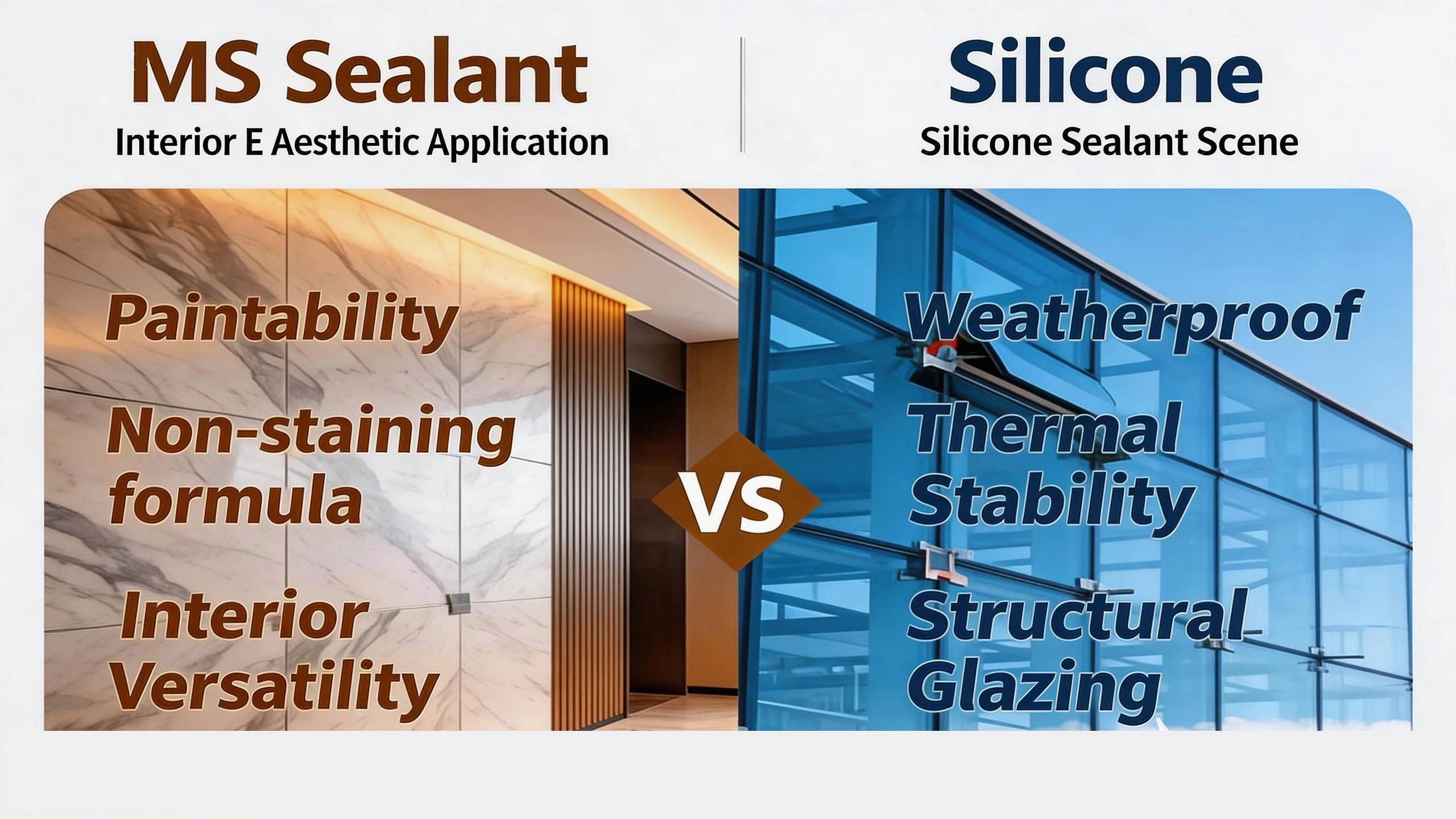
MS Sealant vs. Silicone: Which is Right for Your Construction Project?
The Ultimate Guide to Choosing a Silicone Sealant Manufacturer in 2026: 10 Critical Factors Often Overlooked
HY995
What materials can HY995 bond?
HY995 Crystal Clear MS Polymer Adhesive provides excellent adhesion to a wide range of materials including glass, mirror, metal, aluminum, stainless steel, plastic (PVC, ABS, nylon), rubber, wood, leather, ceramic tiles, natural stone, and concrete. It is suitable for both bonding and sealing applications.
HY-2300
Is it suitable for vertical or overhead applications?
Yes. HY-2300 is non-sag, allowing clean application in vertical and ceiling joints.
HY-976
Which surfaces does this adhesive bond to?
It bonds well to most porous indoor surfaces, including plaster, concrete, plasterboard, gypsum boards, wood-based materials (e.g. chipboard), and polyurethane rigid foams.
HY638
What are the main features of HY-638?
Key performance features include:
- Non-sag consistency for vertical and overhead applications
- Fast tack-free time
- Good adhesion to glass and many common construction materials
- Flexible, durable cured seal
- Wide service temperature range after curing
HY994
Can HY994 be used outdoors?
Yes.HY994 has excellent weather resistance, UV stability, and long-term aging performance, making it suitable for both interior and exterior applications.
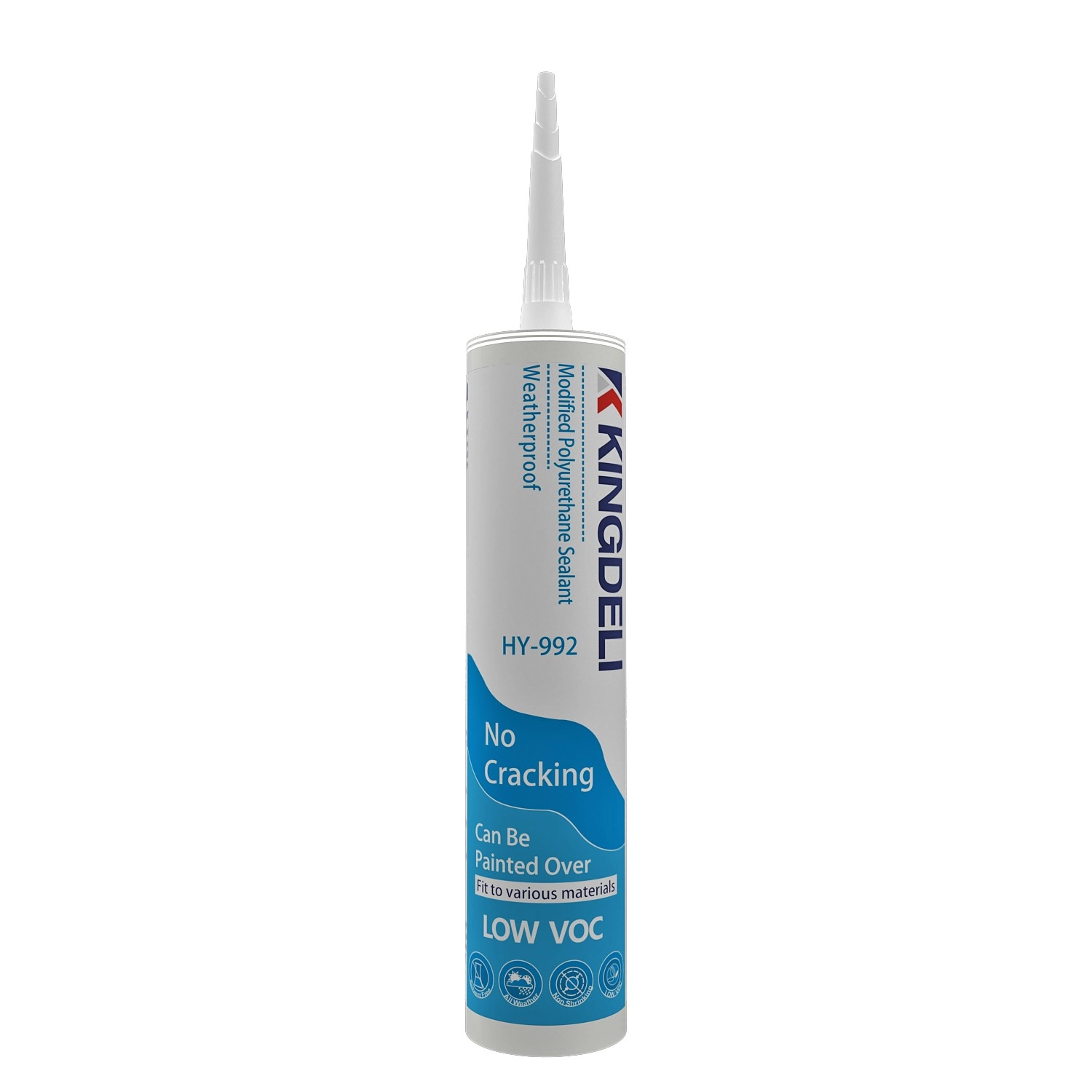
HY992 Modified Polyurethane Construction Sealant
HY992 Modified Polyurethane Sealant is a one-component, moisture-curing construction sealant designed for professional building and structural sealing applications. It provides excellent adhesion, weather resistance, and durable elasticity, making it suitable for a wide range of construction materials.
The formulation delivers strong bonding performance without corrosion or substrate contamination, while maintaining low VOC content for environmentally responsible construction projects.

HY995 Crystal Clear Ms Polymer Adhesive/Sealant
HY995 Crystal Clear Ms Polymer Adhesive/Sealant is a new generation MS Polymer adhesive / sealant formulated for all bonding and sealing applications where long term reliability is required. It has excellent bonding strength on various materials. It will cure to form a durable, flexible, waterproof seal.

HY997 High-Performance Anti-Microbial MS Polymer Sealant
HY997 MS polymer sealant for is is a premium one-component, neutral-curing modified silane sealant engineered for demanding interior applications. It offers a Class 20 movement capability, ensuring long-lasting flexibility and reliable performance under dynamic joint conditions. Curing at room temperature, HY997 delivers superior anti-microbial and mildew-resistant properties, maintaining hygienic and clean environments over time.
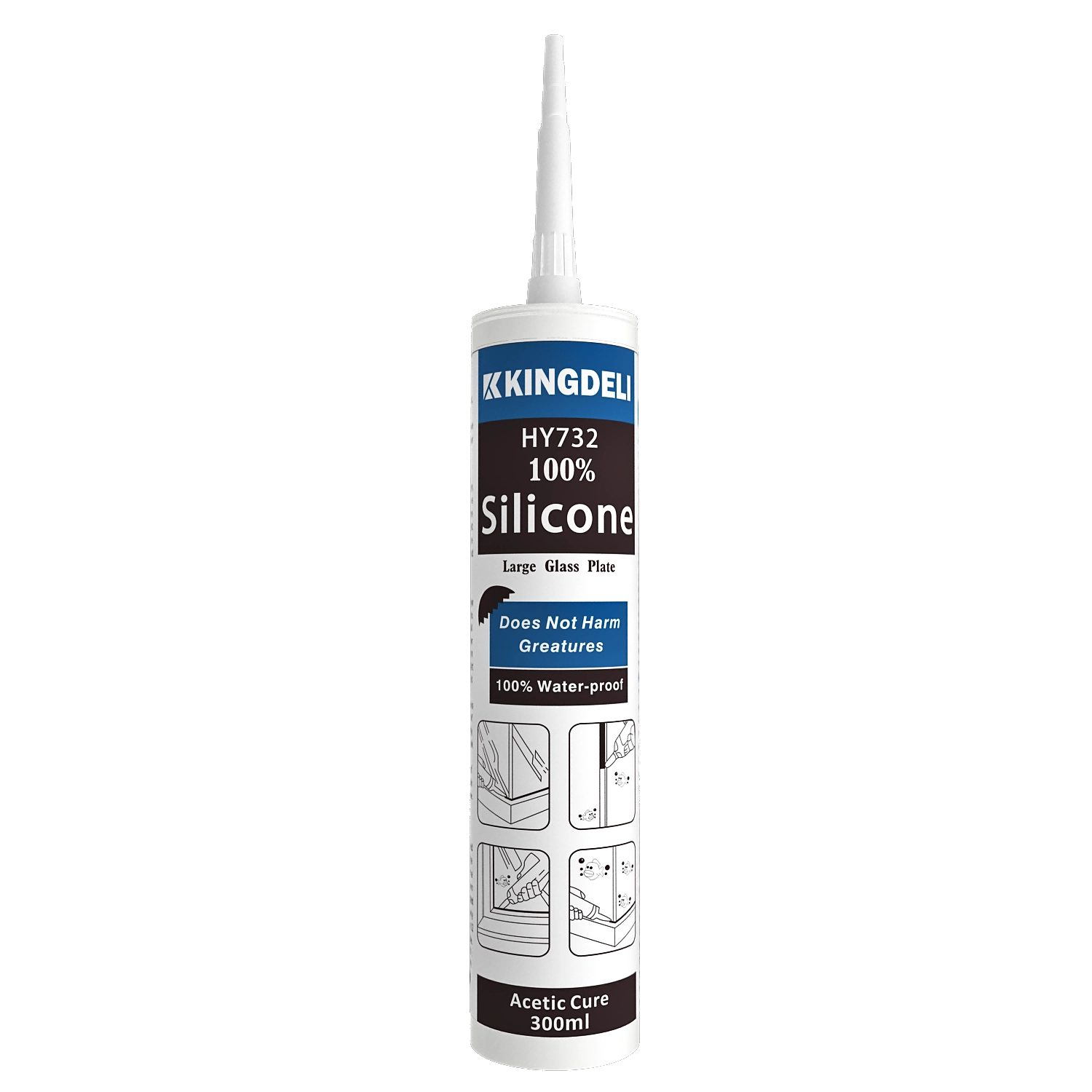
KINGDELI HY732 Professional Acetoxy Cure Silicone Sealant
KINGDELI HY732 is a professional-grade, one-component acetoxy cure silicone sealant designed for fast curing, strong adhesion, and long-lasting flexibility. Ideal for aquariums, glass applications, aluminum doors and windows, kitchens, and bathrooms, it provides reliable sealing performance with excellent anti-fungal protection in high-humidity environments.
Let’s Build Stronger Bonds with Quality Adhesives and Sealants
Have questions about the topic or need tailored sealant solutions for your project?
Our team is ready to provide expert guidance, product recommendations, and application support.
Innovating with Integrity, Bonding the World
Since 1998, KINGDELI has delivered trusted, sustainable sealant solutions that connect industries and inspire progress worldwide.
Whatsapp: +8618825946249
Kingdeli
Kingdeli
Kingdeli
Kingdeli
Kingdeli