


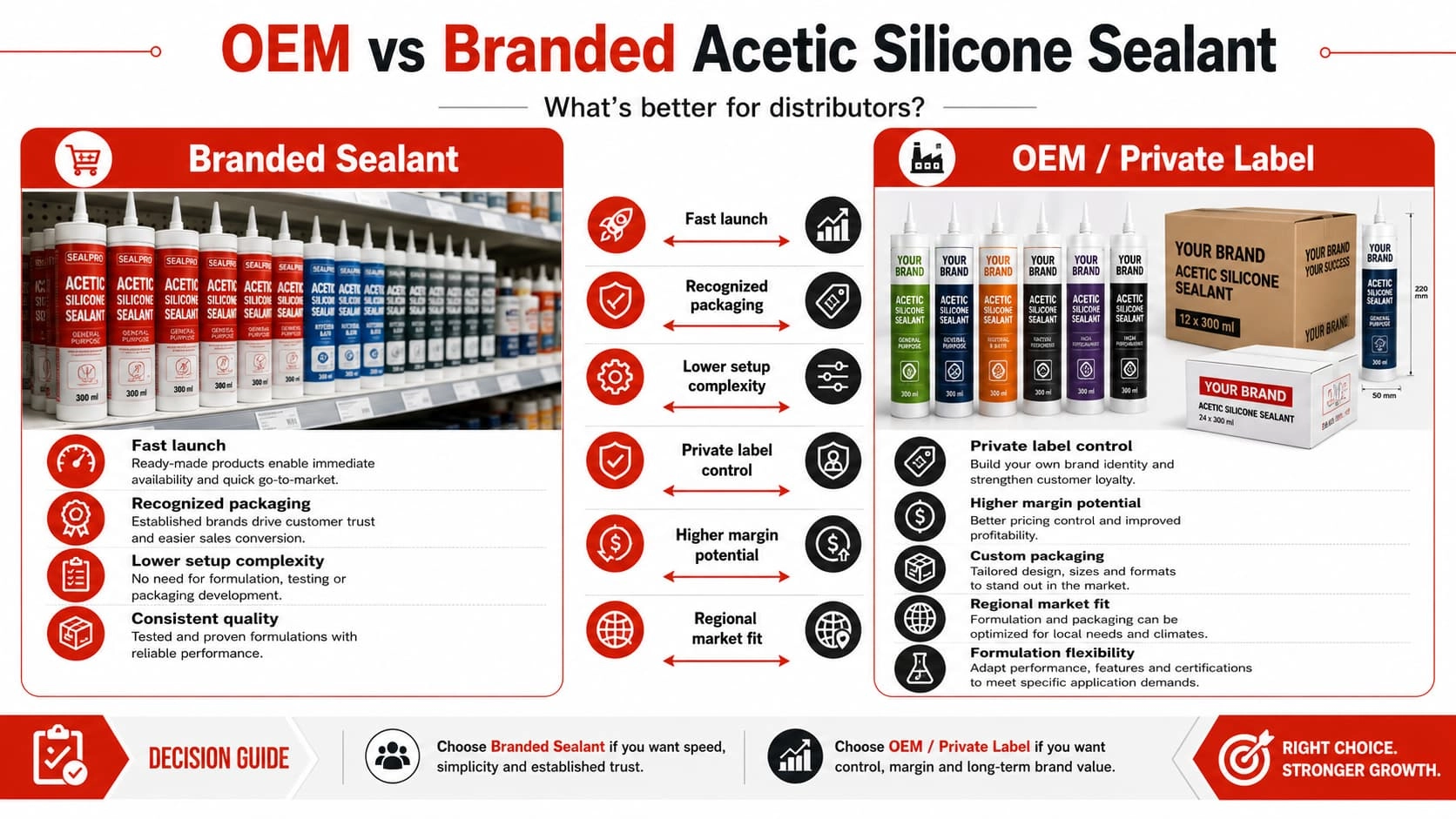
Quick answer: Choose branded acetic silicone sealant if you need fast market entry, lower initial inventory risk, and ready-made technical documentation. Choose OEM acetic silicone sealant if you already have distribution channels and want private label control, better margins, or a formulation tailored to your region's climate and application mix.
You are new to the market, testing demand, or need product moving fast with no setup lead time.
You have steady sales volume and want brand ownership, margin control, and custom formulation.
You are unsure. A supplier that offers both branded resale and OEM/private label lets you scale into it.
Navigating acetic silicone sealant distribution requires more than comparing price per cartridge. For wholesalers and regional distributors, the real decision is how to structure your product catalog: resell an established brand, or build your own. This guide compares both paths across margin, MOQ, packaging, and formulation, so you can decide with your actual sales volume and channel strategy in mind — not just a factory's sales pitch.

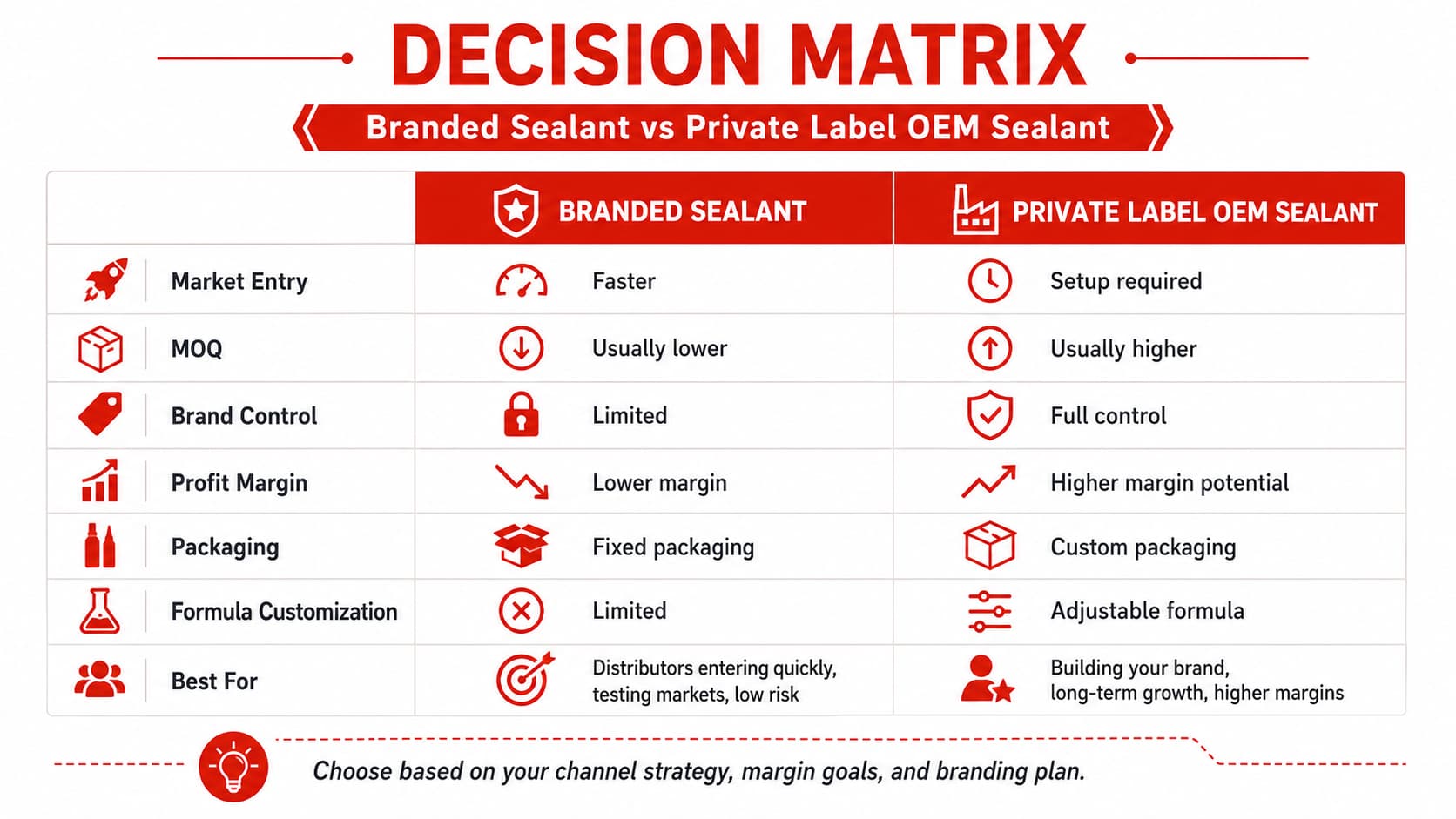
OEM vs Branded Acetic Silicone Sealant: Key Differences
| Factor | Branded Acetic Silicone Sealant | OEM Acetic Silicone Sealant |
|---|---|---|
| Market entry | Faster — product is ready to sell. | Requires setup: artwork, formulation approval, first production run. |
| MOQ | Usually lower. | Usually higher. |
| Brand control | Limited — you are reselling someone else's identity. | Full private label control. |
| Profit margin | Lower, subject to price competition. | Higher, more pricing control. |
| Packaging | Fixed brand packaging. | Custom cartridge, carton, and label design. |
| Formula customization | Limited to what is on the shelf. | Adjustable cure speed, color, anti-fungal additives, viscosity. |
| Best for | New distributors, small-volume resellers, market testing. | Established wholesalers, agents, and brand owners with steady volume. |
When Branded Acetic Silicone Sealant Still Makes Sense
Reselling an established brand is not a lesser strategy — it is the right call for a specific stage of a distribution business.
- New distributors who have not yet validated demand in their territory.
- Small-volume wholesalers who cannot yet justify a custom production run.
- Buyers who need immediate stock without waiting on artwork approval or a filling schedule.
- Businesses without packaging or brand operations in place — no design team, no label supply chain.
- Contractors and resellers who benefit from a name their customers already trust.
The upside is real: branded acetic silicone sealant typically ships with ready-made TDS, SDS, available test reports, and relevant factory or product documentation depending on the destination market. It also usually carries a lower upfront cost since you are not funding custom cartridge artwork or carton printing.
The trade-off is exclusivity. If your warehouse stocks the same branded cartridge as several competitors in your territory, the product is commoditized — buyers will simply shop the lowest quote, which compresses margin over time.
When OEM Acetic Silicone Sealant Becomes the Better Strategy
Once a distribution network has steady, predictable volume, OEM private label acetic silicone sealant is usually the more defensible long-term position.
- Private label control — your logo, your packaging, your product identity. Customers cannot cross-shop your exact formulation elsewhere, which supports repeat purchasing.
- Better margin protection — private label can reduce dependence on third-party brand pricing and give you more control over wholesale margins, although MOQ, packaging setup, and inventory planning should be calculated before ordering.
- Regional formulation — cure speed, anti-fungal additives, and adhesion profile can be adjusted for your climate and the substrates your market actually uses, such as glass, coated aluminum, and ceramic.
- Customer loyalty — once a contractor sees consistent performance under your label, replenishment orders come back to you specifically, not to whichever distributor has the lowest price that week.
- Exclusive regional positioning — a formulation and packaging combination your competitors cannot simply order from the same catalog page.
The trade-off is setup cost and lead time: custom cartridge printing, formulation approval, and typically a higher MOQ than buying pre-made branded stock.
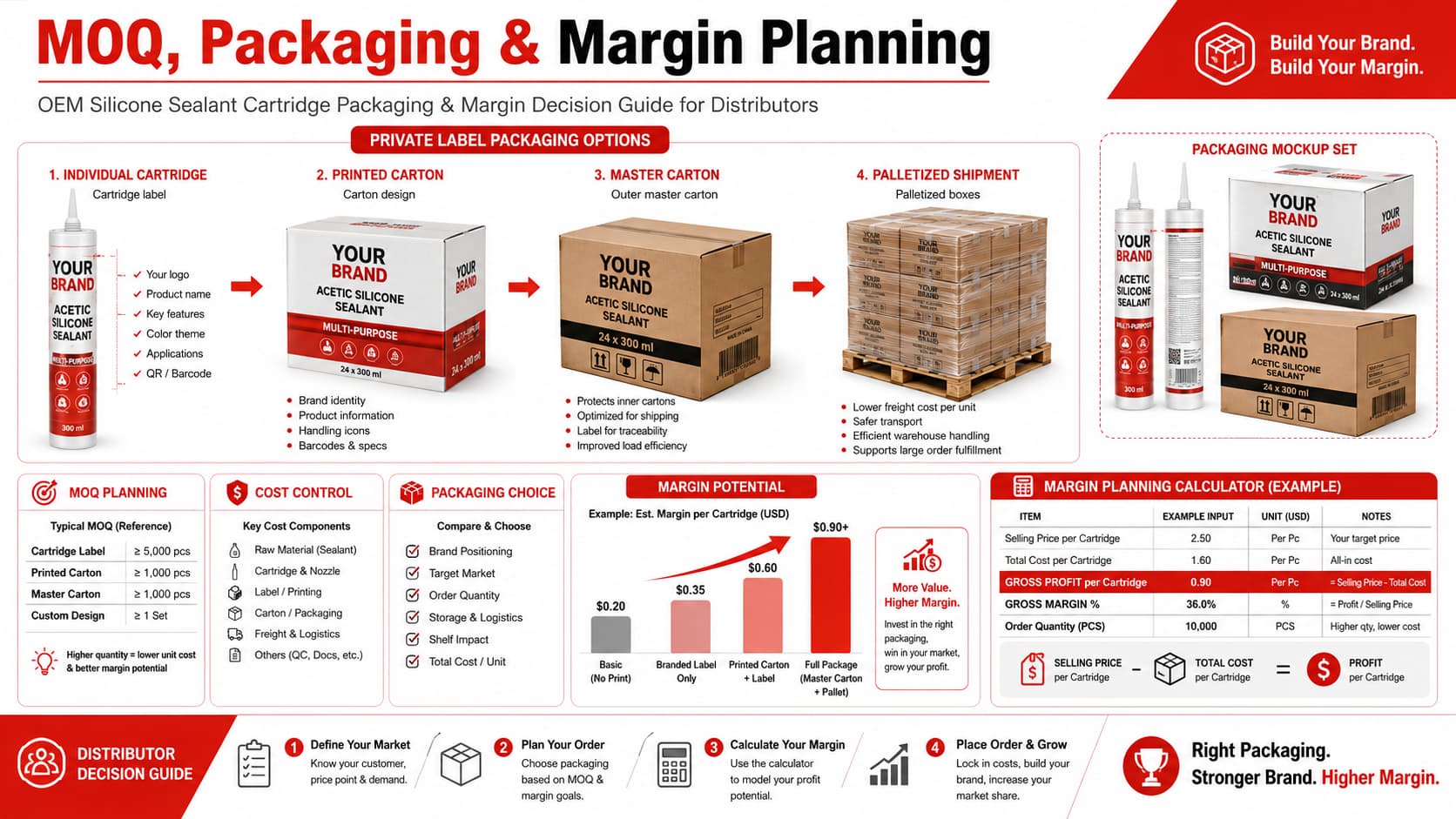
Cost, MOQ, Packaging, and Margin Comparison
| Item | Branded Sealant | OEM Sealant |
|---|---|---|
| Initial setup cost | Lower. | Higher, including artwork, tooling, and formulation approval. |
| Unit cost | Higher per unit. | Lower after scale. |
| Packaging cost | Included in list price. | Customizable; cost depends on design complexity. |
| Margin potential | Limited by brand pricing. | Higher, distributor-controlled. |
| Inventory planning | Easier — reorder as needed. | Requires demand forecasting against MOQ. |
| Brand asset ownership | Manufacturer-owned. | Distributor-owned. |
What to Prepare Before Ordering OEM Acetic Silicone Sealant
Distributors who arrive with this information get faster quotes and more accurate formulation recommendations:
- Target market — retail, contractor supply, hardware store, or project/tender supply.
- Primary application — glass, aquarium, sanitary/ceramic, window & door, HVAC.
- Formula priorities — fast cure, anti-fungal protection, high initial adhesion, weathering resistance.
- Packaging format — 300ml cartridge, foil sausage, carton design, private label artwork.
- MOQ and trial order size — whether you need a sample run before committing to full production.
- Documentation required — TDS, SDS, and any compliance documents your market requires.
- Color requirements — standard or custom-matched to specific substrates.
- Expected monthly volume — helps the factory recommend the right production schedule.
- Destination country and label language — affects compliance labeling and translation needs.
How to Choose an OEM Silicone Sealant Manufacturer
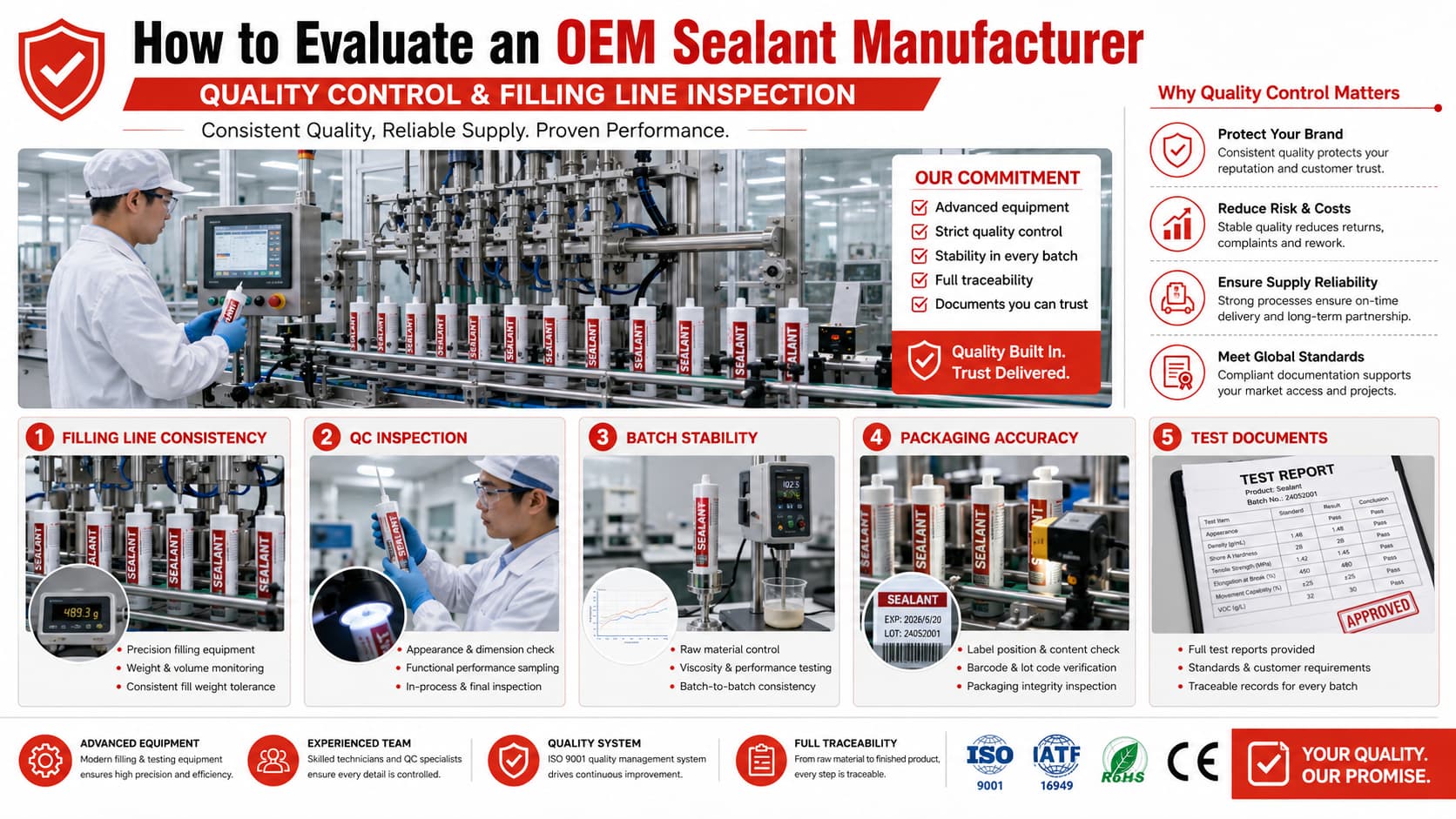
Your brand's reputation depends entirely on what is inside the cartridge. Before committing to a manufacturing partner, verify:
- Raw material purity — formulations built on high-purity siloxane polymer rather than diluted with volatile plasticizers, which may cause shrinkage and joint failure over time.
- Documentation on request — TDS, SDS, relevant test reports, and available factory or product compliance documents provided according to your destination market.
- Filling line consistency — automated filling reduces trapped air and moisture, which affects shelf life.
- Cartridge sealing quality — poor sealing can lead to skinning or curing inside the cartridge before use.
- Shelf life control — ask the supplier to confirm the stated shelf life under your storage conditions; many acetic silicone programs are specified around 9–12 months depending on formulation, packaging seal quality, and warehouse temperature.
- Packaging customization capability — in-house design support for lithographic cartridge printing and carton artwork.
- Export documentation — commercial invoices, certificates of origin, and any available documentation your destination market requires.
- Sample/trial process — whether the factory supports a smaller trial batch before a full production commitment.
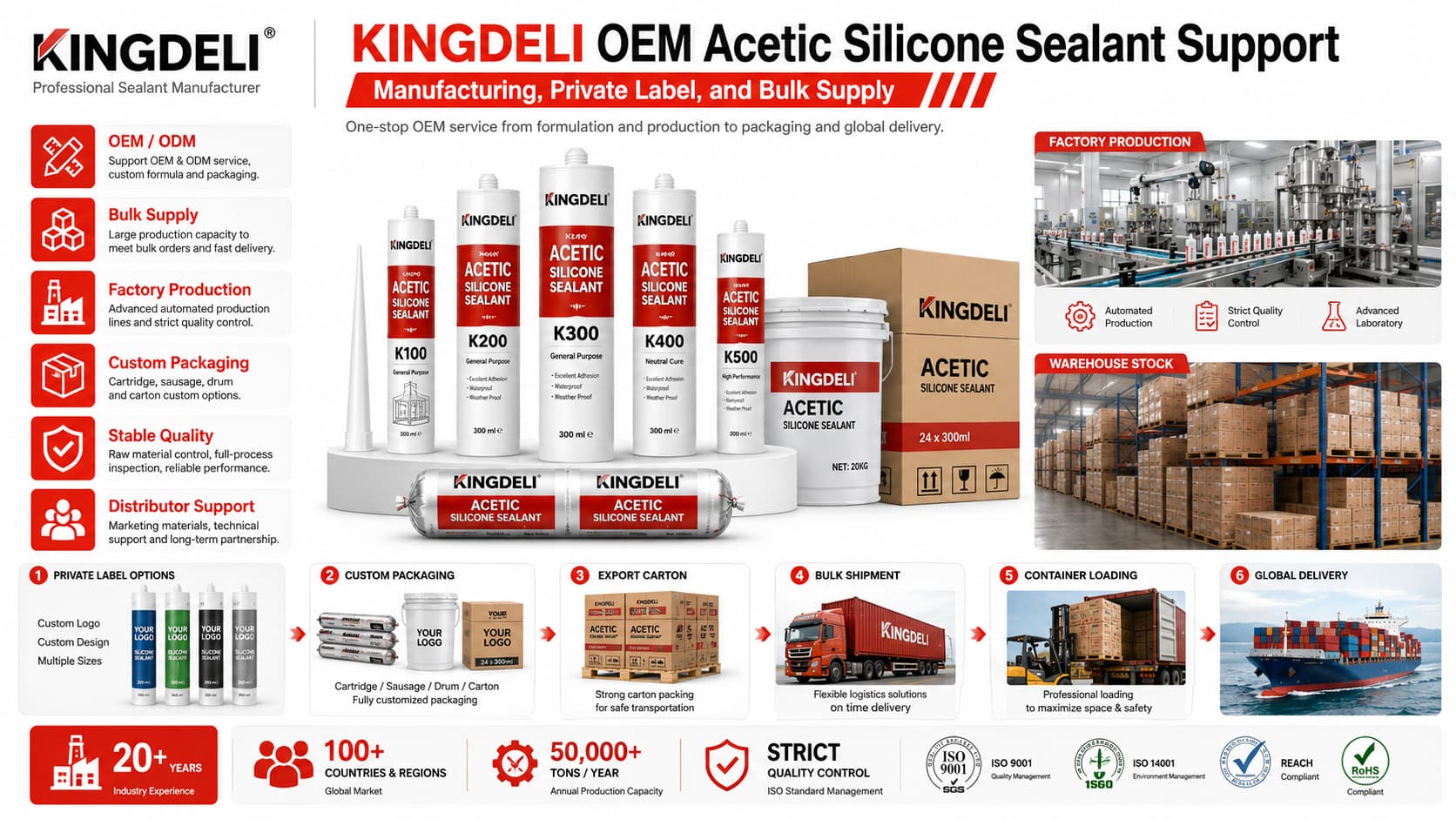
KINGDELI OEM Acetic Silicone Sealant Support
KINGDELI manufactures acetic silicone sealant formulations and supports both branded resale and full OEM/private label production for distributors, wholesalers, agents, and private label brands.
For distributors moving into private label, our support includes:
- Formulation adjustment — cure speed, anti-fungal additives, and viscosity tailored to your target application and climate.
- Private label packaging — custom cartridge artwork and carton design support.
- Color matching — pigment matched to specific architectural or substrate requirements on request.
- Documentation — TDS, SDS, relevant test reports, and available factory or product compliance documents such as ISO management certificates, CE-related documentation, or ASTM-based test data depending on the destination market.
- Bulk supply — produced at our fully automated 66,000 m2 facility with 100,000-ton annual capacity.
If you are ready to evaluate a private label acetic silicone sealant program, our OEM/ODM team can scope formulation and packaging based on your target market and volume. For distributors and wholesalers exploring larger volume commitments, the Bulk Order Inquiry team can quote MOQ and lead time directly. You can also review our Acetic Silicone Sealant product range or the HY732 Professional Acetoxy Cure Silicone Sealant as a reference formulation for aquarium, glass, and sanitary applications.
If your product mix also includes substrates that acetic silicone is not suited for — bare metal, stone, or concrete — our neutral silicone sealant range covers that gap without requiring a second supplier relationship.
Conclusion: Build Your Sealant Brand with Confidence
The choice between branded and OEM acetic silicone sealant comes down to where your distribution business is right now, not which option is universally better. Branded stock gets you moving with lower risk; OEM gets you margin, loyalty, and control once your volume justifies it. Many distributors run both simultaneously — branded for fast-moving general stock, OEM for their core private label line — and shift the balance as their channel matures.
As a manufacturer operating since 1998, KINGDELI supports distributors at either stage, with the manufacturing scale and documentation to back a private label line when you are ready to build one.
To start a private label evaluation, send KINGDELI your target market, application, cartridge size, label language, monthly volume, and required documents so our team can recommend the right OEM acetic silicone sealant program.
FAQs
Is OEM silicone sealant better than branded silicone sealant for distributors?
Neither is universally better. It depends on your sales volume and business stage. Branded sealant suits distributors who need fast market entry with minimal setup. OEM suits distributors with established volume who want margin control and brand ownership.
What is the MOQ for OEM acetic silicone sealant?
MOQ varies by formulation, cartridge printing, carton design, and trial order options. Standard cartridge programs typically require higher order quantities than pre-made branded stock, so it is best to request a specific MOQ quote based on your target packaging and formulation.
Can I customize the cartridge and carton packaging?
Yes. OEM programs typically include custom cartridge artwork, lithographic printing, and carton design support from the manufacturer's in-house design team.
Can OEM acetic silicone sealant be made for different climates?
Yes. Formulations can be adjusted for cure speed, UV resistance, and anti-fungal protection to suit high-humidity, high-heat, or high-UV-exposure regions.
What documents should an OEM sealant manufacturer provide?
At minimum, a Technical Data Sheet (TDS) and Safety Data Sheet (SDS). Depending on your destination market, you may also request relevant test reports, available factory compliance documents, product documentation, or ASTM-based test data when required for import or project approval.
How do distributors protect margins with private label silicone sealant?
Private label can reduce dependence on third-party brand pricing and give distributors more control over wholesale margins. However, packaging setup, MOQ, inventory planning, and freight cost should be calculated before placing an OEM order.
How long does OEM acetic silicone sealant production take?
Lead time depends on formulation complexity, packaging design approval, and order volume. The first order usually requires extra time for artwork and formulation confirmation; repeat orders are typically faster once specifications are locked.
Can KINGDELI support wholesalers, agents, and private label brands?
Yes. KINGDELI supports both branded resale relationships and full OEM/private label programs, including formulation adjustment, custom packaging, and bulk supply from our 66,000 m2 manufacturing facility.
What is the main chemical difference between low-cost sealants and premium OEM formulations?
Premium formulations are built on high-purity siloxane polymer for structure and elasticity. Lower-cost alternatives may be diluted with volatile plasticizers that evaporate after application, leading to shrinkage, cracking, and adhesion failure over time.
How is shelf life managed for custom OEM sealant orders?
Ask the supplier to confirm the stated shelf life under your storage conditions. Many acetic silicone programs are specified around 9–12 months, depending on formulation, cartridge sealing quality, filling process, and warehouse temperature.





Whatsapp: +8618825946249
Kingdeli
Kingdeli
Kingdeli
Kingdeli
Kingdeli