


Why choose acetoxy cure silicone sealant for industrial projects?
- 1. How do I calculate cure time and safe handling intervals for a 12mm bead of professional acetoxy cure silicone sealant in humid and dry industrial environments?
- 2. Which primers and surface treatments ensure lasting adhesion of acetoxy cure silicone to anodized aluminum and treated steel in marine conditions?
- 3. What joint design (width-depth ratio and tooling) minimizes shrinkage and stress on bonded glass panels when using professional acetoxy cure silicone sealant?
- 4. How to mitigate corrosion and staining on sensitive metals (copper, brass, galvanized steel) when an acetoxy sealant is the only option on-site?
- 5. What laboratory tests and on-site mockups should I request from suppliers to verify long-term performance of acetoxy cure silicone sealants for industrial roofing penetrations?
- 6. How to calculate the required quantity and waste allowance for large industrial projects using acetoxy cure silicone sealant considering bead overlap, tooling losses, and shelf life?
This technical guide answers six specific, long-tail questions frequently asked by engineers, project managers and specifiers when buying professional acetoxy cure silicone sealant for industrial work. It embeds practical guidance on cure rate, joint design, primers, corrosion mitigation, testing and material take-off so you can make informed procurement decisions. Standards referenced include ASTM C920 and ASTM C1193; always confirm with manufacturer technical data sheets and on-site mockups before full-scale installation.
1. How do I calculate cure time and safe handling intervals for a 12mm bead of professional acetoxy cure silicone sealant in humid and dry industrial environments?
Acetoxy (acid) cure silicones release acetic acid as they crosslink; cure is by neutralization with atmospheric moisture. Two practical metrics govern scheduling:
- Skin time (time to touch without transfer): commonly 5–15 minutes at ~50% relative humidity (RH) and 20–25°C. Lower RH or lower temperature increases skin time. - Through-cure rate (depth cured per 24 hours): typical commercial acetoxy silicones cure approximately 2–3 mm per 24 hours at 50% RH and 23°C. In low humidity (<30% RH) the rate can drop to 0.5–1 mm/day; at >70% RH rates can exceed 3 mm/day.
Calculation example (12 mm bead): at 2.5 mm/day you can expect full cure in roughly 12/2.5 = 4.8 days (about 5 days). Skin time will usually be <15 minutes, so you can tool and protect the seal within the first hour, but avoid mechanical loading or full structural stress until full cure. For large joints or thick sections (>10 mm) plan for multiple days of cure and allow additional time if jobsite humidity is low or temperatures are below 10°C.
Practical tips: - Use local climate control or humidification to accelerate cure in very dry environments. - For immediate handling or early load, opt for thin beads or a neutral cure/fast-cure variant specified for rapid handling. - Always confirm cure rate on a 10–12 mm mock bead under site conditions; manufacturer data sheets often list “typical” values but field verification is essential per ASTM C1193 guidance.
2. Which primers and surface treatments ensure lasting adhesion of acetoxy cure silicone to anodized aluminum and treated steel in marine conditions?
Adhesion to anodized aluminum and coated/treated steel in marine environments is a frequent failure point. Acetoxy silicones adhere well to many non-porous substrates, but in aggressive or long-term salt-laden environments, use a structured approach:
1) Clean: remove oil, grease, salts and temporary coatings. Use solvent wipe (isopropanol or manufacturer-specified cleaner). Avoid alkaline cleaners that leave residues. Dry thoroughly. 2) Mechanical roughening: light abrasion increases surface energy and mechanical key. For anodized profiles, fine scotch-brite or 180–240 grit is common. 3) Primer/adhesion promoter: use a silane-based primer or manufacturer-recommended adhesion promoter specifically tested for acetoxy silicones on anodized aluminum or galvanized/painted steel. The primer establishes chemical coupling, especially under cyclic wet/dry or salt-spray (ASTM B117) exposure. 4) Compatibility check: acetoxy cure releases acetic acid and can accelerate corrosion on reactive metals (copper, brass) and some galvanizing finishes; for these substrates, confirm the primer prevents contact between metal and uncured sealant and/or consider neutral cure alternatives.
Request supplier evidence of adhesion after accelerated aging (see question 5). For marine-grade durability, insist on primer + sealant systems that have passed salt spray, thermal cycling, and adhesion retention tests rather than relying on “direct stick” claims.
3. What joint design (width-depth ratio and tooling) minimizes shrinkage and stress on bonded glass panels when using professional acetoxy cure silicone sealant?
Proper joint design is one of the highest-impact controls to avoid premature failure. Use these rules derived from industry practice and ASTM guidance:
- Width-to-depth ratio: maintain approximately 2:1 (width twice the depth). Example: for a 12 mm wide joint, target 6 mm depth. This balances sealant volume and allows effective movement accommodation. - Minimum dimensions: avoid depths less than 6 mm where possible; for small joints (>6 mm width) a 2–4 mm depth may be acceptable only if manufacturer allows. - Bond breaker: place a back-up rod (closed-cell polyethylene foam) or bond-breaker tape behind the sealant to prevent three-sided adhesion — three-sided adhesion dramatically increases stress and can lead to tearing under movement. - Tooling: tool the joint to a concave profile to improve stress distribution and remove voids. Tool within the skin time window to obtain a smooth contact surface. - Movement accommodation: specify a silicone with appropriate movement capability (ASTM C920 class, e.g. ±25% or ±50% grade) based on the joint expected thermal/structural movements.
Shrinkage: acetoxy silicones typically have low cure shrinkage by volume compared with polymeric sealants, but if the joint is too deep or three-sided adhesion exists, shrinkage stresses will still concentrate. Use low-modulus silicone variants for glass to reduce stress transfer and protect glass edge pressures.
4. How to mitigate corrosion and staining on sensitive metals (copper, brass, galvanized steel) when an acetoxy sealant is the only option on-site?
Acetic acid by-product can cause staining and accelerate corrosion on copper, lead, brass and some metal coatings. If neutral cure silicone is not available and acetoxy is the only option, take mitigation steps:
- Isolation: apply a chemically resistant barrier film (PVC or polyethylene tape) or a thin layer of compatible paint/varnish on metal surfaces where the sealant will contact. Ensure the barrier is continuous and compatible with expected temperatures. - Primer/coat: apply a manufacturer-approved corrosion-inhibiting primer that is compatible with acetoxy silicone. Test adhesion of primer + sealant in a mockup. - Edge detail: avoid capillary gaps where uncured acetic acid can migrate under painted layers; provide drip edges and drainage where possible. - Post-cure cleanup: remove uncured residues promptly using manufacturer-recommended solvent; acetic acid residue left on metal surfaces can continue to cause staining. - Testing: perform a small-scale field test for 30–90 days, including visual inspection and corrosion potential measurement where critical. Where staining is critical (architectural finishes), neutral cure silicones are the correct long-term choice.
5. What laboratory tests and on-site mockups should I request from suppliers to verify long-term performance of acetoxy cure silicone sealants for industrial roofing penetrations?
Insist on documented evidence tailored to your substrates and environment. Minimum recommended tests and mockups:
- Accelerated weathering (UV): ASTM G154 or equivalent to simulate UV and heat exposure. - Salt spray (marine): ASTM B117 for systems exposed to coastal salt fog. - Thermal cycling/expansion: cyclic movement tests that replicate expected joint movement amplitude and frequency; see ASTM C719 for movement test methods. - Adhesion after aging: peel/tensile adhesion tests after exposure (water immersion, salt spray, thermal cycles). - Water immersion and ponding: hydrostatic resistance and adhesion retention. - Tensile/elongation and compression set: to verify that elongation at break and recovery meet project requirements. - VOC and hazard data: MSDS/SDR information to confirm onsite health controls and compliance. - On-site mockups: at least a 1–3 m length of representative joint installed under site conditions, observed over a 3–12 month period (accelerated tests are not a substitute for field verification).
Documentation: require test reports from accredited labs and manufacturer warranties that reference the tested system (sealant + primer + substrate). For critical penetrations, require supplier responsibility for mockup failures and a remedy clause in the purchase order.
6. How to calculate the required quantity and waste allowance for large industrial projects using acetoxy cure silicone sealant considering bead overlap, tooling losses, and shelf life?
Use a volume-based takeoff, then convert to cartridges/tubs and add project-specific waste factors. Steps and a worked example:
1) Cross-sectional area (approximate circular bead): A = π × (d/2)^2 where d = bead diameter. Many contractors prefer to use rectangular approximations for joint shape: A ≈ width × depth. 2) Volume = A × length (per linear metre). 3) Convert to liters: 1 cubic mm = 1e-6 liters. 4) Convert to units: a standard 300 mL cartridge contains 0.3 L; a 600 mL sausage contains 0.6 L; bulk tubs vary (5 L, 20 L). 5) Waste allowance: add 10–20% for tooling loss, bead overlaps, start/stop waste and contingency. For inexperienced crews or complex access add up to 25% waste. 6) Shelf life/stock rotation: acetoxy silicones typically have 9–18 months shelf life stored at 5–25°C (manufacturer-specified). Order smaller batches for long-duration projects and practice FIFO stock management to avoid expired materials.
Worked example: - Project length: 1,000 m of 10 mm wide × 5 mm deep joint. - Cross-sectional area: 10 mm × 5 mm = 50 mm^2. - Volume total: 50 mm^2 × 1,000,000 mm = 50,000,000 mm^3 = 50,000 mL = 50 L. - Cartridges: 50 L / 0.3 L ≈ 167 cartridges. - Add 15% waste: 167 × 1.15 = 192 cartridges (round up). Alternatively use 20 L tubs: 50 L / 20 L = 2.5 tubs → order 3 tubs plus cartridges for access/finishing work.
Practical procurement tips: consolidate suppliers, request batch traceability and shelf-life certificates, schedule deliveries to avoid long on-site storage in high heat (>35°C) which can shorten shelf life, and label all units with arrival date to maintain FIFO.
For project tendering, include acceptance criteria (test reports, mockup approval), primer compatibility lists, expected cure windows under site conditions, and waste allowance policy in the contract so supplier and installer responsibilities are clear.
Closing summary: Professional acetoxy cure silicone sealant offers fast skin formation, excellent UV and weather resistance, wide service temperature range (commonly -50°C to +150–180°C depending on formulation), and good elasticity for building and industrial joints. Its limitations—release of acetic acid during cure (corrosion risk for sensitive metals), limited paintability, and dependence on ambient moisture for cure—mean project success depends on correct substrate preparation, primer selection, joint design (2:1 width-depth), realistic cure scheduling, and supplier-provided accelerated test evidence (ASTM C920, ASTM C1193 and related tests). For critical applications such as marine, roofing penetrations, and glazed façades, require laboratory reports, on-site mockups, and a documented system (sealant + primer + installation method) before awarding work.
For a tailored specification, product data sheets, or a site-specific quote, contact us at www.kingdelisealant.com or email info@kingdeliadhesive.com — we can provide technical submittals and supplier-backed test documentation.
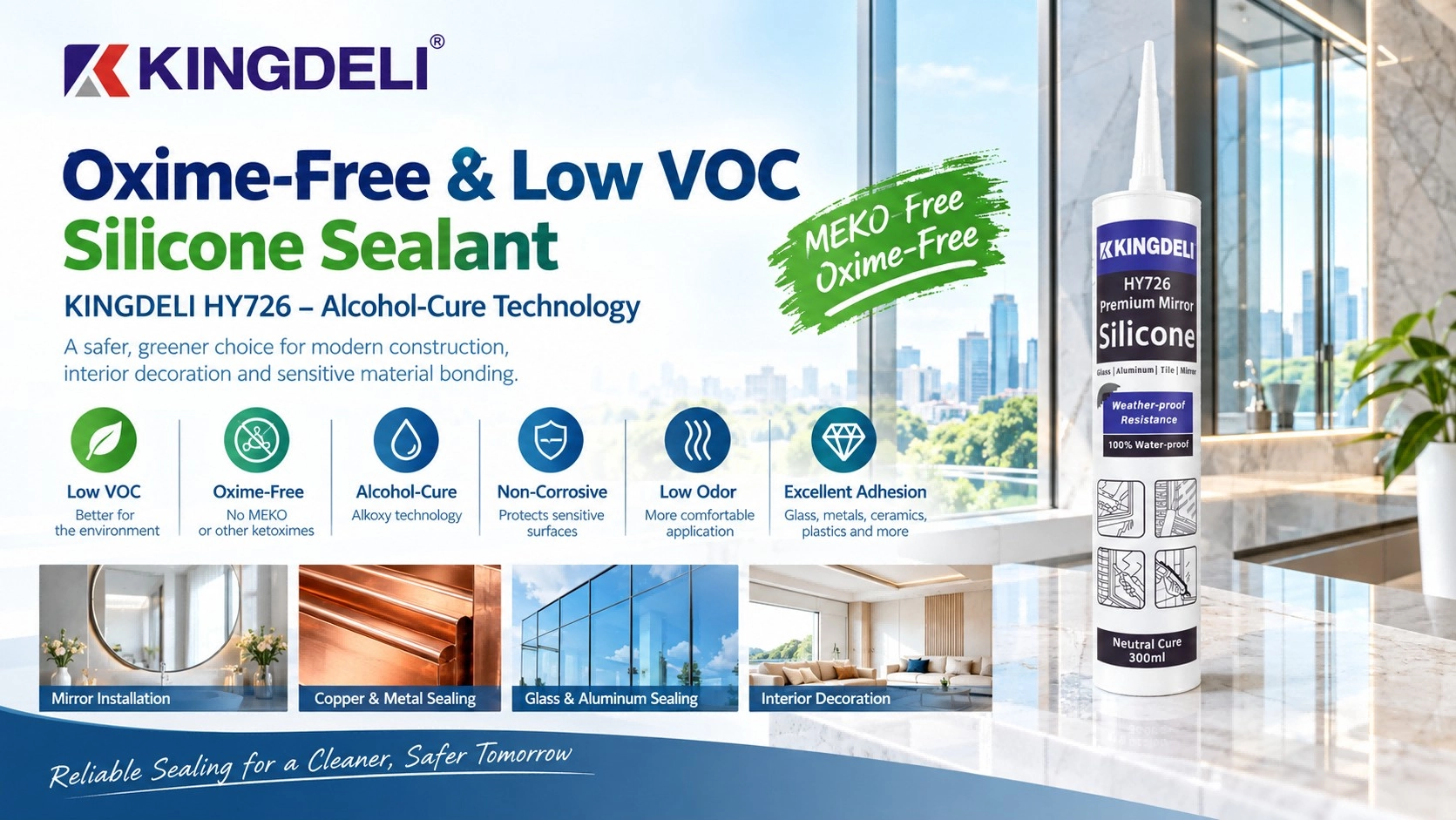
Oxime-Free & Low VOC Silicone Sealant: Discover KINGDELI HY726 Alcohol-Cure Technology
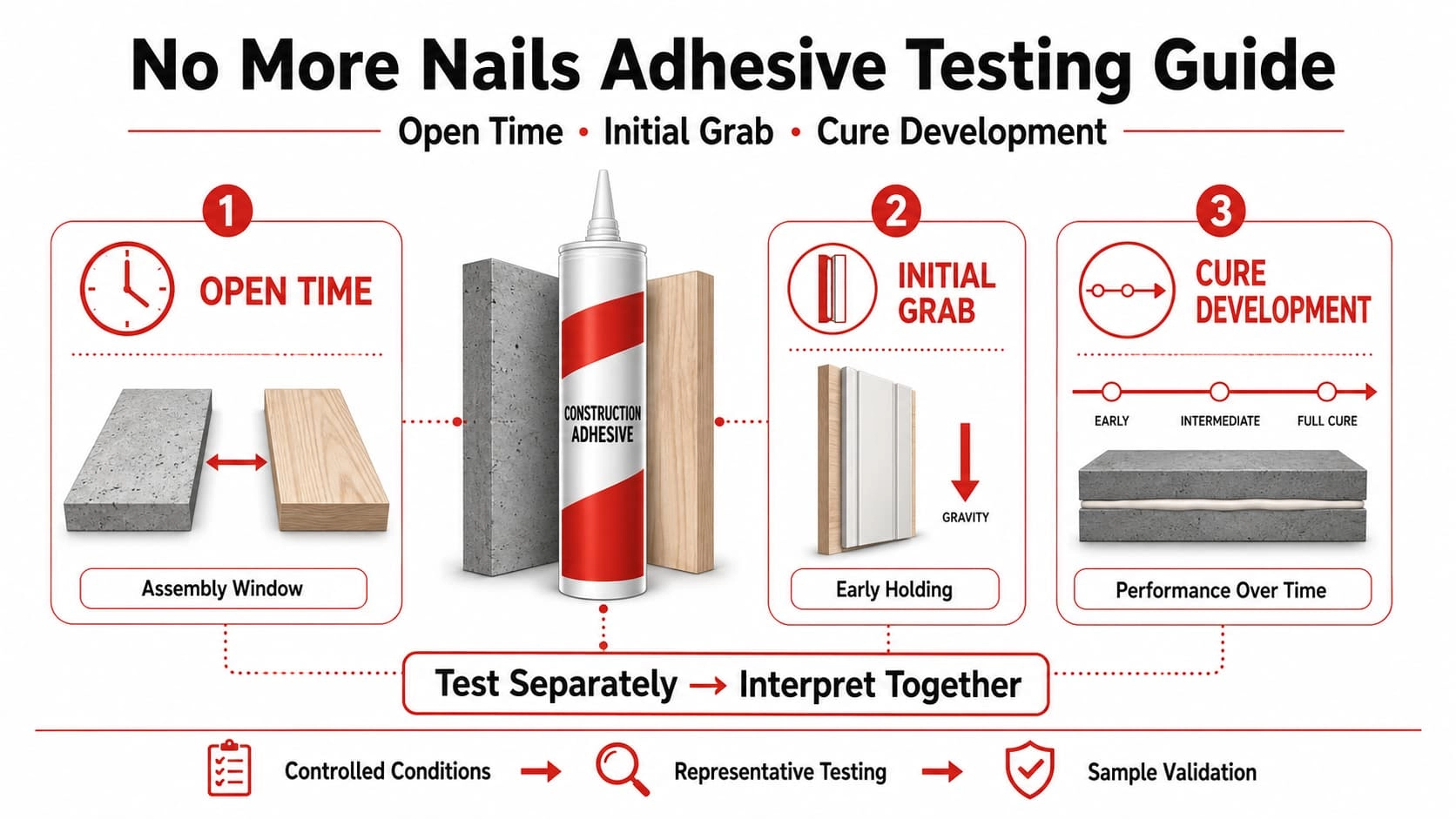
No More Nails Adhesive Open Time, Grab Strength, and Cure Testing Guide
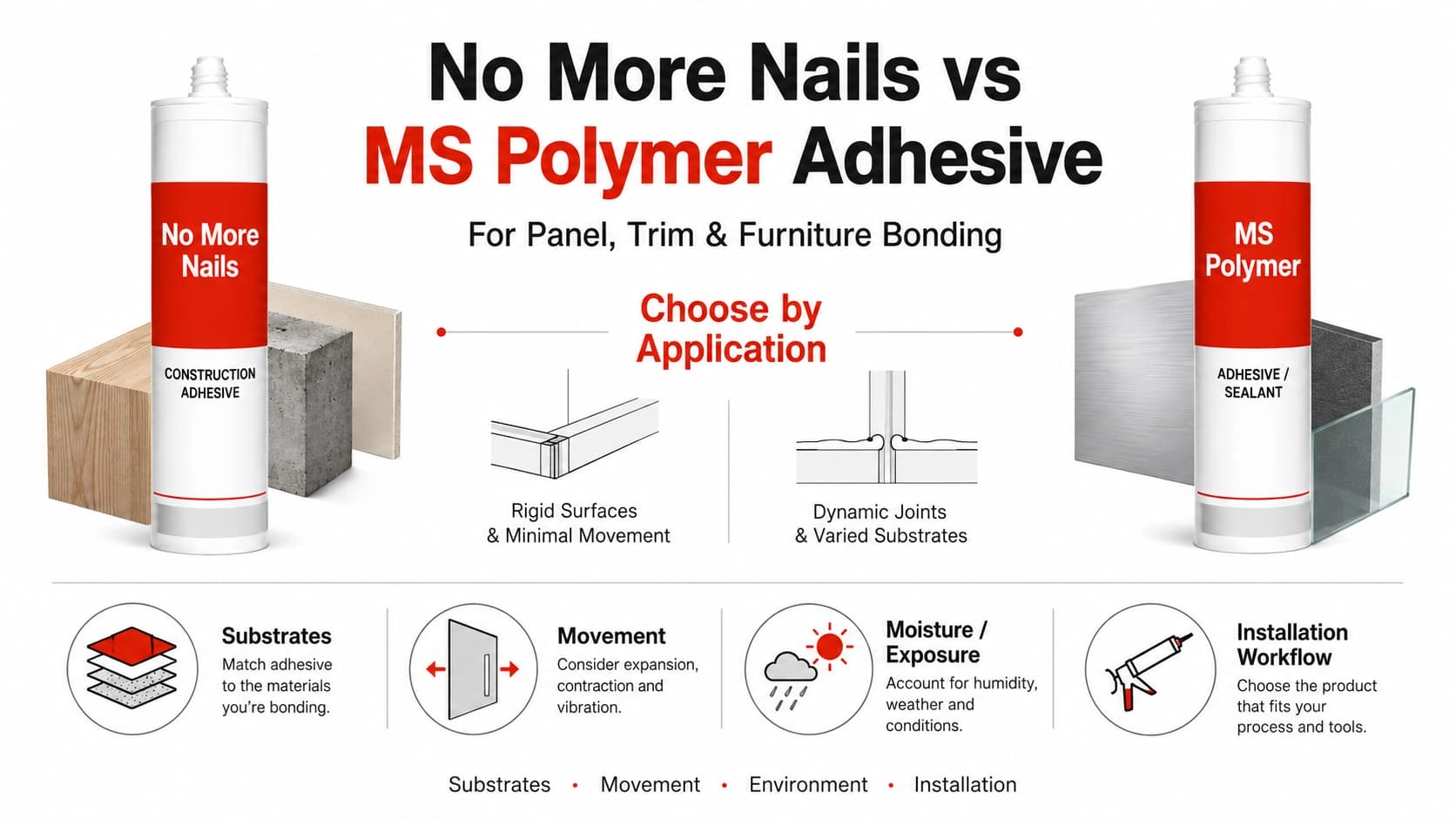
No More Nails vs MS Polymer Adhesive for Panel, Trim, and Furniture Bonding
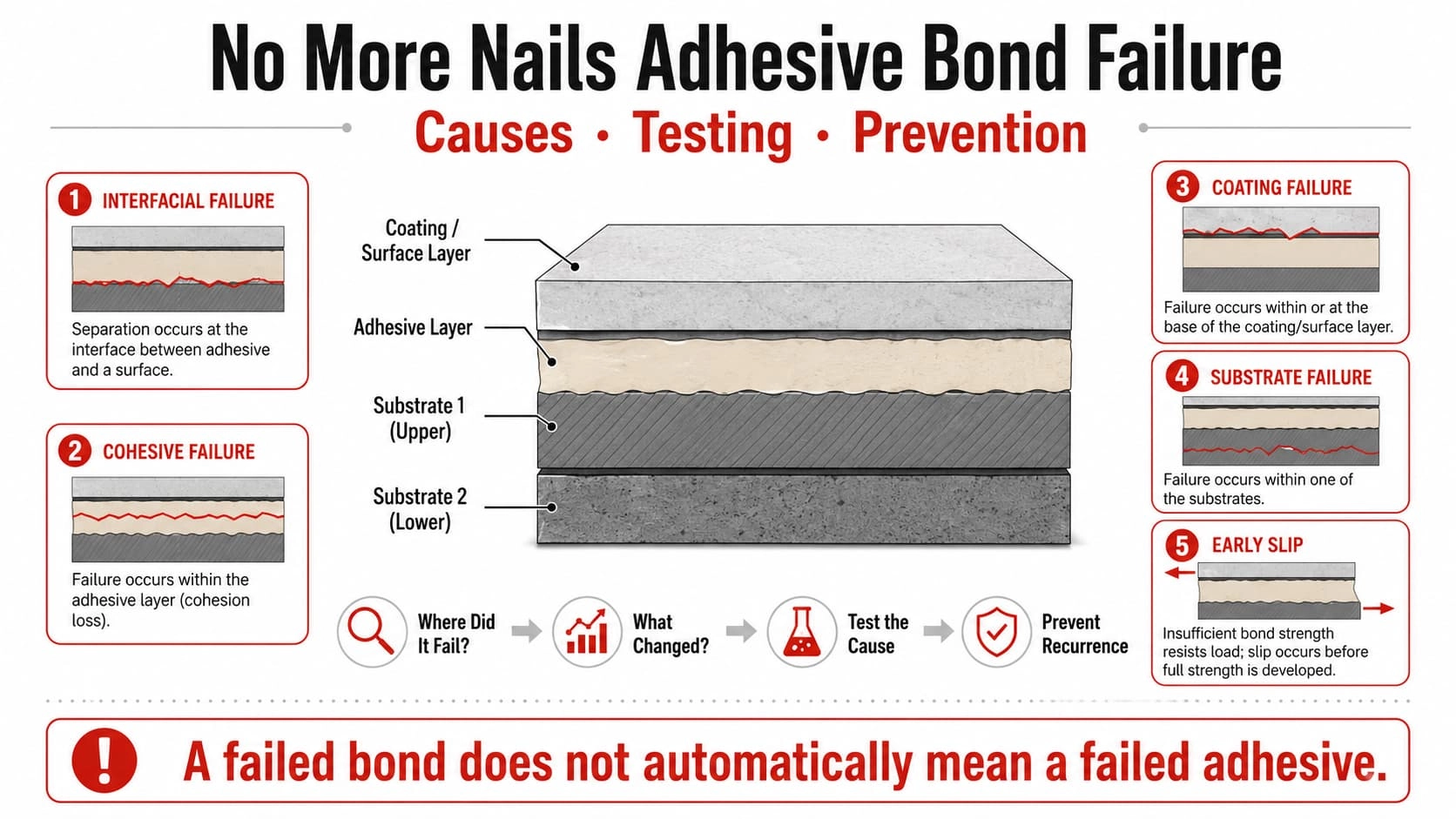
No More Nails Adhesive Bond Failure: Causes, Testing, and Prevention

HY992 Modified Polyurethane Construction Sealant
HY992 Modified Polyurethane Sealant is a one-component, moisture-curing construction sealant designed for professional building and structural sealing applications. It provides excellent adhesion, weather resistance, and durable elasticity, making it suitable for a wide range of construction materials.
The formulation delivers strong bonding performance without corrosion or substrate contamination, while maintaining low VOC content for environmentally responsible construction projects.

HY995 Crystal Clear Ms Polymer Adhesive/Sealant
HY995 Crystal Clear Ms Polymer Adhesive/Sealant is a new generation MS Polymer adhesive / sealant formulated for all bonding and sealing applications where long term reliability is required. It has excellent bonding strength on various materials. It will cure to form a durable, flexible, waterproof seal.

HY997 High-Performance Anti-Microbial MS Polymer Sealant
HY997 MS polymer sealant for is is a premium one-component, neutral-curing modified silane sealant engineered for demanding interior applications. It offers a Class 20 movement capability, ensuring long-lasting flexibility and reliable performance under dynamic joint conditions. Curing at room temperature, HY997 delivers superior anti-microbial and mildew-resistant properties, maintaining hygienic and clean environments over time.

KINGDELI HY732 Professional Acetoxy Cure Silicone Sealant
KINGDELI HY732 is a professional-grade, one-component acetoxy cure silicone sealant designed for fast curing, strong adhesion, and long-lasting flexibility. Ideal for aquariums, glass applications, aluminum doors and windows, kitchens, and bathrooms, it provides reliable sealing performance with excellent anti-fungal protection in high-humidity environments.
Let’s Build Stronger Bonds with Quality Adhesives and Sealants
Have questions about the topic or need tailored sealant solutions for your project?
Our team is ready to provide expert guidance, product recommendations, and application support.
Innovating with Integrity, Bonding the World
Since 1998, KINGDELI has delivered trusted, sustainable sealant solutions that connect industries and inspire progress worldwide.

Whatsapp: +8618825946249
Kingdeli
Kingdeli
Kingdeli
Kingdeli
Kingdeli