


Sealant Lot Traceability Checklist for Importers and Private Label Buyers
- Key Takeaways
- What Is Sealant Lot Traceability?
- Why Do Importers and Private Label Buyers Need Lot Traceability?
- Step 1: Record SKU, Product Category, and Application
- Step 2: Connect the Lot to the Approved Sample
- Step 3: Record Purchase Order and Supplier Reference Information
- Step 4: Check Lot Number, Batch Code, and Production Information
- Step 5: Verify Label, Packaging, and Carton Traceability
- Step 6: Review Documents for Lot Traceability
- Step 7: Create an Incoming Inspection Record
- Sealant Lot Traceability Checklist Template
- Common Traceability Mistakes to Avoid
- 1. Recording only the PO number but not the lot number
- 2. Mixing sample approval records with bulk order records
- 3. Not checking label version for private label products
- 4. Ignoring carton markings
- 5. Comparing documents after goods are already distributed
- 6. Not separating SKUs in multi-product orders
- 7. Forgetting to record expiry or shelf life information
- 8. Not keeping photos of labels and cartons
- 9. Not linking customer feedback to lot records
- 10. Reordering without reviewing previous lot notes
- How Lot Traceability Supports Reorder Review
- When Should Buyers Contact KINGDELI?
- FAQ
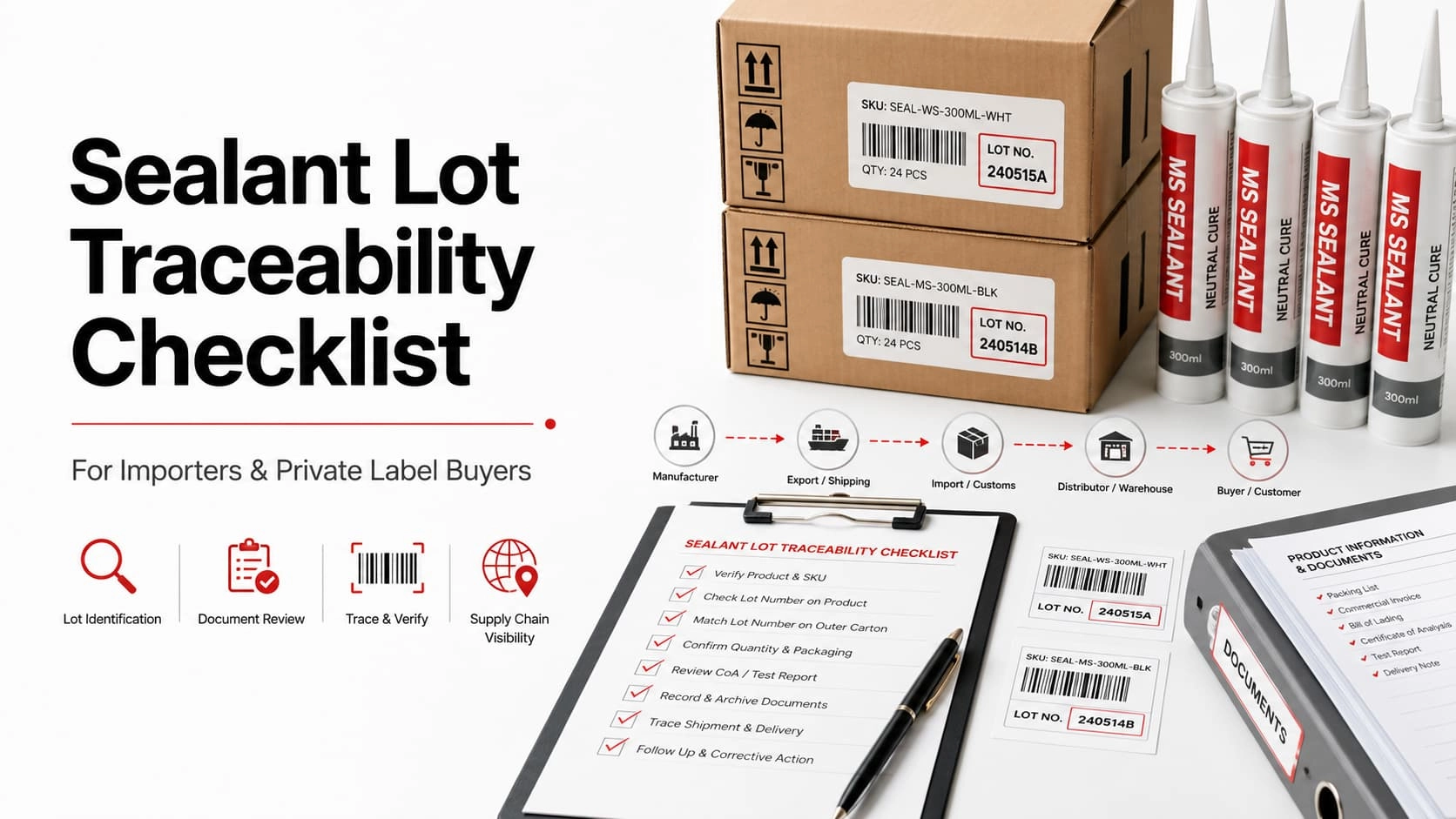
Sealant lot traceability is the process of connecting each bulk order batch with its SKU, product category, approved sample, purchase order, packaging version, label version, documents, carton markings, and incoming inspection records. Importers and private label buyers should record the lot number, batch code, production date if available, shelf life information, color, packaging format, barcode, SKU code, supplier reference, sample approval record, packing list, invoice, TDS, SDS, and inspection notes. A clear lot traceability checklist helps buyers reduce confusion, support internal review, track customer feedback, and make reorder discussions clearer.
Key Takeaways
- Sealant lot traceability is not only about recording a lot number. It should connect the SKU, approved sample, bulk order, packaging, label, documents, and receiving records.
- Importers should avoid using only the purchase order number as the traceability record for multi-SKU sealant orders.
- Private label buyers should track label version, artwork version, barcode, SKU code, carton marking, and packaging format together with the batch or lot information.
- Approved samples should be connected to bulk order records so buyers can compare the received lot with the approved sample version.
- Incoming inspection records help procurement, QA, warehouse, sales, and reorder teams review each lot more clearly.
What Is Sealant Lot Traceability?
Sealant lot traceability is a record-keeping process that helps buyers identify which product version was ordered, which batch was received, which packaging and label version was used, which documents were attached, and which internal records should be used for future reorder or issue review.
For sealant and adhesive importers, lot traceability is useful because bulk orders often involve more than one product, color, packaging format, label version, or shipment batch. A single order may include silicone sealants, acrylic sealants, polyurethane sealants, MS polymer sealants, construction adhesives, RTV gasket makers, No More Nails adhesives, or epoxy tile grout. Buyers can review KINGDELI’s sealant and adhesive products when organizing product categories for procurement records.
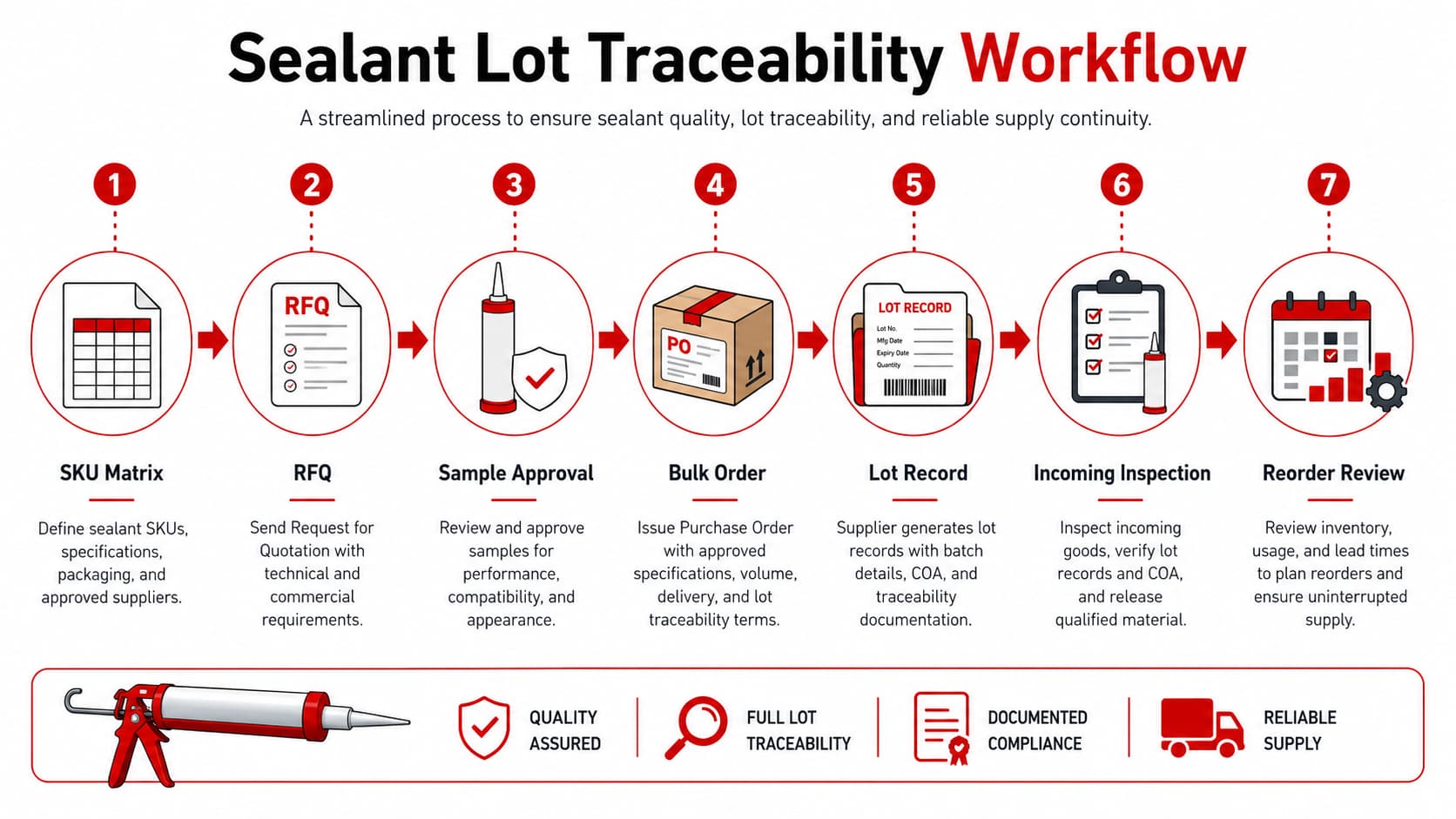
A complete traceability record should not rely on one field only. It should connect:
- SKU code
- Product name
- Product category
- Application
- Approved sample reference
- Purchase order number
- Supplier quotation or RFQ reference
- Lot number or batch code
- Packaging format
- Label version
- Carton marking
- Document version
- Incoming inspection notes
- Reorder comments
Lot traceability helps importers, distributors, private label buyers, procurement teams, QA teams, warehouse teams, and sales teams work from the same record. When a question appears later, the buyer can review which lot was received, where it was stored, which label version was used, and whether any issue was recorded during inspection or customer feedback.
Why Do Importers and Private Label Buyers Need Lot Traceability?
Importers and private label buyers often handle sealant orders across different SKUs, customers, and market channels. Without clear lot traceability, it can become difficult to connect the approved sample, order record, physical goods, packaging, documents, and future reorder discussions.
Lot traceability helps buyers reduce several common problems:
- Multiple SKUs arrive in the same shipment without clear batch records.
- The approved sample code is not linked to the bulk order lot.
- A private label artwork version changes, but the old version is still stored in internal records.
- Inner packaging and outer carton markings do not clearly match.
- Barcodes, SKU codes, carton labels, or product names are recorded inconsistently.
- Documents are stored separately from the lot record.
- Customer feedback cannot be linked to a specific batch.
- Warehouse teams cannot identify which lot belongs to which purchase order.
- Reorder discussions begin without reviewing the previous lot notes.
- Procurement, QA, sales, and warehouse teams use different names for the same product.
A traceability checklist does not guarantee that every quality or shipment issue will be avoided. However, it helps buyers organize important information before, during, and after bulk ordering. It also supports clearer communication with suppliers when reviewing samples, documents, packaging, customer feedback, or reorder needs.
For private label buyers, traceability is especially important because the product is often connected to a customized label, carton, barcode, local language, retail shelf presentation, or distributor SKU code. If those details are not recorded together with the lot number, later review may become difficult.
Step 1: Record SKU, Product Category, and Application
The first step in sealant lot traceability is to connect each lot record with the correct SKU. Buyers should avoid recording only the total order number when a shipment includes multiple sealants, colors, packaging formats, or private label items.
Each SKU should have its own traceability row. This is especially important for importers and distributors that manage product assortments across retail, contractor, wholesale, project, and private label channels.
If the product range has not yet been organized, buyers can first build a sealant SKU matrix to define product categories, applications, packaging formats, sales channels, sample status, and reorder priority.
| Field | What to Record | Why It Matters |
|---|---|---|
| SKU code | Internal distributor code, buyer item code, or planned product code | Connects warehouse, sales, purchasing, and reorder records |
| Product name | Product name used in the buyer’s system or supplier documents | Helps teams identify the item consistently |
| Product category | Silicone, PU, MS polymer, acrylic, adhesive, grout, RTV, or other category | Helps classify the product and avoid confusion |
| Application | Window, bathroom, automotive, tile, façade, bonding, repair, or other use | Supports customer feedback and application review |
| Sales channel | Retail, contractor, wholesaler, private label, project, or distributor channel | Helps track market use and inventory role |
| Color | White, clear, black, gray, beige, or project-specific color | Helps distinguish similar SKUs |
| Packaging format | Cartridge, sausage, pail, drum, tube, carton, or private label package | Supports quotation, warehouse, and inspection review |
For multi-SKU orders, this step is essential. If three similar sealants are shipped in the same container, the buyer should be able to identify which lot belongs to which SKU, application, packaging format, and internal record.
Step 2: Connect the Lot to the Approved Sample
A bulk order lot should be connected to the approved sample record. This helps buyers compare what was approved during sampling with what was received in the bulk order.
Buyers should approve sealant samples before bulk ordering and keep the approved sample information available for later traceability. The sample approval record may include application test notes, packaging review, label version, document status, required changes, and internal reviewer comments.
Important sample approval fields include:
- Approved sample code
- Sample approval date
- Sample version
- Product category
- Tested substrate
- Approved color
- Approved packaging format
- Approved label version
- Document version
- Required changes
- Internal reviewer
- Approval status
- Next action before bulk order
A buyer should not treat a bulk order lot as automatically approved only because a sample was approved earlier. The buyer should check whether the received lot, packaging, label, carton marking, and documents match the approved sample record.
For example, a sample may have been approved with a label revision. If the bulk order uses the old label version, the physical product may be technically acceptable but still not match the approved private label requirement. A traceability record helps identify this type of mismatch.
| Approval Status | Meaning |
|---|---|
| Approved for bulk order | Product, packaging, and documents are approved for bulk discussion |
| Approved with changes | Buyer accepts the product if listed changes are completed |
| Revised sample required | Buyer needs another sample before bulk confirmation |
| Pending document review | Product or packaging may be acceptable, but documents are incomplete |
| Pending internal review | Procurement, QA, sales, or project team has not completed review |
| Rejected | Sample does not meet the buyer’s requirement |
The final traceability record should show whether the received lot is connected to an approved sample, an approved-with-changes sample, or a pending sample status.
Step 3: Record Purchase Order and Supplier Reference Information
The third step is to connect the lot record with the purchase order and supplier communication. A good traceability record should show not only what was received, but also what was requested and confirmed before shipment.
Buyers should record:
- Purchase order number
- RFQ reference
- Supplier quotation reference
- Order date
- Product category
- SKU code
- Ordered quantity
- Packaging format
- Color
- Label requirement
- Target market
- Shipping batch
- Supplier item name
- Contact person
- Required documents
- Special instructions if applicable
RFQ and PO records should include traceability requirements before the bulk order is confirmed. If a buyer does not request batch, label, packaging, or document information early enough, it may be harder to organize records after shipment.
Buyers preparing bulk inquiries can review how to prepare a complete sealant RFQ before asking for quotation or sample support. Traceability expectations can be included in the RFQ so the supplier understands which information the buyer needs for internal records.
For private label or distributor orders, the PO should also connect to packaging and label details. These may include label language, artwork version, barcode, SKU code, carton marking, and packaging format. Without these fields, it may be difficult to compare the received goods with the order requirement.
Step 4: Check Lot Number, Batch Code, and Production Information
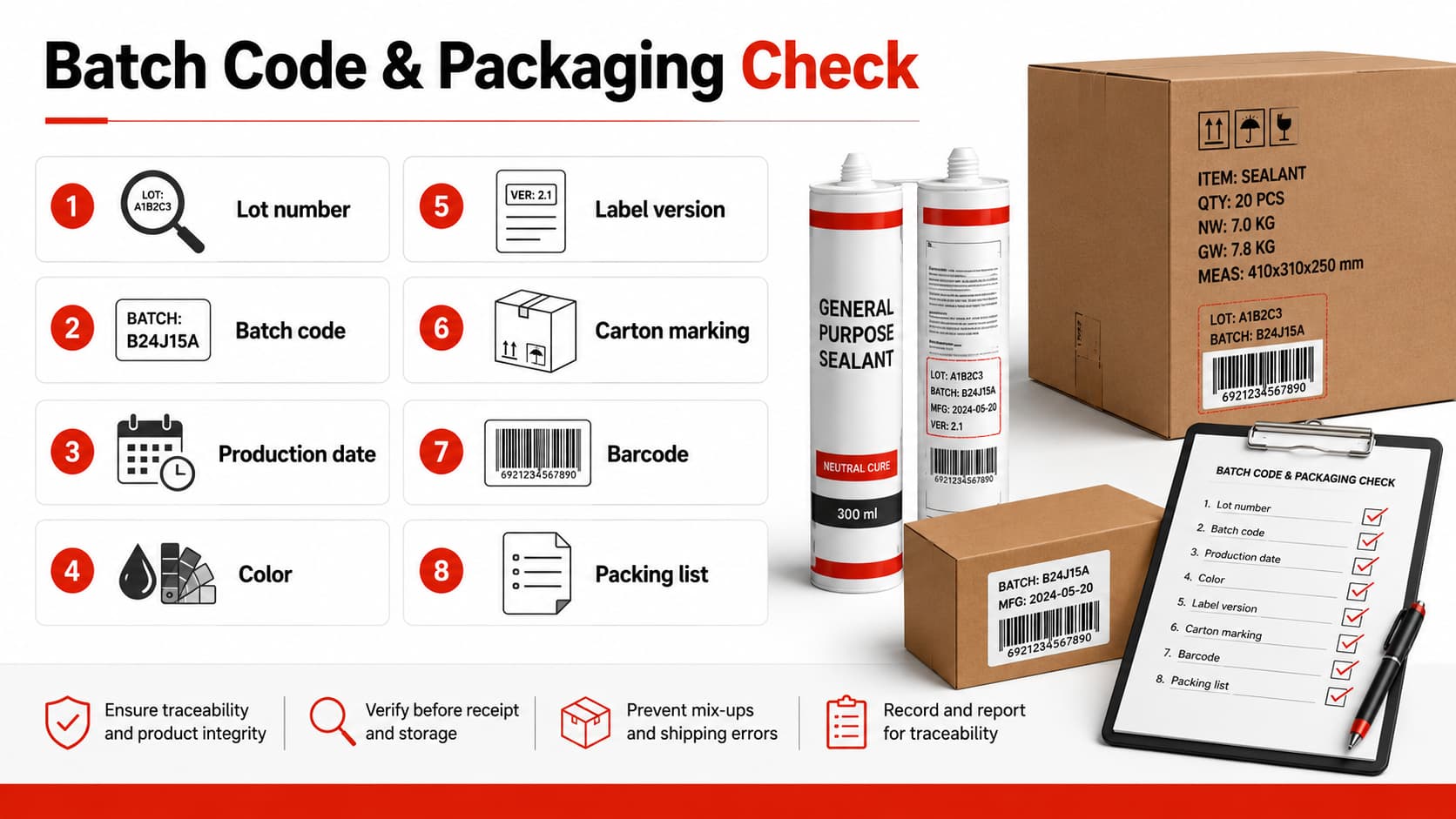
Lot number and batch code are the core fields in a traceability checklist. They help buyers identify which batch of goods was received, inspected, stored, distributed, or reordered.
Buyers should ask the supplier which lot or batch information is available and how it appears on product packaging, cartons, or documents. The available information may vary by product, order type, packaging format, and supplier process.
| Field | What to Check | Notes |
|---|---|---|
| Lot number | Lot or production batch reference | Check whether it appears on product, carton, document, or internal record |
| Batch code | Batch identifier used by supplier | Record exactly as shown |
| Production date | Date if provided on package, carton, or document | Useful for shelf life and warehouse review |
| Expiry date or shelf life information | Expiry date, shelf life period, or storage guidance if provided | Important for inventory and reorder planning |
| Product code | Supplier product code or internal item reference | Helps avoid product name confusion |
| Color code | Color name, color number, or color reference | Useful when multiple colors are ordered |
| Packaging date | Packaging date if available | May help compare production and packing records |
| Carton number | Carton code, carton sequence, or carton marking | Supports warehouse and inspection tracking |
| Pallet number | Pallet reference if used | Useful for larger shipments |
| Quantity per lot | Quantity connected to the lot or batch | Helps separate mixed-lot shipments |
| Retained sample reference | Sample kept by buyer or supplier if applicable | Supports later review if issues appear |
Buyers should pay attention to mixed-lot shipments. A shipment may contain more than one batch for the same SKU. If this happens, each lot should be recorded separately with its quantity, carton information, and warehouse location.
The traceability record should use the exact lot number or batch code shown on the physical product, carton, or document. Abbreviating or rewriting batch codes can create confusion later.
Step 5: Verify Label, Packaging, and Carton Traceability
For private label buyers, packaging traceability is as important as product traceability. The lot record should show whether the inner package, outer carton, label artwork, barcode, SKU code, and documents are connected to the same order and approved version.
Buyers preparing private label or customized packaging can review KINGDELI’s OEM and ODM sealant solutions when organizing label, packaging, and product range questions.
Packaging and label traceability should include:
- Product name on inner package
- Product category
- Color name or color code
- Volume or unit size
- Label language
- Label artwork version
- Private label artwork version
- Barcode
- Buyer SKU code
- Supplier product code
- Batch code on cartridge, sausage, pail, or other package
- Carton marking
- Carton quantity
- Carton code
- Carton label language
- Outer carton batch or lot reference
- Pallet label if used
- Packaging condition
- Mixed carton notes
- Damaged or unclear marking notes
Buyers should compare the inner product package with the outer carton. A mismatch between cartridge label and carton label can create warehouse, sales, or customer service problems. For example, the cartridge may show one product name while the carton shows another internal code. The product may still be usable, but the traceability record should capture the mismatch and the team should clarify it before distribution.
Private label buyers should also record label artwork versions. If a label is revised after sample approval, the approved version should be clearly connected to the bulk lot. This is important for repeat orders, retail shelf consistency, and distributor SKU management.
Step 6: Review Documents for Lot Traceability
Documents support the traceability record. They help buyers compare the physical goods with the order, sample approval record, packaging requirements, and internal receiving notes.
Not every order requires every document. Requirements may depend on product type, market, buyer process, project requirement, or import practice. Buyers should confirm which documents are needed before ordering and check which documents are received with the shipment.
| Document | What to Check | Notes |
|---|---|---|
| Technical Data Sheet, or TDS | Product reference, product category, and document version | Should match the product being reviewed |
| Safety Data Sheet, or SDS | Safety document, language, and product reference | Important for import, internal records, and handling information |
| Packing list | Product description, quantity, carton information, and shipment details | Compare with received goods |
| Commercial invoice | Product names, quantities, and order information | Check consistency with PO and packing list |
| Sample approval record | Approved sample code, approval date, packaging version, and required changes | Connects sample review with bulk order |
| Label artwork file | Version, language, barcode, and SKU code | Important for private label buyers |
| Packaging specification | Packaging format, unit size, carton details, and marking requirements | Useful for warehouse and reorder review |
| Test report if required | Project or buyer-specific requirement | Do not assume every order requires the same report |
| COA or batch document if provided | Lot or batch reference and product information | Check against physical goods and shipment record |
| Photo record | Photos of labels, cartons, batch codes, and packaging condition | Helps future review and supplier communication |
Document review should happen before goods are distributed when possible. If documents are checked only after products have entered the market, it may be harder to locate cartons, compare labels, or separate lots.
The traceability checklist should include a simple “checked” field for key documents. This allows procurement, QA, and warehouse teams to see which files are complete and which ones still need follow-up.
Step 7: Create an Incoming Inspection Record
Incoming inspection connects the traceability record with the physical shipment. It helps buyers confirm what arrived, when it arrived, how it was marked, and whether any visible issue was found at receiving.
An incoming inspection record does not need to be complicated, but it should be consistent. Buyers should create a repeatable format that can be used by warehouse, QA, or procurement teams.
Useful incoming inspection fields include:
- Receiving date
- Shipment reference
- Purchase order number
- SKU code
- Product name
- Product category
- Lot number
- Batch code
- Carton count
- Quantity received
- Packaging condition
- Visible damage
- Leakage or deformation notes
- Label accuracy
- Carton marking accuracy
- Barcode or SKU code check
- Documents received
- Photo record
- Retained sample reference if applicable
- Warehouse location
- Inspector name
- Issue notes
- Next action
| Inspection Item | What to Record | Why It Matters |
|---|---|---|
| Receiving date | Date goods arrived | Helps connect shipment and warehouse records |
| Lot or batch code | Code shown on product, carton, or document | Supports later traceability |
| Carton condition | Damage, moisture, deformation, or unclear marks | Helps review transportation or packaging issues |
| Label accuracy | Product name, color, SKU code, barcode, and language | Important for retail, private label, and warehouse use |
| Document received | Packing list, invoice, TDS, SDS, artwork, or other files | Helps complete procurement records |
| Warehouse location | Shelf, pallet, zone, or warehouse reference | Helps locate goods later |
| Issue notes | Any mismatch, damage, missing document, or unclear code | Supports supplier communication and internal review |
If an issue is found, the buyer should record it before the goods are distributed. Photos of labels, cartons, batch codes, packaging damage, or document mismatch can help procurement and QA teams review the situation more clearly.
Sealant Lot Traceability Checklist Template
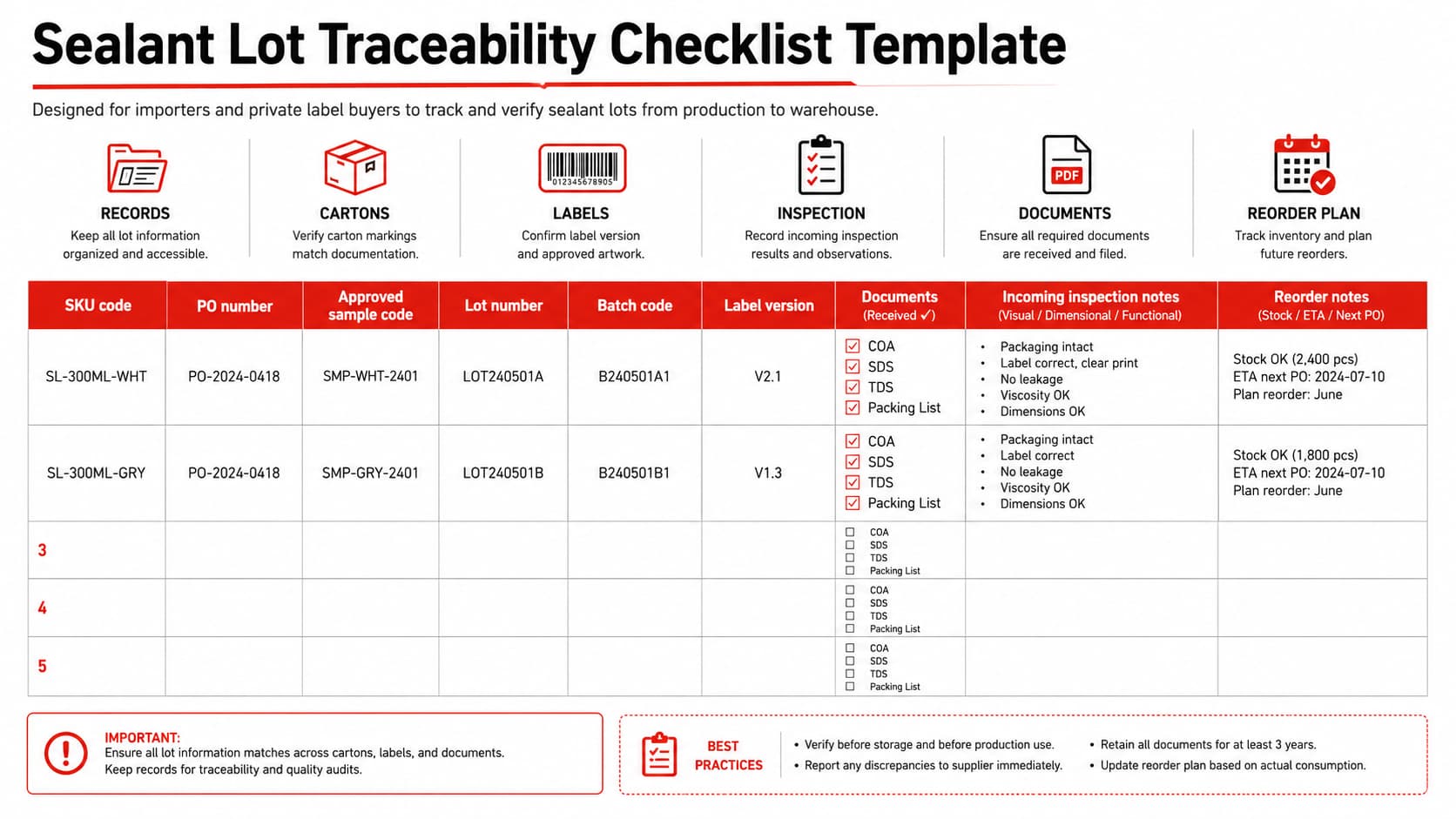
Importers and private label buyers can use the following template to organize lot traceability records for bulk sealant orders.
Traceability Checklist Fields
SKU code:
Product name:
Product category:
Application:
Sales channel:
PO number:
RFQ reference:
Supplier quotation reference:
Approved sample code:
Sample approval date:
Sample approval status:
Lot number:
Batch code:
Production date:
Expiry date / shelf life:
Packaging format:
Unit size:
Color:
Label version:
Private label artwork version:
Barcode / SKU code:
Carton marking:
Carton quantity:
Pallet reference, if used:
Packing list checked: Yes / No
Invoice checked: Yes / No
TDS checked: Yes / No
SDS checked: Yes / No
COA or batch document checked, if provided:
Incoming inspection date:
Inspector:
Warehouse location:
Visible damage or leakage:
Label mismatch notes:
Document issue notes:
Customer feedback reference:
Issue notes:
Reorder notes:
The template can be used as a spreadsheet, internal checklist, QA record, or purchasing file. The format can be adjusted based on the buyer’s internal system, but the key idea is to keep SKU, sample, PO, lot, packaging, document, inspection, and reorder information connected.
For distributors handling many SKUs, a lot traceability checklist can also be added as a separate tab in the SKU matrix. This helps the team review each product range together with sample status, batch records, and reorder history.
Common Traceability Mistakes to Avoid
A traceability checklist is useful only if the information is complete, consistent, and easy to review. Buyers should avoid the following common mistakes.
How Lot Traceability Supports Reorder Review
Lot traceability is not only useful when goods arrive. It also helps buyers prepare future reorders more clearly.
Before reordering, buyers can review:
- Which lot was previously received
- Which sample was approved
- Which packaging version was used
- Which label version was used
- Whether documents were complete
- Whether incoming inspection found issues
- Whether customers reported feedback
- Whether warehouse teams recorded storage or handling notes
- Whether sales teams reported slow-moving products
- Whether any changes are needed before the next order
This review helps prevent repeated mistakes. For example, if the previous lot had unclear carton marking, the buyer can add clearer carton label instructions in the next RFQ or PO. If a private label artwork version was revised, the buyer can confirm the correct version before reordering. If a certain color moved slowly, the buyer can review reorder quantity or market demand before the next purchase.
Lot traceability also helps teams communicate internally. Procurement, QA, warehouse, sales, and management can review the same record rather than relying on scattered messages or memory.
When Should Buyers Contact KINGDELI?
Buyers can contact KINGDELI when they are preparing a bulk sealant order, organizing a private label program, reviewing sample approval status, or planning traceability requirements for future reorders.
Before contacting a supplier, it is helpful to prepare:
- SKU list
- Product categories
- Target applications
- Sales channels
- Packaging formats
- Label language
- Private label artwork status
- Barcode or SKU code requirements
- Approved sample codes
- Sample approval notes
- RFQ or PO reference
- Required documents
- Lot or batch traceability expectations
- Incoming inspection concerns
- Reorder notes if available
If you are preparing a bulk sealant order or private label program, share your SKU list, sample approval status, packaging requirements, label version, document needs, and traceability expectations with KINGDELI for further discussion.
A clear lot traceability checklist helps buyers connect SKU planning, RFQ preparation, sample approval, bulk receiving, incoming inspection, and reorder review in one organized process.
FAQ
What is sealant lot traceability?
Sealant lot traceability is the process of connecting a sealant or adhesive batch with its SKU, product category, approved sample, purchase order, lot number, batch code, packaging version, label version, documents, incoming inspection record, and reorder notes. It helps buyers review which product version was ordered, received, inspected, and used for future purchasing decisions.
What should importers record for sealant batch traceability?
Importers should record the SKU code, product name, product category, application, purchase order number, RFQ reference, approved sample code, lot number, batch code, production date if available, shelf life information, packaging format, color, label version, document status, incoming inspection notes, warehouse location, issue notes, and reorder comments.
How do private label buyers track sealant lot numbers?
Private label buyers should track lot numbers together with the product package, outer carton, label artwork version, barcode, buyer SKU code, supplier product code, packing list, purchase order, sample approval reference, and document records. This helps connect the physical goods with the approved private label requirements.
Should a sealant lot be linked to the approved sample?
Yes. A sealant lot should be linked to the approved sample whenever sample approval was part of the purchasing process. Buyers should record the approved sample code, approval date, packaging version, label version, required changes, and internal reviewer notes so the received bulk lot can be compared with the approved sample record.
What documents support sealant lot traceability?
Documents that may support sealant lot traceability include TDS, SDS, packing list, commercial invoice, sample approval record, label artwork file, packaging specification, test report if required, and COA or batch document if provided. Buyers should confirm which documents are needed before ordering and check them against the received goods.
How can lot traceability help future sealant reorders?
Lot traceability helps future reorders by giving buyers a record of previous SKU, batch, packaging, label, document, inspection, and customer feedback information. Before reordering, procurement and QA teams can review previous lot notes, required changes, slow-moving inventory signals, and supplier communication to make the next order discussion clearer.
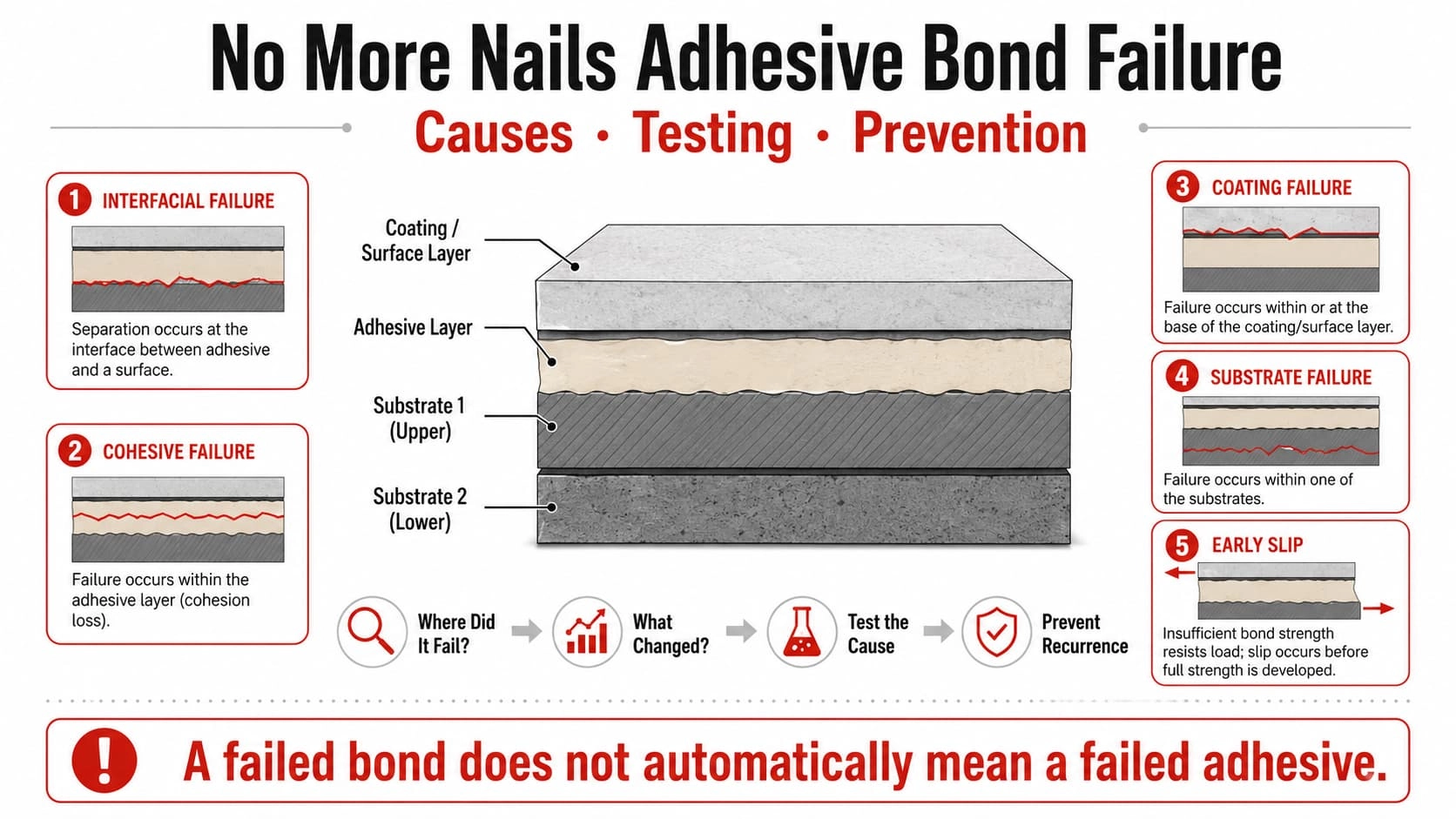
No More Nails Adhesive Bond Failure: Causes, Testing, and Prevention
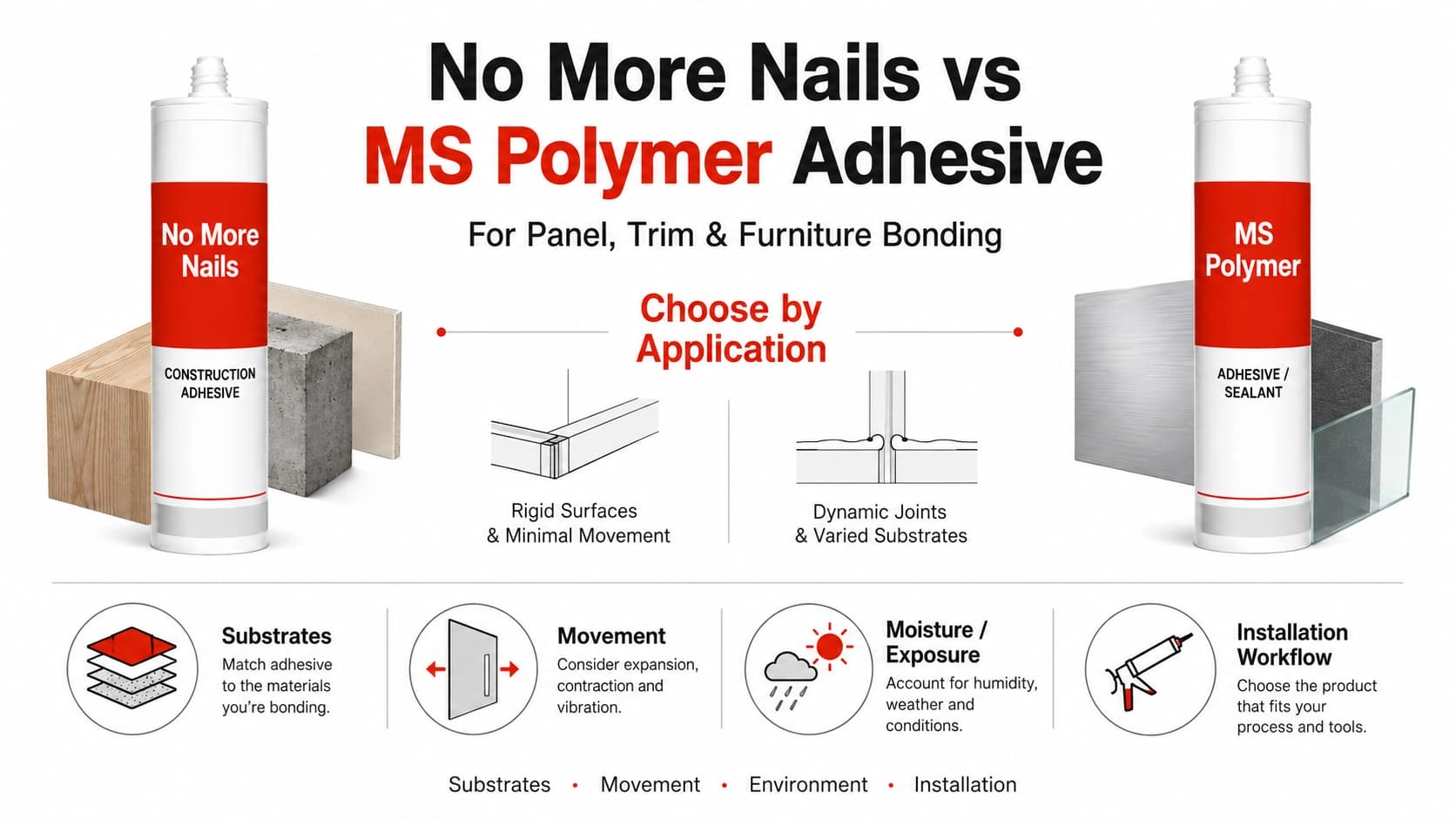
No More Nails vs MS Polymer Adhesive for Panel, Trim, and Furniture Bonding
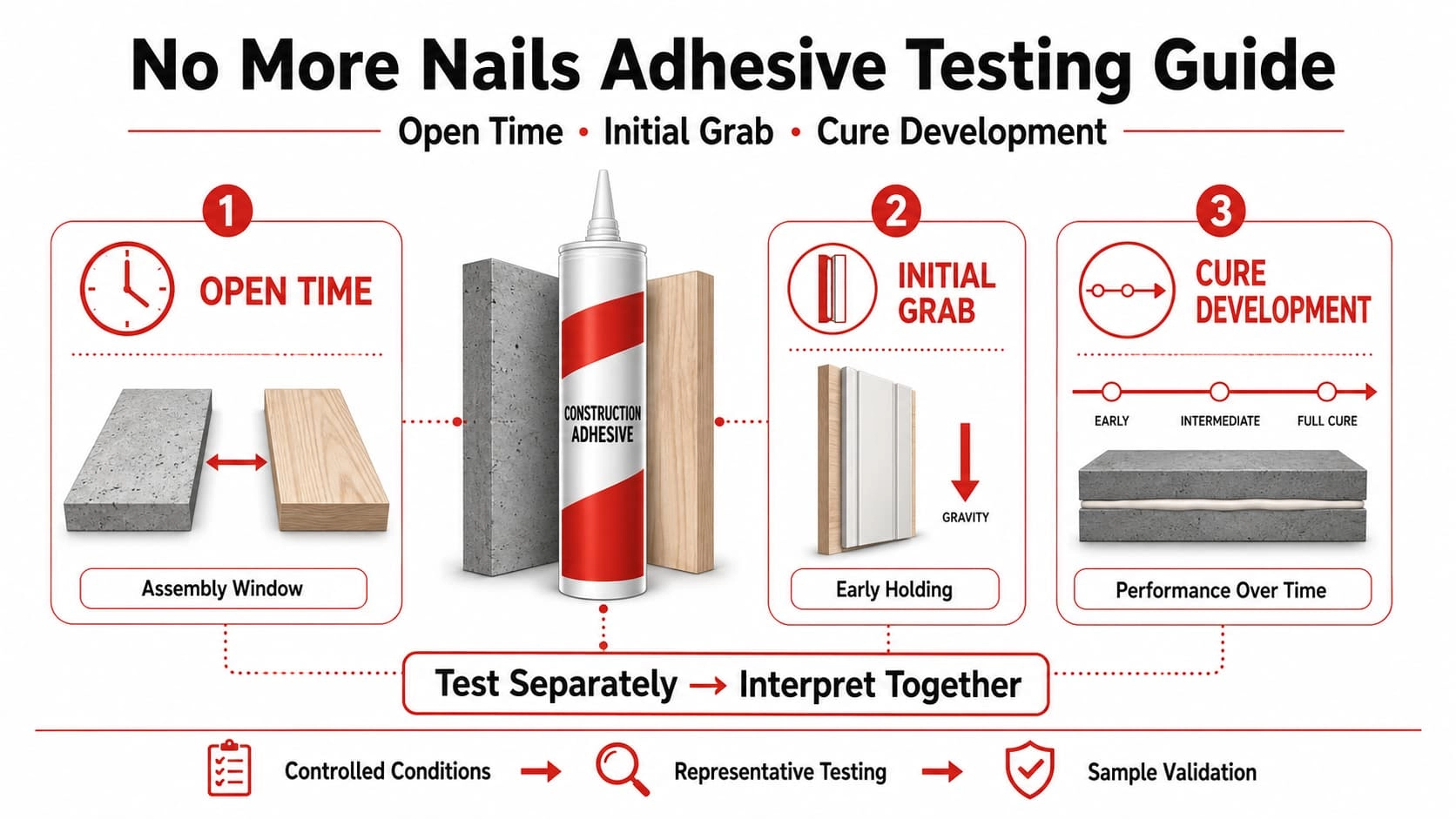
No More Nails Adhesive Open Time, Grab Strength, and Cure Testing Guide
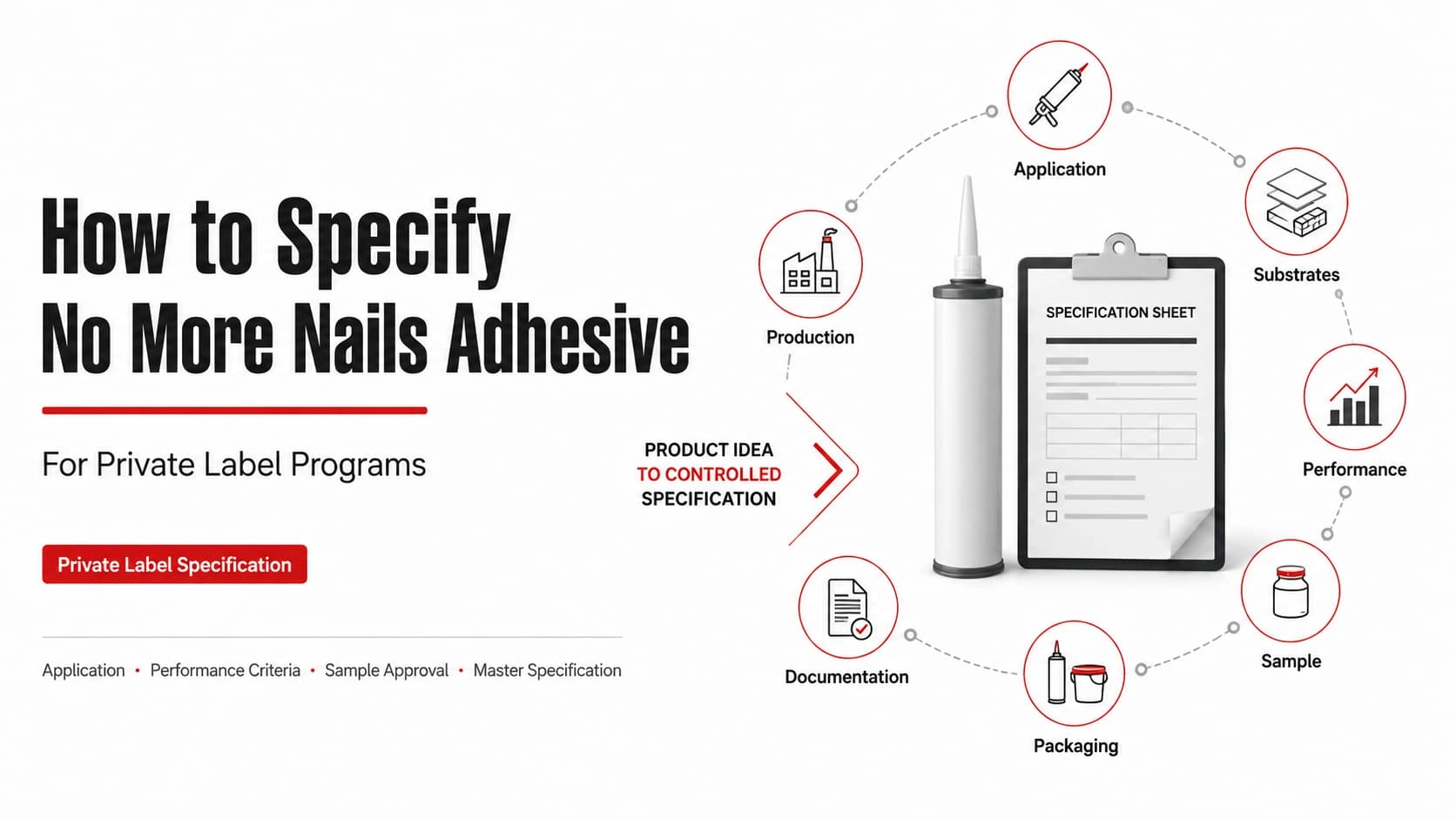
How to Specify No More Nails Adhesive for Private Label Programs

HY992 Modified Polyurethane Construction Sealant
HY992 Modified Polyurethane Sealant is a one-component, moisture-curing construction sealant designed for professional building and structural sealing applications. It provides excellent adhesion, weather resistance, and durable elasticity, making it suitable for a wide range of construction materials.
The formulation delivers strong bonding performance without corrosion or substrate contamination, while maintaining low VOC content for environmentally responsible construction projects.

HY995 Crystal Clear Ms Polymer Adhesive/Sealant
HY995 Crystal Clear Ms Polymer Adhesive/Sealant is a new generation MS Polymer adhesive / sealant formulated for all bonding and sealing applications where long term reliability is required. It has excellent bonding strength on various materials. It will cure to form a durable, flexible, waterproof seal.

HY997 High-Performance Anti-Microbial MS Polymer Sealant
HY997 MS polymer sealant for is is a premium one-component, neutral-curing modified silane sealant engineered for demanding interior applications. It offers a Class 20 movement capability, ensuring long-lasting flexibility and reliable performance under dynamic joint conditions. Curing at room temperature, HY997 delivers superior anti-microbial and mildew-resistant properties, maintaining hygienic and clean environments over time.

KINGDELI HY732 Professional Acetoxy Cure Silicone Sealant
KINGDELI HY732 is a professional-grade, one-component acetoxy cure silicone sealant designed for fast curing, strong adhesion, and long-lasting flexibility. Ideal for aquariums, glass applications, aluminum doors and windows, kitchens, and bathrooms, it provides reliable sealing performance with excellent anti-fungal protection in high-humidity environments.
Let’s Build Stronger Bonds with Quality Adhesives and Sealants
Have questions about the topic or need tailored sealant solutions for your project?
Our team is ready to provide expert guidance, product recommendations, and application support.
Innovating with Integrity, Bonding the World
Since 1998, KINGDELI has delivered trusted, sustainable sealant solutions that connect industries and inspire progress worldwide.

Whatsapp: +8618825946249
Kingdeli
Kingdeli
Kingdeli
Kingdeli
Kingdeli