


No More Nails vs MS Polymer Adhesive for Panel, Trim, and Furniture Bonding
- No More Nails vs MS Polymer: What Is the Main Difference?
- “No More Nails” Does Not Define One Universal Formulation
- MS Polymer Describes a Technology Family
- Quick Comparison: Which Adhesive Fits Which Requirement?
- When Does a No More Nails Adhesive Make More Sense?
- Fixed Decorative and Mounting Applications
- When Installation Behavior Matters More Than Elasticity
- When Does an MS Polymer Adhesive Make More Sense?
- When the Joint Needs Elastic Bonding
- When Bonding Mixed or Less-Porous Materials
- When Moisture or Environmental Exposure Matters
- When Bonding and Sealing Are Both Required
- No More Nails vs MS Polymer for Panel Bonding
- Start With the Panel and Backing Material
- Decorative Panels on Stable Substrates
- Large or Movement-Sensitive Panels
- Panel Bonding May Require a Complete System
- No More Nails vs MS Polymer for Trim and Moulding
- Initial Grab and Temporary Support
- Repositioning and Alignment
- Wall Flatness and Bond-Line Variation
- Visible Finish Matters
- When MS Polymer Becomes More Relevant for Trim
- No More Nails vs MS Polymer for Furniture-Related Bonding
- Furniture Applications That May Be Suitable for Evaluation
- Do Not Assume Either Product Replaces Wood Glue
- Structural Furniture Joints Need Separate Validation
- Compare the Substrates Before You Compare the Adhesives
- Initial Grab, Open Time, Cure, and Flexibility: What Do They Mean for Selection?
- Initial Grab Is an Installation Property, Not the Entire Decision
- Open Time Changes the Workflow
- Cure Must Match the Application Conditions
- Flexibility Has Value Only When Movement Exists
- A 6-Step Selection Process for Buyers
- Step 1 — Define Both Substrates
- Step 2 — Define the Environment
- Step 3 — Define Joint Movement
- Step 4 — Define the Installation Workflow
- Step 5 — Shortlist Exact Product Grades
- Step 6 — Validate on Representative Materials
- What Should Importers and Private-Label Buyers Confirm Before Choosing?
- Common Selection Mistakes
- Assuming MS Polymer Is Automatically Stronger
- Choosing Only by Initial Grab
- Treating All No More Nails Products as the Same Formula
- Ignoring Coatings and Surface Layers
- Treating Every Furniture Joint as a Construction-Adhesive Application
- Related Adhesive Selection Resources
- FAQ: No More Nails vs MS Polymer Adhesive
- Is MS polymer adhesive stronger than No More Nails?
- Can No More Nails be used on non-porous materials?
- Which adhesive is better for wall panels?
- Can MS polymer or No More Nails replace wood glue in furniture manufacturing?
- Choose the Joint, Then Choose the Adhesive
- Discuss Your Adhesive Application
Neither No More Nails adhesive nor MS polymer adhesive is automatically the better choice.
A No More Nails adhesive is often a practical candidate when the joint is primarily a fixed mounting or decorative installation, movement is limited, and the selected product grade is compatible with the substrates and exposure conditions. An MS polymer adhesive becomes more relevant when the joint needs elastic bonding, movement accommodation, broader mixed-material capability, or resistance to more demanding moisture and environmental conditions.
Quick Answer
The better adhesive is the one that matches the joint. Compare the substrates, movement, environment, installation workflow, and exact product grade before deciding between No More Nails and MS polymer.
The final choice should come from the joint itself:
- What are the two substrates?
- Are the surfaces porous, coated, or non-porous?
- Will the materials move, vibrate, expand, or contract?
- Is the application dry, damp, or exposed?
- Does the installer need immediate grab or repositioning time?
- What does the exact product grade allow?
The most useful comparison is not “Which adhesive is stronger?” but “Which adhesive better matches this joint and this installation?”
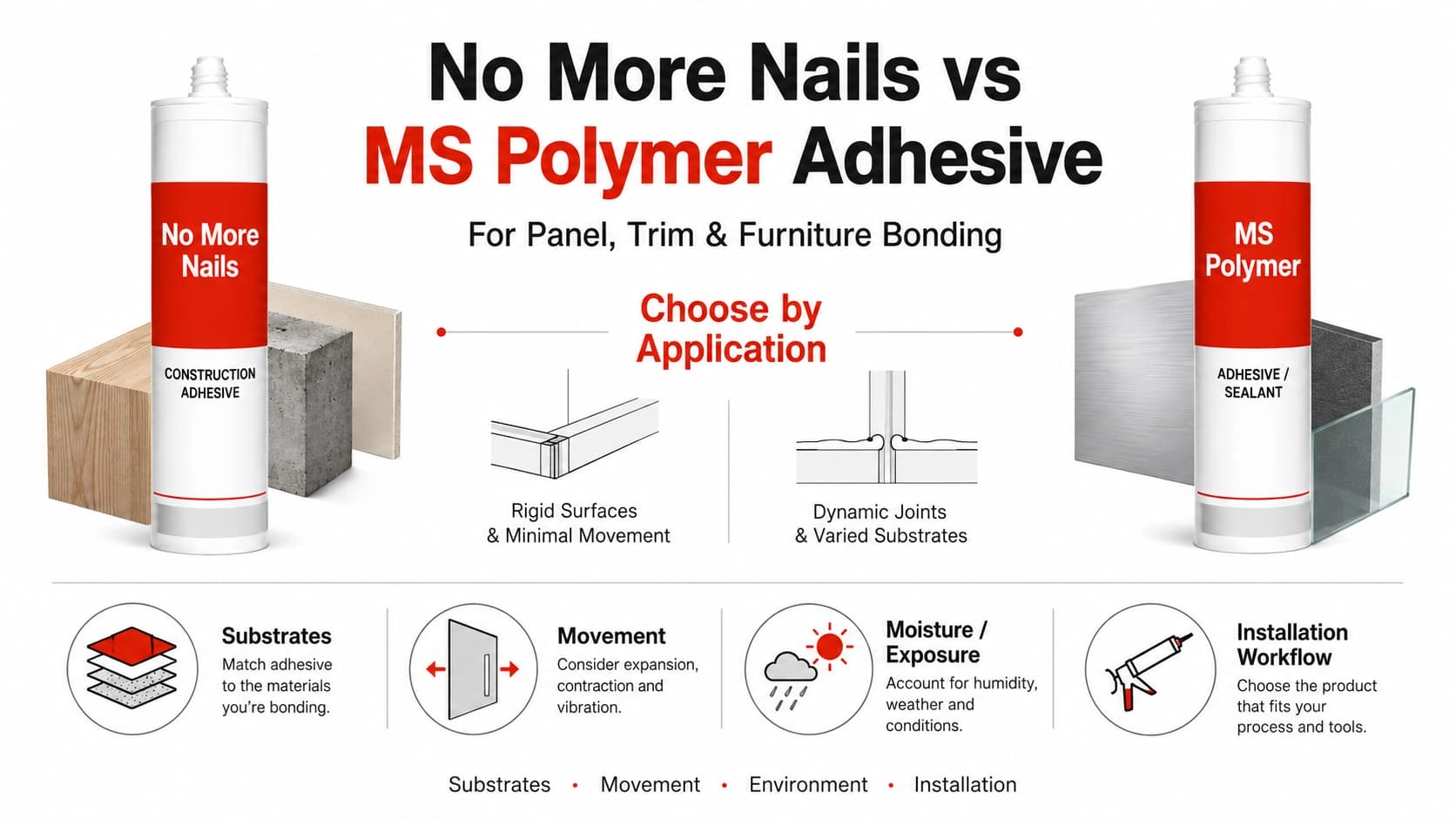
No More Nails vs MS Polymer: What Is the Main Difference?
The two terms describe different levels of product definition.
“No More Nails” is a commercial product or product-family description whose chemistry and performance can vary by grade, while MS polymer describes a polymer technology used in different finished adhesive and sealant formulations. Buyers should therefore compare specific product grades and applications rather than assuming that either name defines one fixed performance profile.
“No More Nails” Does Not Define One Universal Formulation
“No More Nails” should not be treated as one universal chemistry.
Commercial No More Nails ranges can contain different products for different installation requirements, substrates, environments, and performance levels. The name alone does not tell a buyer the exact:
- Chemistry
- Substrate compatibility
- Initial grab
- Working time
- Cure behavior
- Flexibility
- Environmental resistance
The exact product grade still matters. For KINGDELI projects, the No More Nails product category should therefore be treated as a starting point for product selection rather than as a complete technical specification.
MS Polymer Describes a Technology Family
MS polymer describes a polymer technology used in many adhesive and adhesive/sealant formulations.
Many MS polymer adhesives are evaluated for applications involving:
- Mixed materials
- Movement
- Vibration
- Panels
- Moisture
- Bonding and sealing
However, MS polymer still does not define one universal finished product. Different grades can vary in initial grab, elasticity, modulus, cure behavior, substrate compatibility, weather resistance, and intended joint design.
The correct comparison is therefore: specific No More Nails grade vs specific MS polymer adhesive grade for a defined application.
Quick Comparison: Which Adhesive Fits Which Requirement?
The table below is a selection framework rather than a universal product approval.
| Decision Factor | No More Nails Adhesive | MS Polymer Adhesive | Buyer Question |
|---|---|---|---|
| Fixed mounting | Often a practical candidate | Also possible | Is this primarily a stable mounting task? |
| Initial grab | Grade-dependent | Grade-dependent | How much temporary support is acceptable? |
| Repositioning | Grade-dependent | Grade-dependent | Does the installer need adjustment time? |
| Mixed materials | Product-specific | Often a relevant candidate | What exactly are Substrate A and B? |
| Non-porous materials | Exact grade must be checked | Many grades target broader combinations | Are one or both surfaces low-porosity? |
| Joint movement | Product-specific | Elastic grades may offer a better fit | Will the materials move or expand differently? |
| Moisture / exposure | Exact grade must be checked | Many grades target more demanding conditions | Is the installation dry, damp, or exposed? |
| Bonding + sealing | Not universal | Common in some grades | Does the joint also need sealing behavior? |
| Furniture use | Selected mounting / assembly tasks | Selected mounting / assembly tasks | Is this mounting or woodworking joinery? |
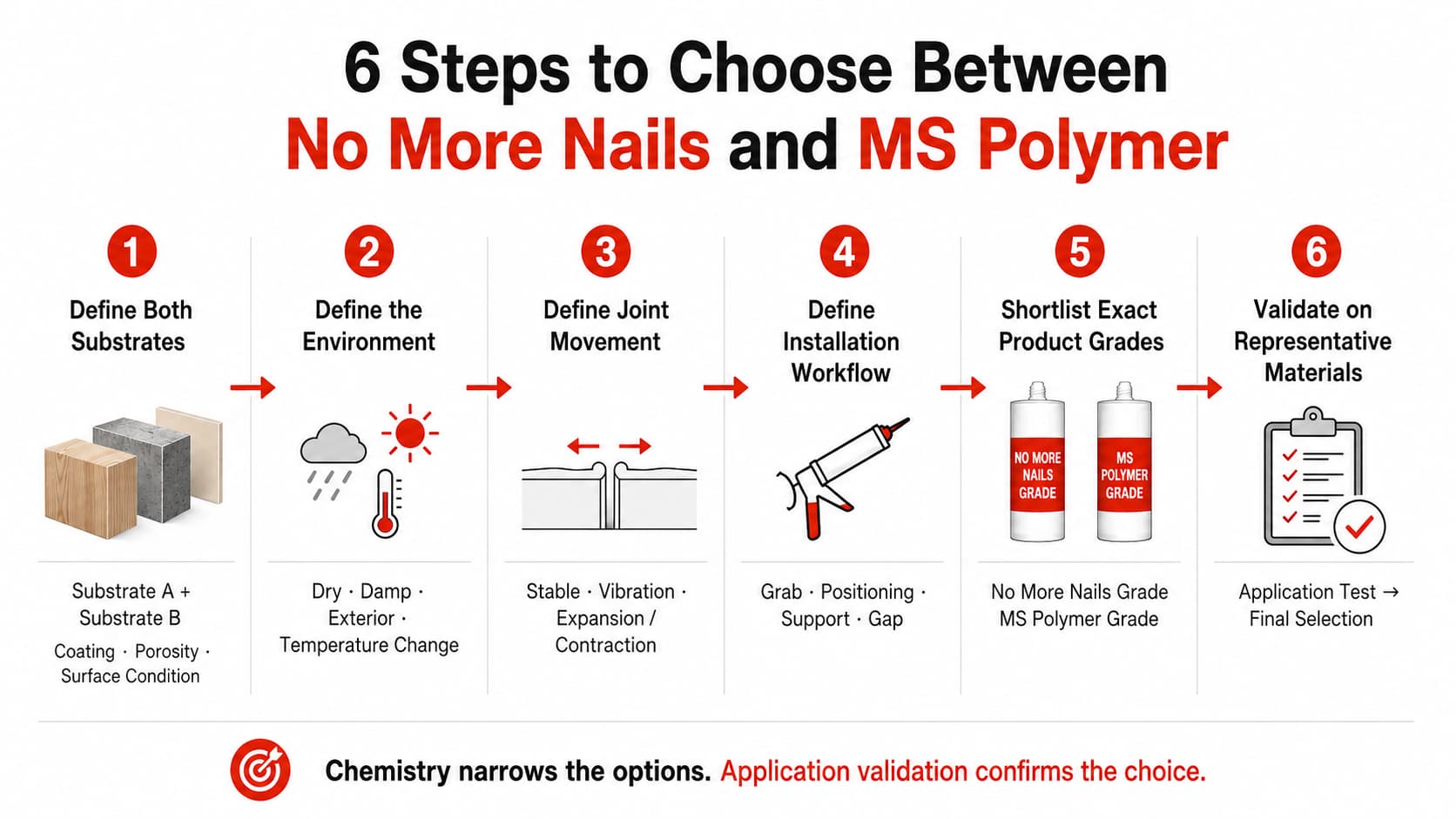
The selection should be based on substrates, movement, environment, installation workflow, and exact product performance, not on product-family reputation.
When Does a No More Nails Adhesive Make More Sense?
A No More Nails construction adhesive is often a practical candidate when the joint is primarily a fixed mounting or decorative installation, movement is limited, and the selected product grade is compatible with the substrates and exposure conditions. In these applications, buyers may place more weight on initial grab, positioning behavior, ease of application, and finish than on high joint elasticity.
Fixed Decorative and Mounting Applications
A purpose-designed No More Nails adhesive can make sense when:
- The bonded components are relatively stable
- The joint is not expected to accommodate significant movement
- The application is primarily mounting or decorative installation
- The product grade is suitable for the actual materials and environment
Potential applications may include selected decorative panels, mouldings, skirting, trim, and other mounting tasks.
The important qualifier is always the same: the exact grade must fit the application.
When Installation Behavior Matters More Than Elasticity
An elastic adhesive is not automatically better. If the joint is stable and movement accommodation is not a major requirement, the installer may care more about:
- Whether the adhesive holds the component in position
- How much adjustment time is available
- Whether temporary support is needed
- How easy the product is to apply
- Whether the visible finish remains clean
In those conditions, a well-matched No More Nails construction adhesive can be entirely appropriate.
When Does an MS Polymer Adhesive Make More Sense?
An MS polymer adhesive becomes a more relevant candidate when the joint conditions place greater value on elasticity, mixed-material bonding, movement accommodation, or environmental resistance.
When the Joint Needs Elastic Bonding
Different materials can expand, contract, or vibrate at different rates. For example:
- Large panels may change dimension with temperature
- Metal and wood-based materials may respond differently to environmental changes
- Installed components may experience vibration or repeated movement
Where the joint needs to accommodate part of that movement, an elastic MS polymer adhesive may offer a better fit than a conventional mounting adhesive. The decision should still be based on the exact joint and product grade.
When Bonding Mixed or Less-Porous Materials
The selection becomes more demanding when the assembly includes combinations such as:
- Metal to coated board
- Composite panel to metal
- Coated trim to tile
- Laminated panel to another low-porosity surface
- Selected plastics or treated materials
Many MS polymer adhesives are developed for broad multi-material bonding, so buyers should include an MS polymer option in the shortlist when the joint contains mixed or less-porous materials. Difficult plastics, coatings, surface treatments, and other specialized materials still require product-level confirmation.
When Moisture or Environmental Exposure Matters
If moisture, weather, or environmental cycling is part of the application, an MS polymer adhesive may become a more relevant candidate. This can include:
- Damp installations
- Exterior applications
- Assemblies exposed to changing weather
- Joints combining movement and moisture exposure
Polymer type alone does not prove suitability. The required exposure should always be checked against the exact product's technical documentation.
When Bonding and Sealing Are Both Required
Some MS polymer products combine adhesive and sealant functions. This can be valuable when a joint needs both bonding and sealing against moisture or air. That is a specific application advantage, not a reason to choose MS polymer for every installation.
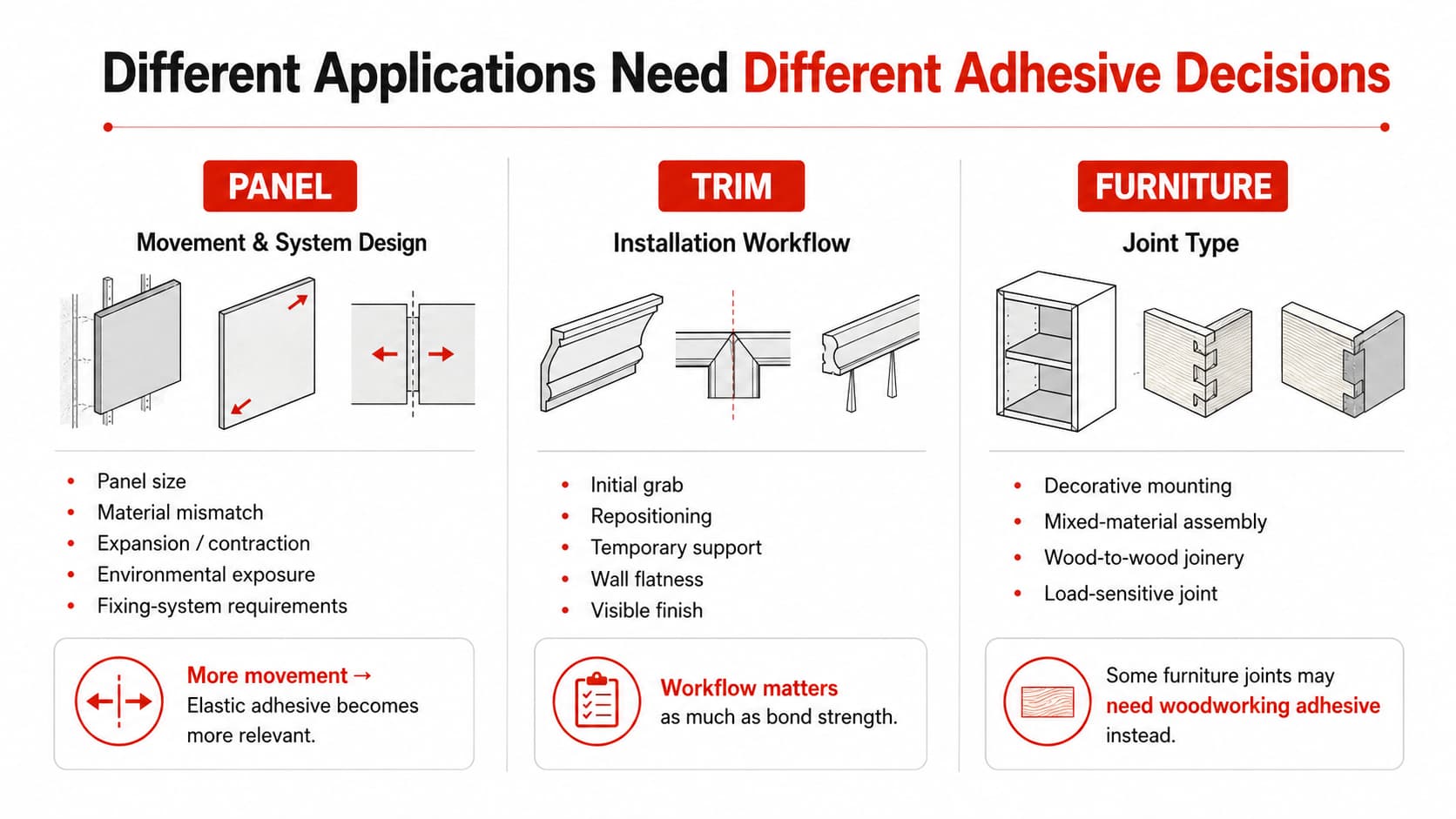
No More Nails vs MS Polymer for Panel Bonding
For small or stable decorative panels on compatible substrates, a purpose-designed No More Nails construction adhesive can be a practical candidate. As panel size, material mismatch, movement, or environmental exposure increase, an elastic MS polymer adhesive becomes more relevant. Large exterior, façade, or load-sensitive panels may require a complete tested fixing system rather than an adhesive-only decision.
This makes panel bonding primarily a question of movement, stress distribution, and system design.
Start With the Panel and Backing Material
Before comparing adhesives, define:
- Panel material
- Backing material
- Coating or finish
- Porosity
- Panel size
- Expected movement
- Environmental exposure
A small decorative wood-based panel installed on a stable backing presents a very different joint from a large composite panel, coated HPL, metal-faced panel, cement-based board, or exterior cladding.
Decorative Panels on Stable Substrates
For relatively stable decorative panels installed on compatible surfaces, No More Nails can be a natural candidate when the selected grade provides the required grab, working behavior, substrate compatibility, cure performance, and environmental suitability.
“Panel adhesive” should not be interpreted as universal compatibility with every panel and wall material.
Large or Movement-Sensitive Panels
As panel size increases, stress becomes more important. Selection factors can include:
- Expansion and contraction
- Different thermal movement between materials
- Panel vibration
- Long bond lines
- Environmental cycling
Where the bonded assembly benefits from an elastic adhesive layer, MS polymer may offer a better fit. The key reason is not simply that MS polymer is “stronger.” It is that elasticity and stress accommodation may become part of the joint design.
Panel Bonding May Require a Complete System
Large exterior panels, façade panels, and load-sensitive assemblies should not be treated as a simple choice between two adhesive cartridges. The fixing system may also involve:
- Substrate preparation
- Primers
- Defined bead geometry
- Temporary fixation
- Mechanical restraint
- Panel-manufacturer instructions
- Engineering requirements
For these applications, adhesive selection is only one part of the system. For broader material-bonding considerations, see KINGDELI's bonding solutions for different building materials.
No More Nails vs MS Polymer for Trim and Moulding
Trim and moulding should be evaluated mainly through the installation workflow.
The critical questions are often:
- Will the trim remain in position after installation?
- Does the installer need time to align it?
- Is the wall flat?
- Will temporary support be needed?
- Is squeeze-out visible?
- Will the final finish remain clean?
Initial Grab and Temporary Support
Long, narrow trim pieces can pull away from uneven surfaces. A suitable No More Nails construction adhesive may fit this workflow well when it provides enough initial grab for the component and substrate combination.
The relevant question is not simply whether the adhesive has “high grab,” but whether it holds the actual trim in the required position with an acceptable amount of temporary support.
Repositioning and Alignment
Trim frequently needs adjustment during installation. For example:
- Moulding may need alignment with adjacent pieces
- Skirting may follow an uneven wall
- Decorative profiles may need visual positioning before the adhesive sets
An adhesive with extremely aggressive initial grab may be helpful in one workflow but inconvenient in another if repositioning is important. The buyer or installer should therefore consider both grab and usable positioning time.
Wall Flatness and Bond-Line Variation
Trim installation often involves imperfect walls. If the backing surface is uneven, consistency, non-sag behavior, gap tolerance, and curing conditions become more relevant to product selection.
This does not automatically mean MS polymer is required. It means the installation geometry should be included in the selection process.
Visible Finish Matters
Trim and moulding are often decorative elements. Installation therefore needs to consider:
- Adhesive squeeze-out
- Surface staining
- Paint compatibility where relevant
- Cleanability during installation
- Visible finish
In trim applications, these practical installation factors may matter as much as maximum laboratory bond strength.
When MS Polymer Becomes More Relevant for Trim
An MS polymer adhesive becomes more relevant when trim applications add requirements such as mixed or difficult materials, significant joint movement, vibration, moisture exposure, or exterior installation. The reason is the change in joint requirements, not because trim automatically belongs to one chemistry family.
No More Nails vs MS Polymer for Furniture-Related Bonding
Furniture-related bonding should first be classified by joint type. Both No More Nails and MS polymer may be suitable for selected mounting and mixed-material assembly tasks, while traditional woodworking joints may require a dedicated woodworking adhesive or another engineered bonding system.
Furniture Applications That May Be Suitable for Evaluation
No More Nails or MS polymer adhesives may be evaluated for selected tasks such as:
- Decorative facing panels
- Furniture trim
- Backing components
- Mixed-material decorative attachments
- Selected metal-to-board components
- Gap-tolerant non-structural mounting
These are primarily mounting or assembly applications.
Do Not Assume Either Product Replaces Wood Glue
A close-fitting wood-to-wood furniture joint presents a different requirement from attaching a decorative panel.
For conventional cabinetmaking, wood joinery, dowel joints, mortise-and-tenon joints, and other close-fitting woodworking assemblies, a dedicated woodworking adhesive may be the more appropriate category.
The fact that an adhesive can bond to wood does not automatically make it the correct adhesive for woodworking.
Structural Furniture Joints Need Separate Validation
Load-sensitive furniture assemblies require additional caution. Examples include:
- Chairs
- Frames
- Structural cabinets
- Load-bearing components
Selection may depend on joint geometry, stress direction, clamping, manufacturing process, long-term loading, and safety requirements. Neither No More Nails nor MS polymer should be assumed suitable solely because it adheres to the materials involved.
Compare the Substrates Before You Compare the Adhesives
The substrate pair often determines which adhesive options are worth evaluating.
| Substrate or Joint | Main Question | Selection Direction |
|---|---|---|
| Wood / MDF | Porous, coated, or laminated? | Both may be candidates depending on grade |
| Drywall / plaster | Is the surface stable? | Mounting adhesive can be practical if compatible |
| Painted surface | Is the coating firmly bonded? | Surface-layer strength may control the result |
| Metal | What is the second material? | MS polymer is often worth evaluating |
| Ceramic / stone | What load and exposure are expected? | Product-specific validation |
| Plastic | Which exact polymer? | Always verify compatibility |
| Composite panel | Large, coated, or movement-sensitive? | Elastic adhesive may gain relevance |
| Porous + non-porous | How does the product cure? | Check exact grade and application guidance |
| Two non-porous surfaces | Can the selected adhesive cure correctly? | Product-level validation is essential |
Substrate compatibility includes more than the base material. The actual bonding surface may be paint, coating, laminate, primer, oxide layer, contamination, or weak plaster.
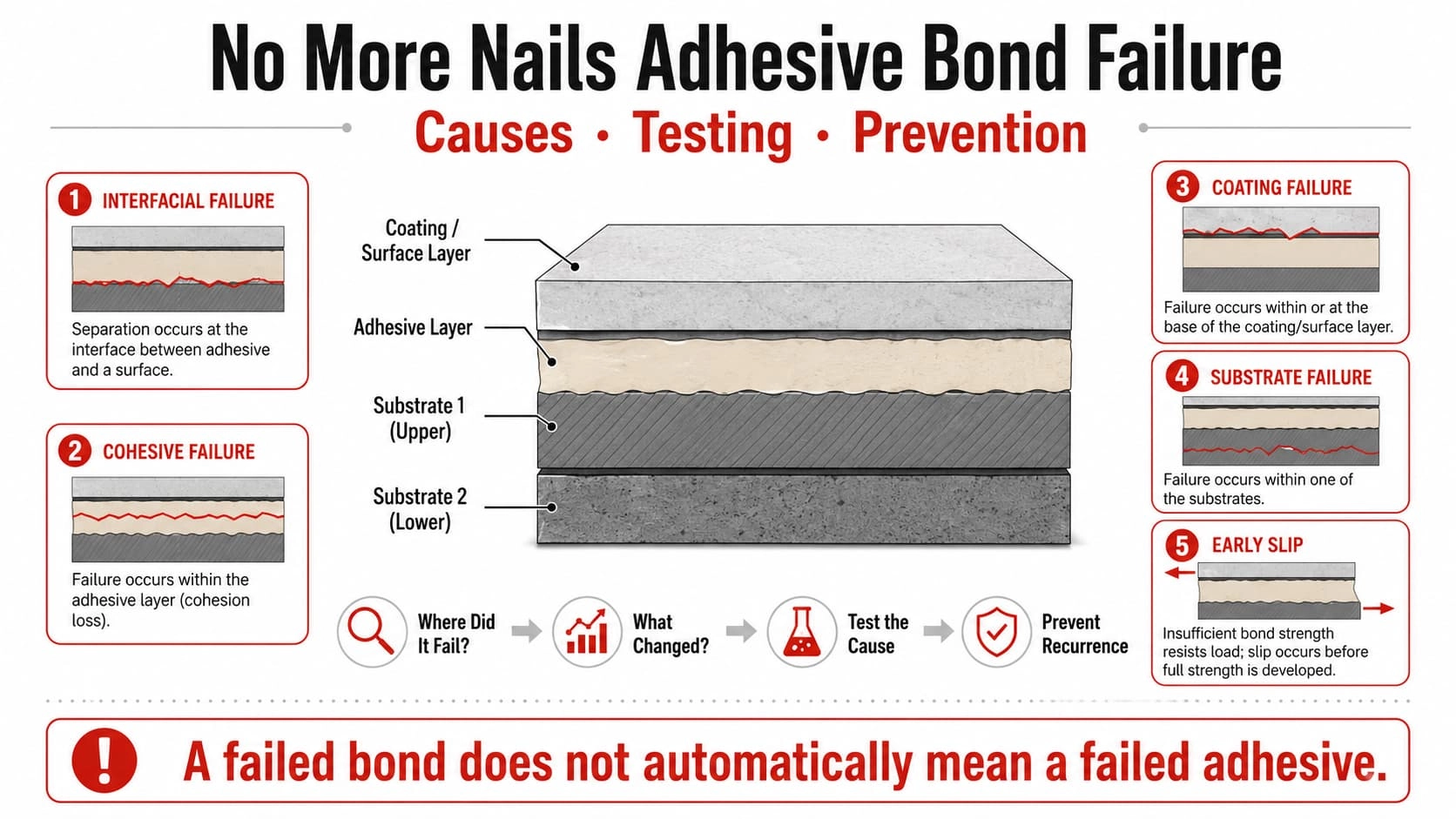
The adhesive can only perform as reliably as the layer to which it is attached. For example, an adhesive may bond securely to a painted wall while the paint itself separates from the underlying surface. That is a substrate-system failure, not necessarily an adhesive failure.
Initial Grab, Open Time, Cure, and Flexibility: What Do They Mean for Selection?
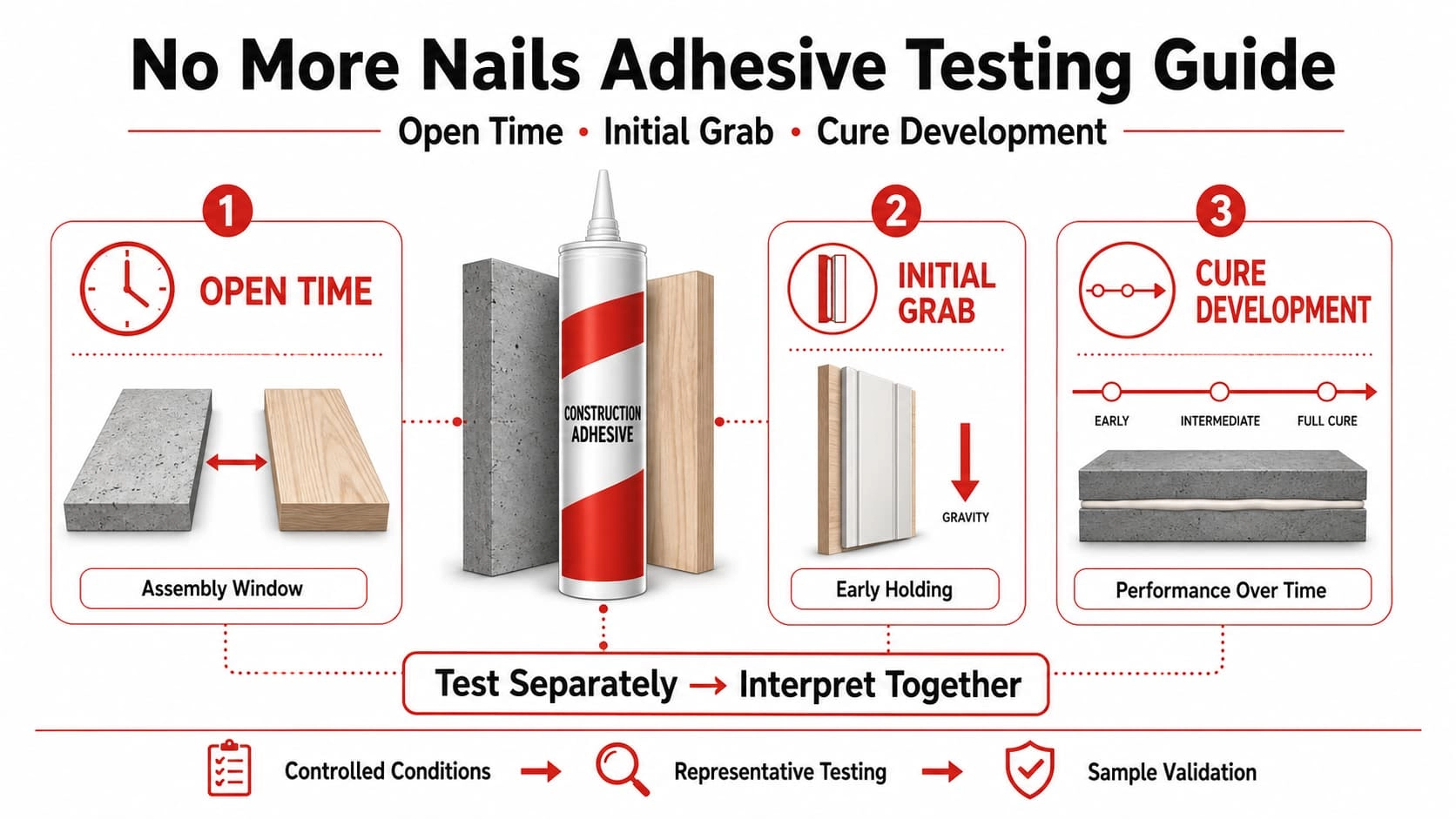
These properties matter because they affect how the adhesive fits the application. Detailed testing belongs in a dedicated testing process; for selection, buyers mainly need to understand what each factor changes in the installation or joint.
| Factor | Why It Matters to Selection |
|---|---|
| Initial grab | Affects temporary support and how quickly components stay in place |
| Open / positioning time | Affects alignment, adjustment, and installer workflow |
| Cure behavior | Affects handling time, validation schedule, and compatibility with application conditions |
| Flexibility | Matters when the bonded materials move, vibrate, expand, or contract |
Initial Grab Is an Installation Property, Not the Entire Decision
High initial grab can reduce temporary support. It does not by itself prove long-term adhesion, movement capability, environmental durability, or substrate compatibility.
Both No More Nails and MS polymer product families can contain high-grab grades.
Open Time Changes the Workflow
Longer working time can help with panel alignment, trim positioning, and large components. Faster positioning may be preferable in other installations. Neither is automatically better.
Cure Must Match the Application Conditions
Cure behavior can be influenced by chemistry, temperature, humidity, bond-line thickness, and substrate porosity. Exact product guidance should be used when comparing shortlisted grades.
Flexibility Has Value Only When Movement Exists
Elasticity is valuable where the joint needs movement accommodation. For stable decorative installations, it may be less important than grab, positioning, application behavior, or appearance.
A 6-Step Selection Process for Buyers
To choose between No More Nails and MS polymer adhesive, first define the exact substrates, environment, joint movement, and installation workflow. Then shortlist specific product grades and validate them on representative materials. Chemistry should narrow the options; application validation should confirm the final choice.
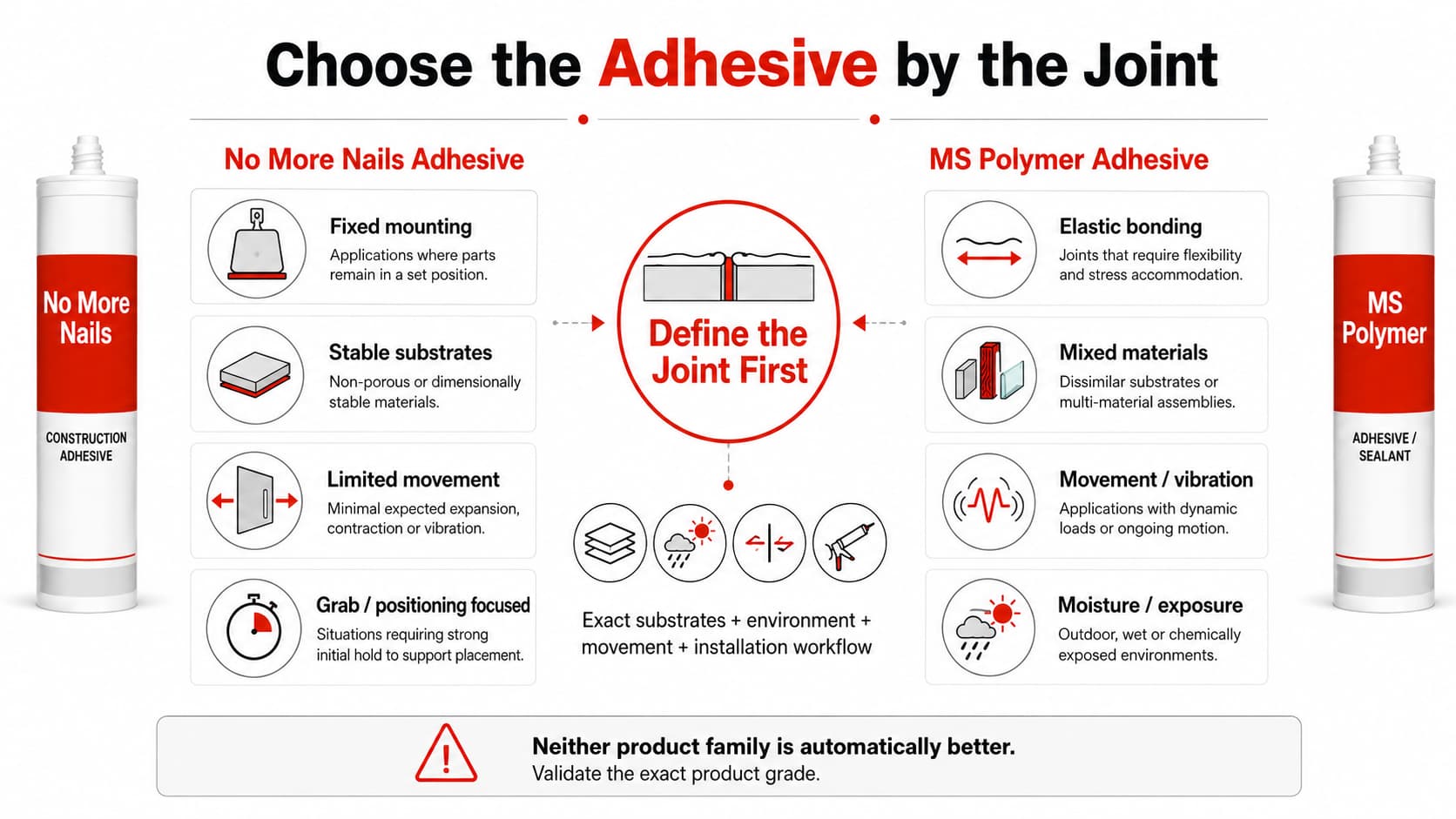
Step 1 — Define Both Substrates
Record:
- Substrate A
- Substrate B
- Coatings
- Porosity
- Surface treatment
- Actual surface condition
Avoid vague descriptions such as “panel to wall” when the real materials are known.
Step 2 — Define the Environment
Confirm whether the application is:
- Dry interior
- Humid
- Moisture-exposed
- Exterior
- Subject to significant temperature changes
Only include conditions relevant to the actual project.
Step 3 — Define Joint Movement
Determine whether the materials are expected to:
- Remain stable
- Vibrate
- Expand or contract
- Move at different rates
This determines how important adhesive elasticity may be.
Step 4 — Define the Installation Workflow
Consider:
- Initial grab
- Repositioning
- Temporary support
- Alignment
- Bond-line variation
- Non-sag behavior
- Dispensing
Step 5 — Shortlist Exact Product Grades
Do not stop at “No More Nails” or “MS polymer.” Move to specific candidate products and review intended applications, recommended substrates, technical documentation, limitations, application method, and cure requirements.
KINGDELI currently has both a No More Nails adhesive range and an MS polymer sealant and adhesive range for project-level evaluation.
Step 6 — Validate on Representative Materials
Final selection should be checked using:
- Representative substrates
- Realistic surface preparation
- Intended bond geometry
- Relevant application conditions
- Agreed performance observations or acceptance criteria
The product family helps create the shortlist. The application test confirms the final decision.
What Should Importers and Private-Label Buyers Confirm Before Choosing?
Importers and private-label buyers comparing No More Nails and MS polymer do not need to create a complete OEM specification at this stage. They first need enough information to decide which product route should move forward.
Buyer Comparison Checklist
- Exact substrate pair: What are Substrate A and Substrate B, including coatings or finishes?
- Environment: Is the joint dry, damp, exterior, or exposed to temperature change?
- Movement: Will the materials remain stable or move independently?
- Installation behavior: How important are grab, repositioning, non-sag behavior, and temporary support?
- Exact candidate product grade: Which No More Nails or MS polymer product is actually being proposed?
- Validation and documentation: What technical information and representative sample testing will be used to confirm the choice?
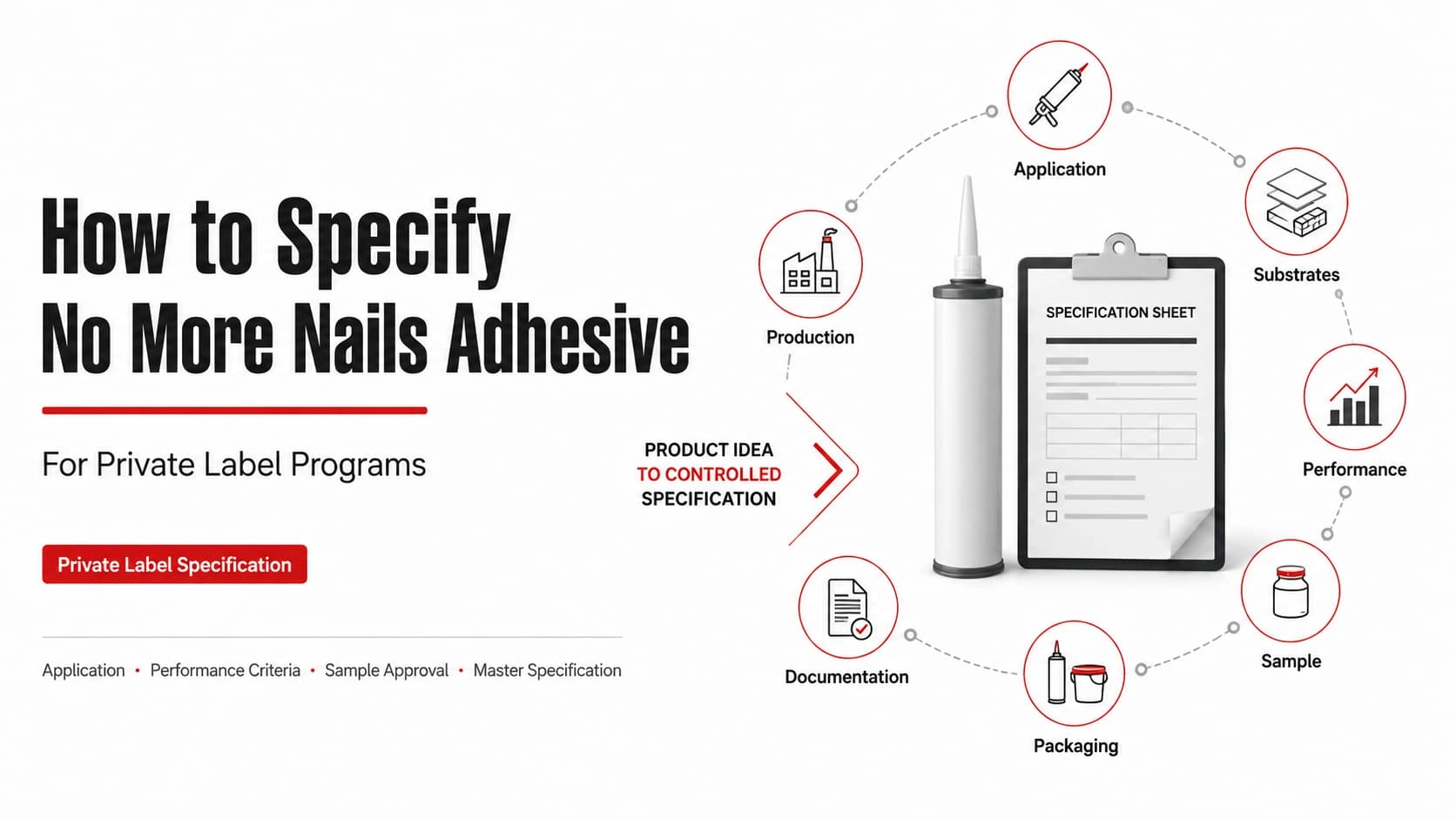
Once the preferred route has been selected, those requirements can be developed into a controlled product specification for sampling, private-label development, or production.
For that next stage, see how to define a private-label No More Nails adhesive specification or review KINGDELI's OEM and ODM adhesive development.
Common Selection Mistakes
Assuming MS Polymer Is Automatically Stronger
It is not valid to say that every MS polymer adhesive is stronger than every No More Nails adhesive. Bond performance depends on the exact product, substrate, cure conditions, joint geometry, and test method. Elasticity and strength are also different properties.
Choosing Only by Initial Grab
Initial grab mainly affects installation. It does not prove long-term compatibility, environmental durability, movement capability, or final bond performance.
Treating All No More Nails Products as the Same Formula
Different grades can have different application and performance profiles. The exact product should always be part of the selection decision.
Ignoring Coatings and Surface Layers
A painted or coated substrate should not be treated as the bare material underneath. The weakest layer may be paint, coating, weak plaster, or contamination. Surface condition therefore belongs in the adhesive decision.
Treating Every Furniture Joint as a Construction-Adhesive Application
First determine whether the task is mounting, decorative attachment, mixed-material assembly, woodworking joinery, or structural bonding. Only then choose the adhesive category.
Related Adhesive Selection Resources
Compare KINGDELI's No More Nails adhesive range with its MS polymer sealant and adhesive range.
For application-oriented material bonding, review KINGDELI bonding solutions for different building materials.
If the project will move into private-label development, use the Private Label No More Nails Adhesive Specification Guide to turn the selected product route into a controlled development brief.
FAQ: No More Nails vs MS Polymer Adhesive
Is MS polymer adhesive stronger than No More Nails?
Not necessarily. Strength depends on the exact products, substrates, cure conditions, joint geometry, and test method. MS polymer may provide a better fit when elastic bonding or movement accommodation is important, but that does not make every MS polymer adhesive stronger than every No More Nails product.
Can No More Nails be used on non-porous materials?
It depends on the exact product grade and substrate combination. Buyers should check product-specific technical guidance and validate coated, metal, plastic, glass, or other low-porosity surfaces rather than assuming that all No More Nails adhesives have the same compatibility.
Which adhesive is better for wall panels?
For a stable decorative panel installed on compatible substrates, a purpose-designed No More Nails adhesive can be a practical candidate. As panel size, material mismatch, movement, moisture, or environmental exposure increase, an elastic MS polymer adhesive becomes more relevant. Large exterior, façade, or load-sensitive panels may require a complete fixing system rather than an adhesive-only decision.
Can MS polymer or No More Nails replace wood glue in furniture manufacturing?
Not for every furniture joint. Both may be useful for selected panels, trim, mounting, and mixed-material assembly, but close-fitting wood-to-wood joinery, cabinetmaking, or load-sensitive furniture joints may require a dedicated woodworking adhesive or another engineered bonding system.
Choose the Joint, Then Choose the Adhesive
The better adhesive is the one that matches the joint—not the one with the stronger product-family reputation.
A No More Nails adhesive can be a practical choice for stable mounting, trim, and compatible decorative-panel applications where joint movement is limited and the exact grade fits the materials and exposure conditions.
An MS polymer adhesive becomes more relevant where the application involves elastic bonding, movement, mixed materials, vibration, moisture or environmental exposure, or more demanding panel conditions.
Define the substrates → define the environment → define movement → define the installation workflow → shortlist exact product grades → validate the final choice.
KINGDELI offers both No More Nails and MS polymer adhesive product categories. The exact chemistry, product grade, substrate compatibility, technical performance, and application limits should be confirmed for the individual product and project.
Discuss Your Adhesive Application
Send the two substrates, surface condition, installation environment, expected joint movement, application method, and required installation behavior. KINGDELI can then evaluate whether a No More Nails adhesive, MS polymer adhesive, or another product route should move forward for technical discussion and sample validation.
No More Nails Adhesive Bond Failure: Causes, Testing, and Prevention
No More Nails vs MS Polymer Adhesive for Panel, Trim, and Furniture Bonding
No More Nails Adhesive Open Time, Grab Strength, and Cure Testing Guide
How to Specify No More Nails Adhesive for Private Label Programs

HY992 Modified Polyurethane Construction Sealant
HY992 Modified Polyurethane Sealant is a one-component, moisture-curing construction sealant designed for professional building and structural sealing applications. It provides excellent adhesion, weather resistance, and durable elasticity, making it suitable for a wide range of construction materials.
The formulation delivers strong bonding performance without corrosion or substrate contamination, while maintaining low VOC content for environmentally responsible construction projects.

HY995 Crystal Clear Ms Polymer Adhesive/Sealant
HY995 Crystal Clear Ms Polymer Adhesive/Sealant is a new generation MS Polymer adhesive / sealant formulated for all bonding and sealing applications where long term reliability is required. It has excellent bonding strength on various materials. It will cure to form a durable, flexible, waterproof seal.

HY997 High-Performance Anti-Microbial MS Polymer Sealant
HY997 MS polymer sealant for is is a premium one-component, neutral-curing modified silane sealant engineered for demanding interior applications. It offers a Class 20 movement capability, ensuring long-lasting flexibility and reliable performance under dynamic joint conditions. Curing at room temperature, HY997 delivers superior anti-microbial and mildew-resistant properties, maintaining hygienic and clean environments over time.

KINGDELI HY732 Professional Acetoxy Cure Silicone Sealant
KINGDELI HY732 is a professional-grade, one-component acetoxy cure silicone sealant designed for fast curing, strong adhesion, and long-lasting flexibility. Ideal for aquariums, glass applications, aluminum doors and windows, kitchens, and bathrooms, it provides reliable sealing performance with excellent anti-fungal protection in high-humidity environments.
Let’s Build Stronger Bonds with Quality Adhesives and Sealants
Have questions about the topic or need tailored sealant solutions for your project?
Our team is ready to provide expert guidance, product recommendations, and application support.
Innovating with Integrity, Bonding the World
Since 1998, KINGDELI has delivered trusted, sustainable sealant solutions that connect industries and inspire progress worldwide.

Whatsapp: +8618825946249
Kingdeli
Kingdeli
Kingdeli
Kingdeli
Kingdeli