


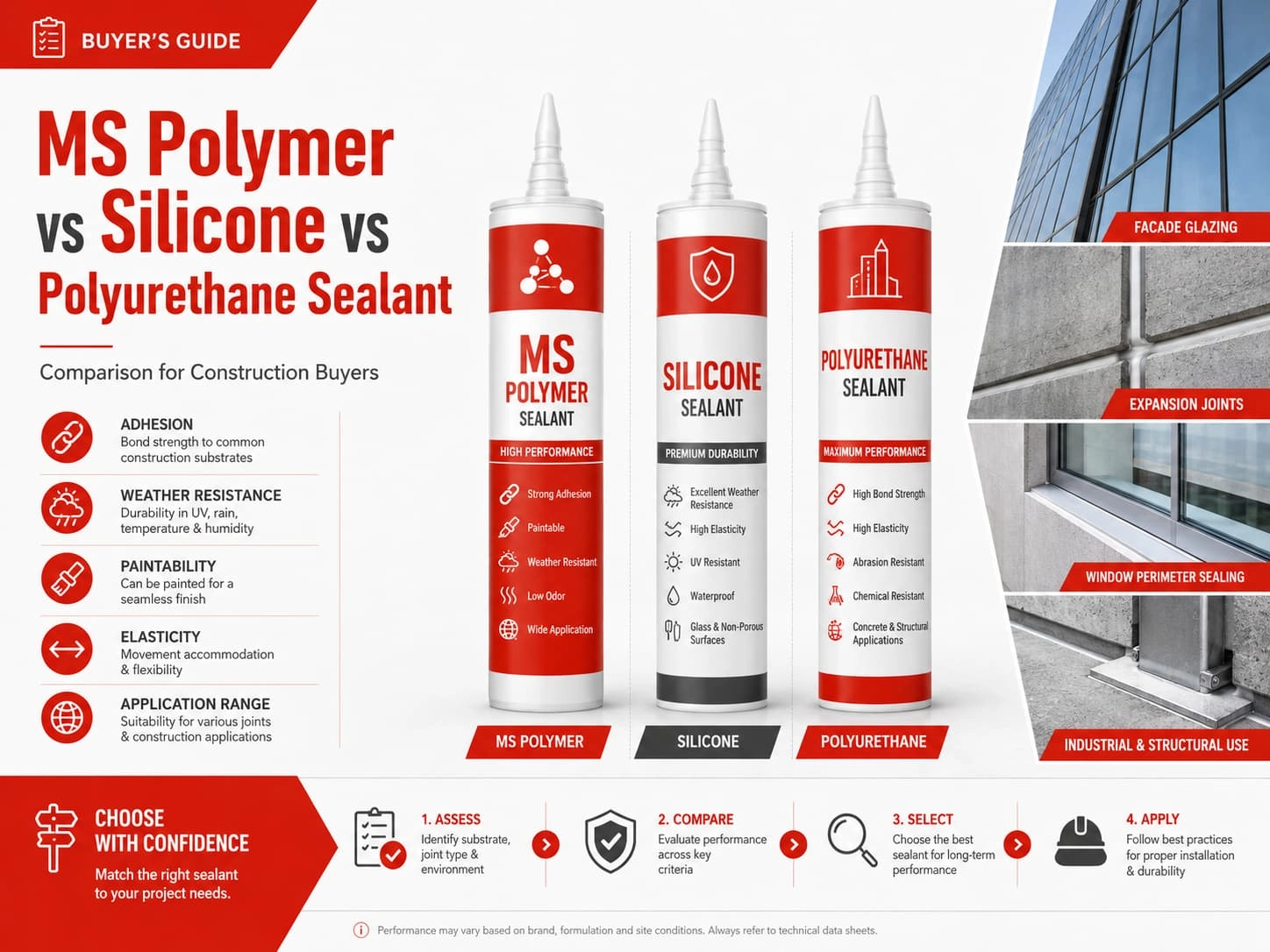
Quick answer: MS polymer sealant is usually the better choice when you need paintability, broad adhesion, low odor, and lower staining risk on stone or facade joints. Silicone remains excellent for glazing, sanitary sealing, and UV-exposed joints that will not be painted. Polyurethane is still useful for heavy-duty construction bonding where high mechanical strength is the priority, though it may need UV protection and careful safety handling around isocyanates. The right choice depends on your substrate, paintability requirement, UV exposure, and the specific product's TDS — not on which chemistry has the better reputation.
You need glazing, sanitary, or aquarium joints that will not be painted.
You need heavy-duty structural bonding on concrete or metal.
You need paintable facade joints, stone sealing, or low-odor indoor work.

Understanding the Three Chemistries
Distributors and specifiers have historically had to choose between two dominant families — silicone and polyurethane — each with a specific trade-off. Modified Silane (MS) polymer was developed later as a hybrid technology intended to close the gap between them. Here's what each actually does well, and where each falls short.
Silicone Sealant
Silicone's inorganic backbone gives it excellent resistance to UV rays and temperature extremes, so cured joints do not easily crack or degrade in direct sun. Its main limitation is surface energy: standard silicone rejects most paints, so architectural joints that need to be painted over typically cannot use it. Depending on the cure chemistry, odor and substrate compatibility also vary. See our Acetic Silicone Sealant and Neutral Silicone Sealant ranges for the difference.
Polyurethane (PU) Sealant
PU is a long-established choice for structural bonding, with strong grab on concrete and metal and full paintability. Its main limitation is UV exposure: as an organic compound, PU can yellow, chalk, and eventually crack under prolonged direct sunlight without a protective coating or paint layer. Some PU systems may also involve isocyanate chemistry, so ventilation, PPE, and local safety requirements should be checked before indoor use. See our full guide to polyurethane sealant uses, pros, and cons for the complete picture.
MS Polymer Sealant
Modified Silane polymer was engineered to combine silicone's UV resistance and flexibility with polyurethane's paintability and bonding strength. It is generally isocyanate-free and low odor, and it tends to perform well on a broader range of substrates than either legacy chemistry alone — though, as with any sealant family, actual performance still depends on the specific formulation, so checking the product's TDS matters more than the technology label. For the full technical breakdown, see our MS Polymer Sealant Professional Guide.
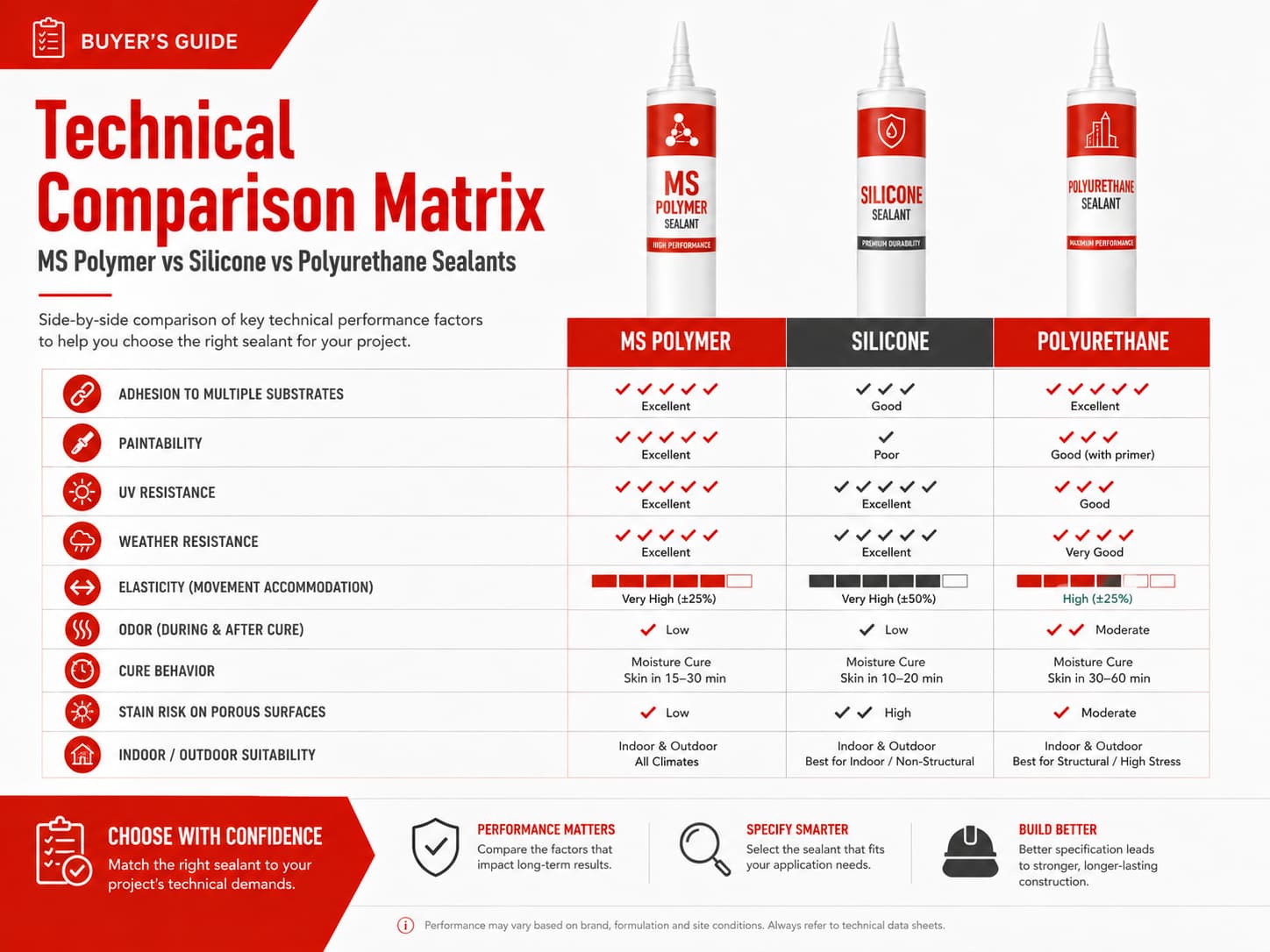
MS Polymer vs Silicone vs PU: Technical Comparison Table
| Factor | Silicone Sealant | Polyurethane Sealant | MS Polymer Sealant |
|---|---|---|---|
| Paintability | Usually poor. | Good. | Good to excellent. |
| UV resistance | Excellent. | Moderate to good, may need coating. | Good to excellent. |
| Adhesion range | Strong on glass and smooth substrates. | Strong on concrete, metal, and porous substrates. | Broad adhesion across many substrates. |
| Odor / safety | Depends on cure type, such as acetic vs. neutral. | Some systems may involve isocyanate chemistry. | Usually low odor and isocyanate-free. |
| Stone staining risk | Possible with some formulas due to oil migration. | Lower in many cases. | Often preferred for non-staining stone applications. |
| Damp surface tolerance | Product-dependent. | Product-dependent; bubbling can occur in some systems. | Often better, but confirm by TDS. |
| Shrinkage | Low. | Higher in some solvent-diluted formulas. | Low shrinkage in quality, undiluted formulations; check the product TDS. |
| Best for | Glazing, sanitary, UV-exposed unpainted joints. | Heavy-duty structural bonding. | Paintable facade joints, stone, hybrid bonding. |
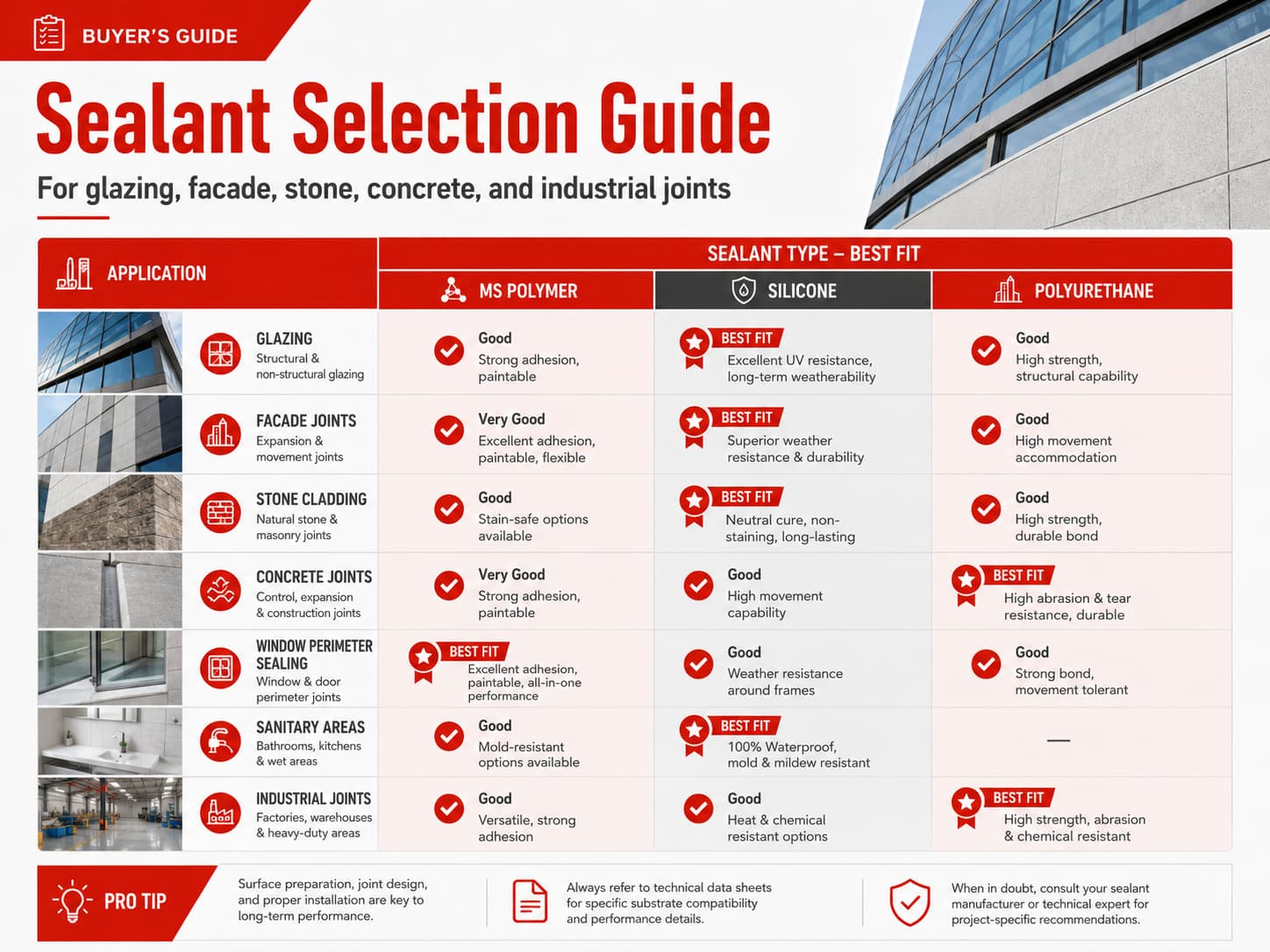
Which Sealant Should You Choose by Application?
Chemistry comparisons matter less to most buyers than a direct answer: for my project, which one?
| Project Need | Better Choice | Why |
|---|---|---|
| Glass glazing, aquarium, sanitary joints | Silicone | Strong adhesion to glass, excellent UV and water resistance. |
| Paintable exterior facade joints | MS Polymer | Paintable, flexible, broad adhesion. |
| Natural stone or marble sealing | MS Polymer | Lower staining risk in suitable formulations. |
| Heavy-duty concrete bonding | PU or MS Polymer | Depends on required strength, UV exposure, and joint movement. |
| Indoor, low-odor projects such as hospitals and schools | MS Polymer | Low odor, often isocyanate-free. |
| Sun-exposed structural movement joints | MS Polymer or Silicone | Depends on whether the joint needs to be painted. |
| Budget hidden joints that are not weather-exposed | PU, acrylic, or silicone | Depends on exposure and performance requirements. |
Paintability, UV Resistance, and Stone Staining Compared
Paintability
Many paintable MS polymer formulations are designed to accept common architectural coatings more reliably than standard silicone, which often causes paint to bead or peel. This is the deciding factor for architectural facades where the sealant needs to disappear under a painted finish. Paint compatibility should still be confirmed on the product TDS or by field testing.
UV and Weathering
In direct, sustained UV exposure, unprotected PU is the chemistry most likely to chalk and lose elasticity over time, eventually requiring resealing. MS polymer's UV resistance is generally closer to silicone's than to PU's, making it a strong candidate for exposed high-rise facade joints — though actual weathering performance still varies by formulation and should be checked against the product's accelerated weathering test data.
Stone Staining
A known issue with some silicone formulations is fluid migration: unreacted silicone oils can slowly migrate into porous stone like marble, granite, or limestone, leaving a visible dark stain around the joint over time. Many non-staining MS polymer formulations are designed to reduce oil migration risk on porous stone, but project-specific compatibility testing is still recommended for marble, granite, and limestone. See our detailed breakdown in Why MS Polymer Sealant Works for Paintable and Non-Staining Joints.
Damp Surface Adhesion, Odor, and Shrinkage Compared
Working on damp surfaces. Rain or morning dew can stall a job site, since many silicone and PU systems need a dry substrate for reliable adhesion, and some PU formulations can bubble if applied to a damp surface. Many MS polymer formulations tolerate damp substrates better and often bond without a primer — though for joints that will face permanent water immersion, a primer is still generally recommended regardless of chemistry.
Indoor odor and air quality. Some polyurethane systems may involve isocyanate chemistry, so ventilation, PPE, and local safety requirements should be checked before indoor use. MS polymer sealants are typically isocyanate-free and low-VOC, which is why they are a common specification for hospitals, schools, and other indoor air quality-sensitive environments. See The Eco-Friendly Advantage: Why MS Polymer Sealant Supports Green Building Goals.
Shrinkage and cracking. Lower-cost PU and silicone products are sometimes diluted with solvents that evaporate as the joint cures, causing the sealant to shrink and pull away from the joint edges over time. This is a formulation-quality issue more than a chemistry-family issue. A well-formulated, undiluted product in any of the three families should be evaluated by its stated shrinkage value on the TDS rather than assumed based on chemistry alone.
When Not to Choose MS Polymer Sealant
MS polymer is a strong general-purpose option, but it is not the automatic right answer for every joint:
- Do not default to it for structural glazing unless the specific product is explicitly certified for structural glass applications.
- Do not assume it is suitable for permanent underwater immersion unless the TDS specifically confirms it.
- Do not exceed the product's stated temperature range — verify against the TDS rather than a general "excellent weather resistance" claim.
- Do not apply it to untested plastics, oily surfaces, or degraded concrete without a compatibility test first.
- Do not treat "MS polymer" as a substitute for engineering specification — confirm movement class, tensile strength, and certifications on the actual product's TDS before switching from an incumbent chemistry.
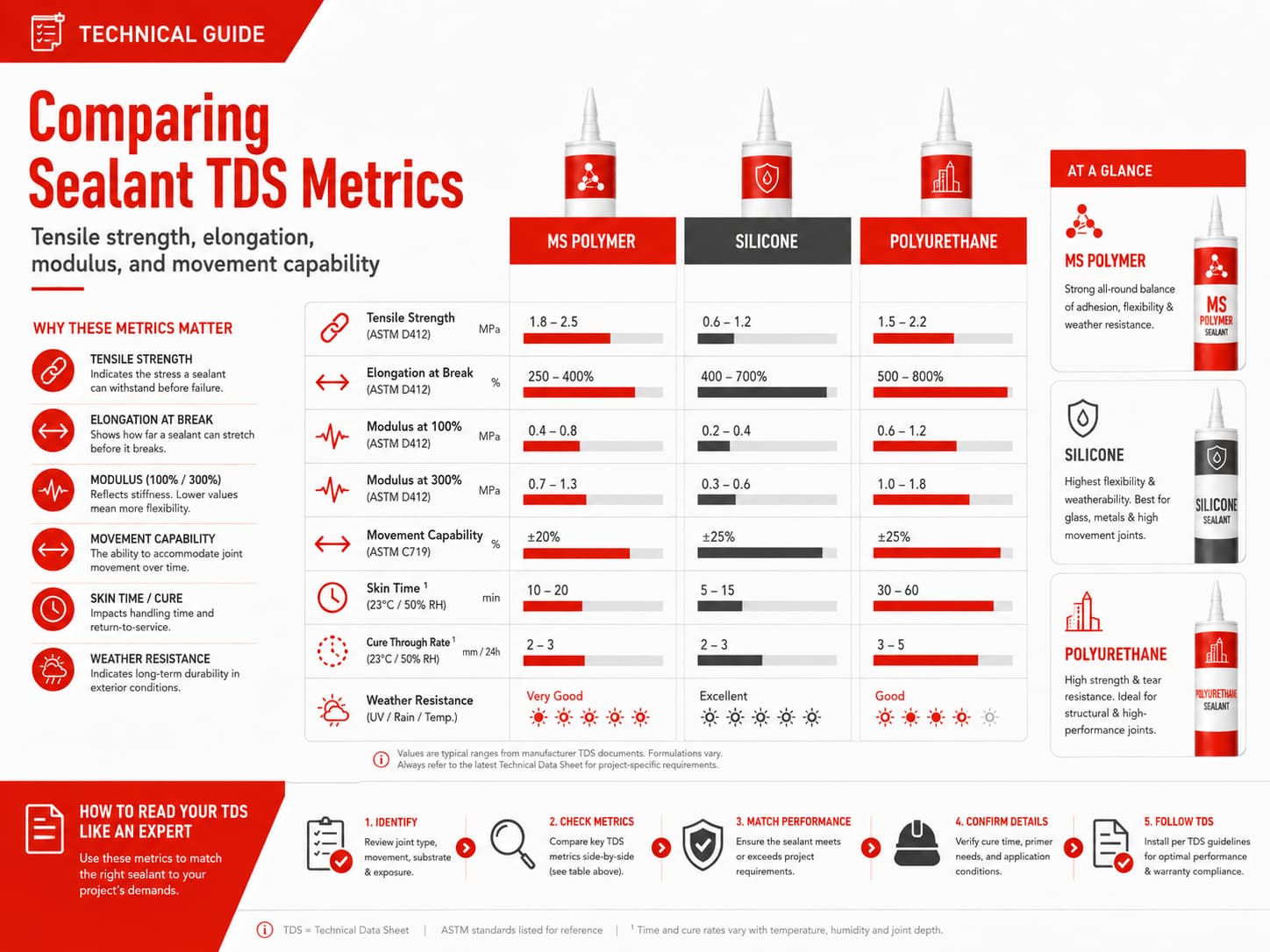
How to Compare TDS Before Switching Sealants
Before switching an existing specification from silicone or PU to MS polymer — or between MS polymer products from different suppliers — compare these TDS values directly:
| TDS Item | Why It Matters |
|---|---|
| Tensile strength | Determines bonding load and joint strength. |
| Elongation at break | Shows movement tolerance before failure. |
| Modulus | Affects stress transferred to substrates; low modulus suits movement joints. |
| Shore A hardness | Balances flexibility against abrasion resistance. |
| Movement capability | Confirms suitability for expansion joints. |
| Skin-over time | Affects installation speed and scheduling. |
| UV / weathering test data | Indicates real exterior durability, not just a general claim. |
| Staining test results | Confirms compatibility with natural stone. |
| VOC / isocyanate content | Relevant for indoor safety and green building compliance. |
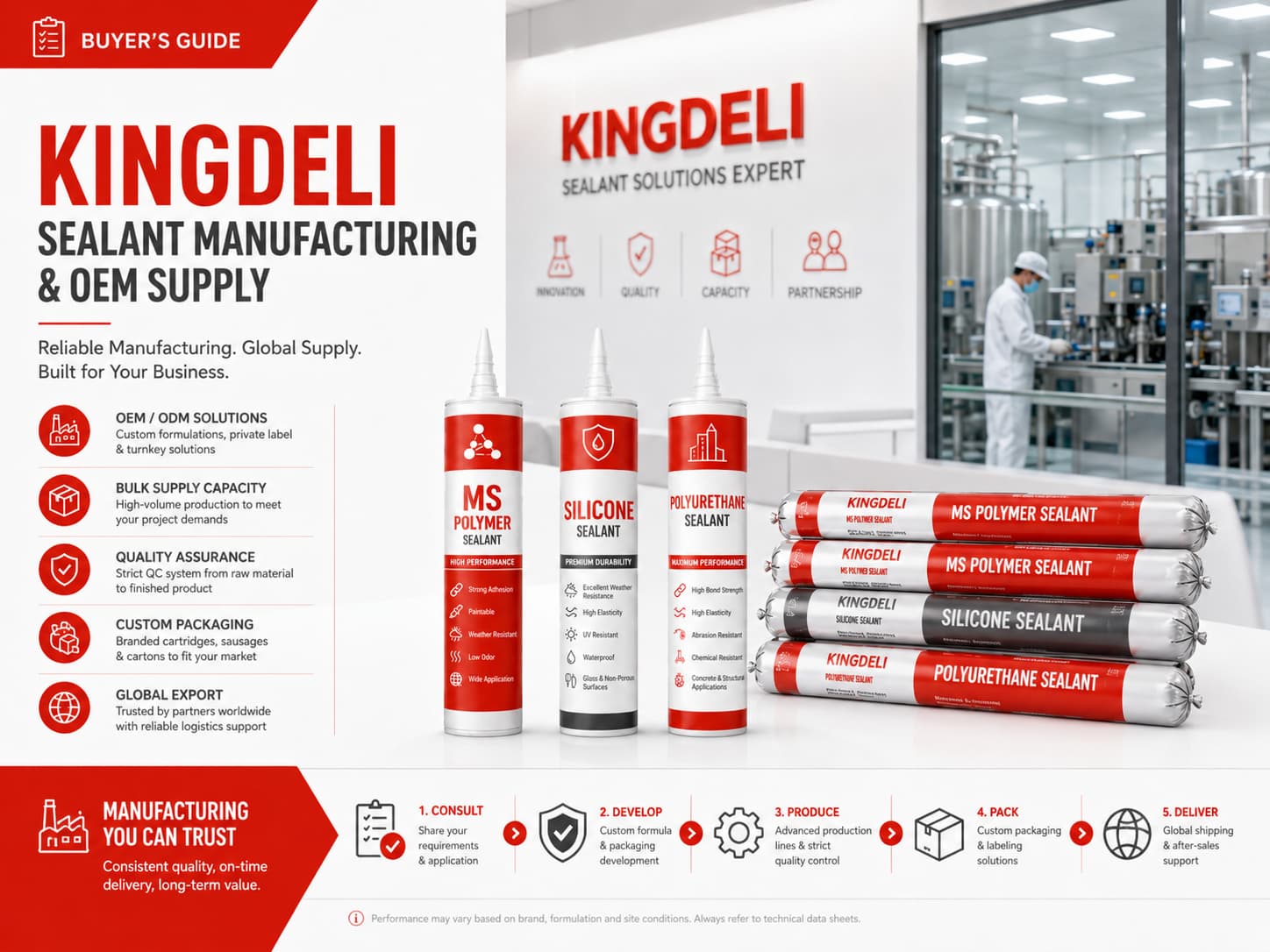
KINGDELI: MS Polymer, Silicone, and Polyurethane Sealant Supply
Rather than pushing one chemistry as universally superior, KINGDELI manufactures all three families — MS polymer, silicone, and polyurethane — so distributors and specifiers can match the product to the actual job, not to whatever a single-chemistry supplier happens to sell.
- Consistent quality from factory-direct production — factory-direct formulation control and automated production help reduce batch variation, shrinkage risk, and adhesion inconsistency in large-volume supply.
- OEM/ODM support — private label formulation and packaging tailored to your target market and climate through our OEM/ODM program.
- Bulk supply capability — cartridge, sausage, or drum packaging for distributors placing volume orders through our Bulk Order Inquiry team.
- Documentation on request — TDS, SDS, available test reports, and relevant compliance documents depending on product line and destination market.
For general-purpose bonding and sealing where clear appearance and reliable adhesion are required. View HY995 product details.
For interior applications needing Class 20 movement capability and mildew resistance. View HY997 product details.
For applications where PU's structural bonding strength is still the better fit. View HY992 product details.
For glass and sanitary applications where acetic silicone remains the right choice. View HY732 product details.
Not Sure Which Sealant Chemistry Fits Your Project?
Send us your substrate, joint size, movement requirement, paintability needs, and exposure conditions — our technical team can recommend the right sealant family and specific formulation.
For custom formulation and private label supply, visit our OEM/ODM page. For volume pricing and lead time, submit a Bulk Order Inquiry.
Conclusion
There is no single "winner" between MS polymer, silicone, and polyurethane — each solves a different set of job-site problems. MS polymer has closed much of the historical gap between silicone's weatherability and PU's paintability and strength, which is why it has become a common recommendation for paintable facade joints, stone sealing, and low-odor indoor work. But silicone remains the stronger choice for glazing and unpainted UV-exposed joints, and PU still has a place in heavy-duty structural bonding where its mechanical strength is the priority. The right decision comes down to your substrate, your paintability and UV exposure requirements, and what the specific product's TDS actually confirms.
As a manufacturer producing all three sealant families since 1998, KINGDELI can help you compare formulations against your project's actual requirements rather than a single chemistry's marketing claims.
FAQs
Is MS polymer sealant better than silicone?
It depends on the application. MS polymer is generally the better choice when the joint needs to be painted, when it involves natural stone, or when low odor matters. Silicone remains the stronger choice for glazing, sanitary sealing, and unpainted joints with maximum UV exposure.
Is MS polymer sealant better than polyurethane?
For paintable, UV-exposed, or low-odor applications, MS polymer is usually preferred. For heavy-duty structural bonding where maximum tensile strength on concrete or metal is the priority, polyurethane can still be the better fit. Compare TDS values directly rather than assuming.
When should I choose silicone instead of MS polymer?
Choose silicone for glass glazing, aquarium assembly, and sanitary joints that will not be painted, especially where maximum UV stability on an unpainted, smooth surface is the priority.
When should I choose polyurethane instead of MS polymer?
Choose PU for heavy-duty structural bonding on concrete, masonry, or metal where mechanical strength is the primary requirement and the joint will be protected from prolonged direct UV exposure or fully painted.
Can MS polymer sealant be painted?
Many paintable MS polymer formulations accept common architectural coatings more reliably than standard silicone. Always confirm paintability on the specific product's TDS or through field testing before specifying.
Does MS polymer sealant stain natural stone?
Many non-staining MS polymer formulations are designed to avoid the migrating oil risk that can cause some silicone products to stain porous stone like marble or granite over time. For high-value stone projects, compatibility testing is still recommended.
Can MS polymer sealant be used on damp surfaces?
Many MS polymer formulations tolerate damp substrates and often bond without a primer, which is useful in variable weather conditions on a job site. For joints facing permanent water immersion, a primer is still generally recommended.
Is MS polymer sealant suitable for exterior joints?
Yes, particularly for paintable facade and expansion joints. Confirm the specific product's UV and weathering test data on the TDS for high-exposure exterior applications.
Can MS polymer sealant replace PU in structural bonding?
Not always. MS polymer can replace PU in many construction and bonding applications, especially where UV resistance, lower odor, or paintability matters. For high-load structural bonding, compare product-specific TDS values such as tensile strength, modulus, and elongation rather than assuming one chemistry is universally stronger.
How do I choose between MS polymer, silicone, and PU sealant?
Start with your substrate and whether the joint needs to be painted. Then check UV exposure, movement requirements, and indoor air quality needs. Confirm your final choice against the specific product's TDS rather than the general reputation of the chemistry family.





Whatsapp: +8618825946249
Kingdeli
Kingdeli
Kingdeli
Kingdeli
Kingdeli