


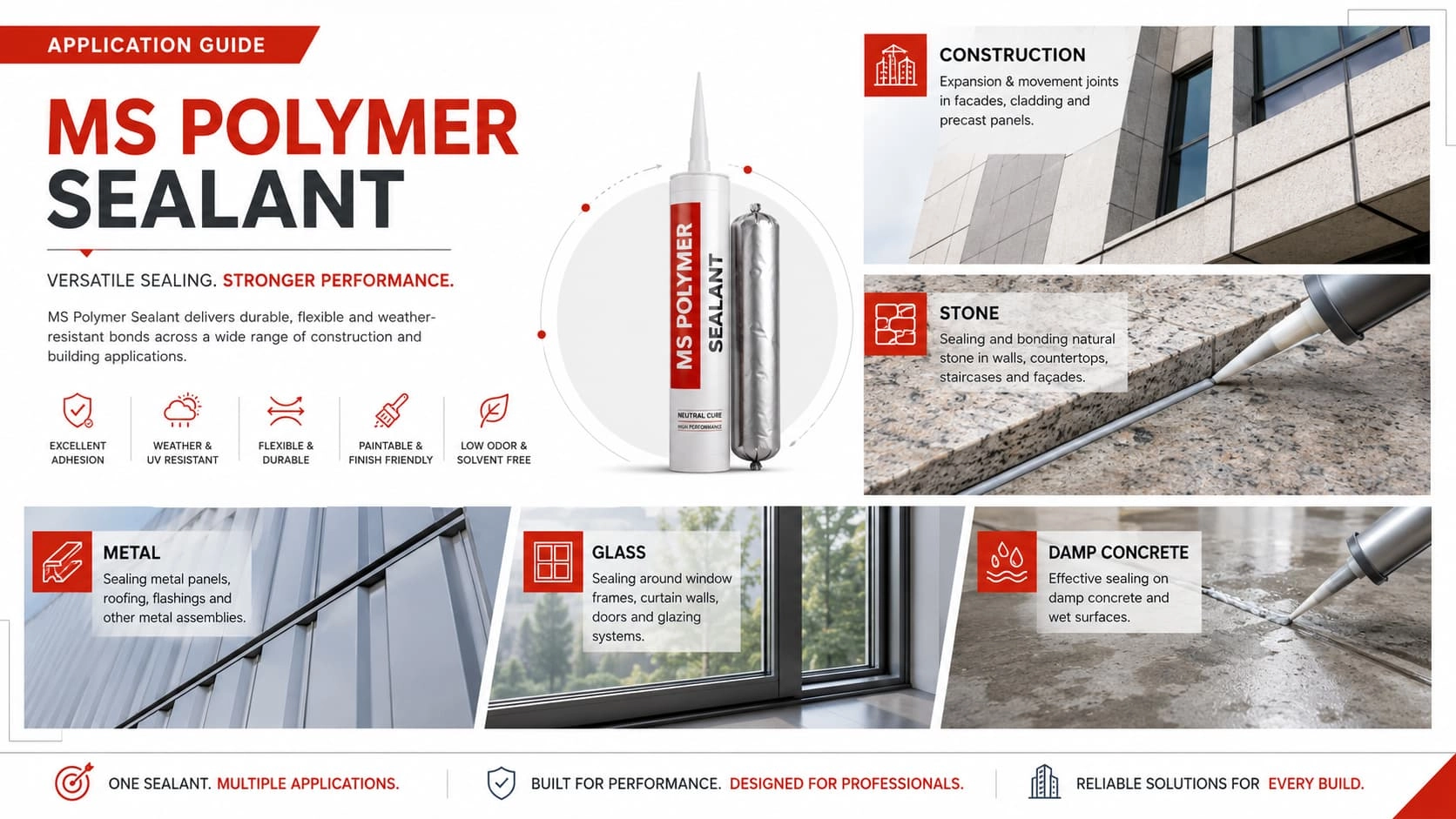
Quick answer: MS polymer sealant is a one-component, moisture-curing hybrid sealant based on Modified Silane (MS) technology. It combines silicone-like weather resistance with polyurethane-like bonding strength, while remaining paintable, low-odor, isocyanate-free, and suitable for many construction and industrial joints.
Facade, stone, damp concrete, metal, glass, automotive, and marine applications.
Paintable, flexible, low odor, broad adhesion, and suitable for many professional joints.
Movement class, curing time, substrate compatibility, and the product-specific TDS.
If you landed here to understand what MS polymer actually is before specifying it on a project, this guide covers the definition, how it differs from silicone and polyurethane, where it performs well, where it does not, and what to check on a TDS before you order.

MS Polymer vs MS Polymer Sealant: What's the Difference?
These two terms get used interchangeably, but it is worth separating them before you specify or purchase anything.
MS Polymer, or Modified Silane polymer, is the base polymer chemistry — a polyether backbone terminated with silane functional groups. It is the raw technology, not a finished product you can buy or apply.
MS Polymer Sealant is the finished, formulated product built on that polymer — with fillers, plasticizers, catalysts, and additives tuned for a specific application such as construction joints, glazing, marine decking, and so on.
The practical takeaway for buyers: do not specify or purchase based on the polymer name alone. Two products both labeled "MS polymer sealant" can have very different movement capability, cure speed, or stone-staining performance depending on the specific formulation. Always check the individual product's TDS rather than assuming all MS polymer sealants perform identically.
How MS Polymer Sealant Works
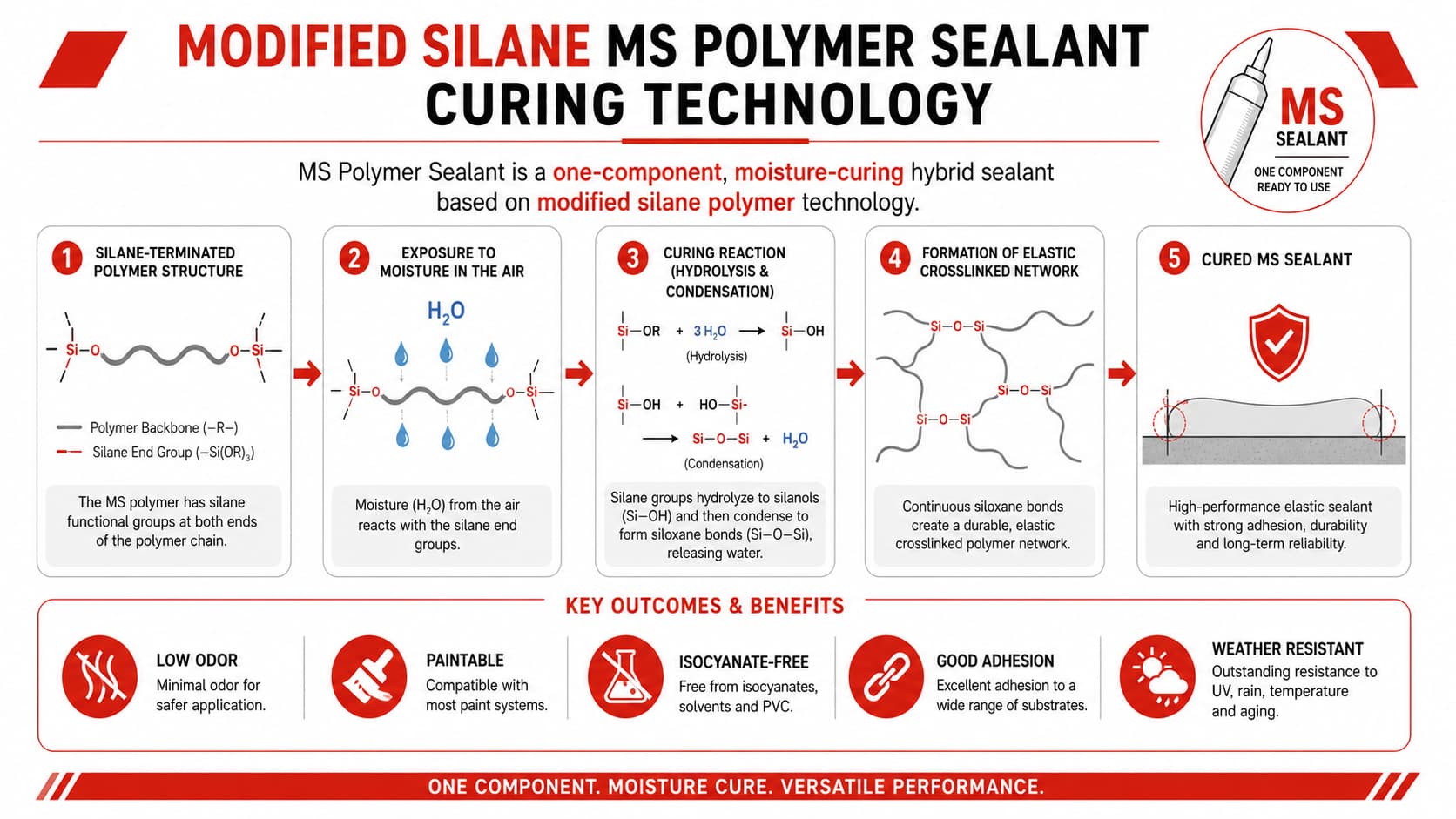
The term "MS" stands for Modified Silane. MS polymer technology has been used and refined for decades as a hybrid sealant chemistry, helping address two specific limitations associated with some older sealant systems: gas bubbling in certain moisture-cure polyurethane systems and the poor paintability of many silicone sealants.
In simple terms:
- It is a moisture-curing sealant — it cross-links when exposed to atmospheric humidity, not through a chemical hardener you mix in.
- The backbone is silane-terminated polyether, which cross-links into a dense, elastic network.
- Unlike acetic silicone, it does not release an acidic byproduct during cure.
- Unlike some polyurethane systems, it does not release CO2 during cure, which helps avoid bubbling in the finished joint.
- The cured material stays flexible across a wide temperature range without the excessive shrinkage or brittleness sometimes seen in cheaper, heavily diluted formulations.
MS Polymer Sealant vs Silicone vs Polyurethane
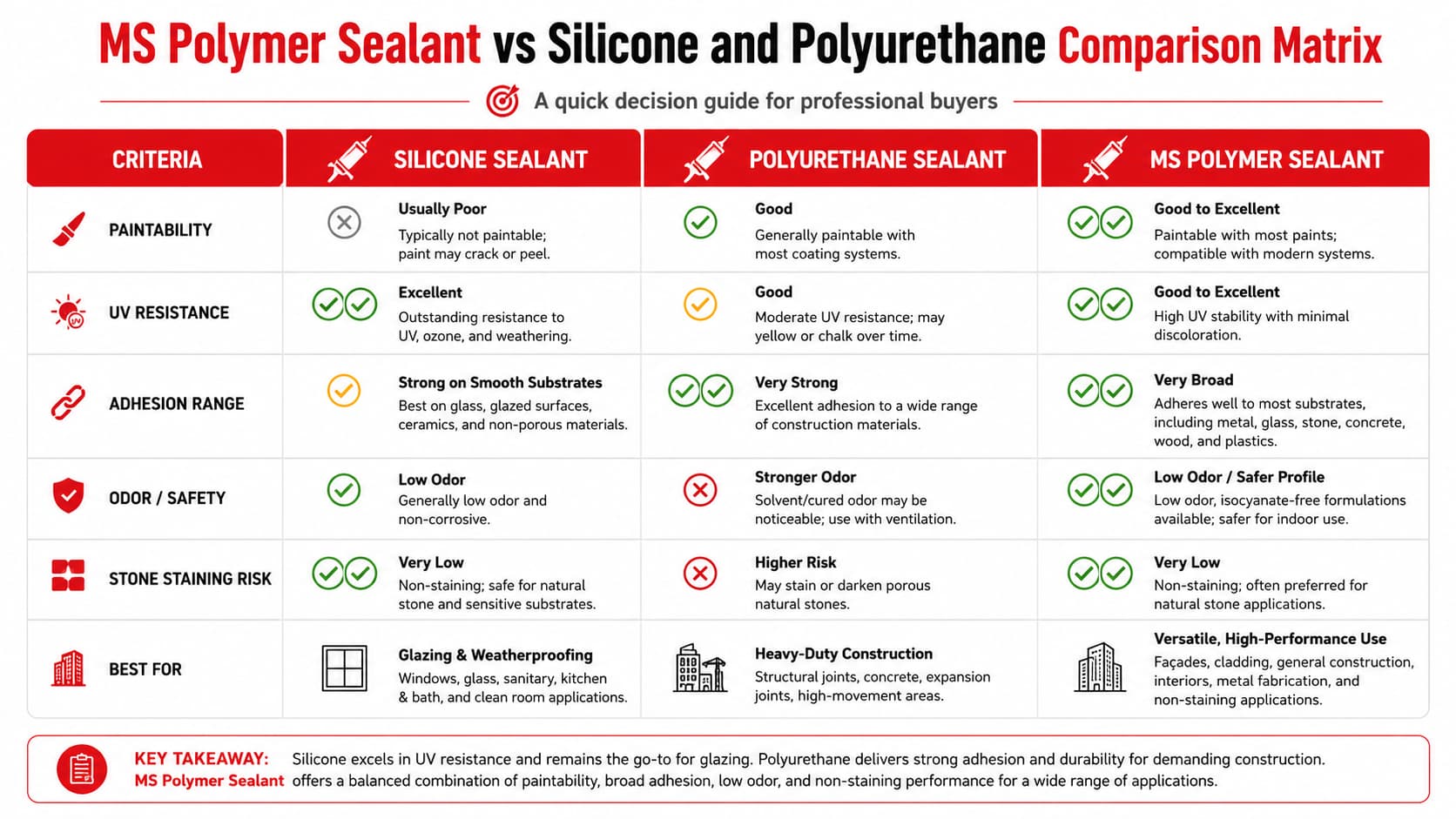
This is usually the deciding factor once a buyer already knows roughly what MS polymer is and wants to compare it against the alternatives.
| Factor | Silicone Sealant | Polyurethane Sealant | MS Polymer Sealant |
|---|---|---|---|
| Paintability | Usually poor. | Good. | Good to excellent. |
| UV resistance | Excellent. | Moderate to poor without protection. | Good to excellent. |
| Adhesion | Strong on glass and smooth substrates. | Strong on porous and industrial substrates. | Broad adhesion across many substrates. |
| Odor / safety | Depends on cure type, such as acetic vs neutral. | May involve isocyanate chemistry. | Usually isocyanate-free and low odor. |
| Shrinkage | Low. | Higher in some solvent-containing formulas. | Low shrinkage in quality formulations; check the product TDS. |
| Stone staining risk | Possible with some formulas due to oil migration. | Lower. | Often preferred for non-staining stone applications. |
| Best for | Glazing, sanitary, weather sealing. | Heavy-duty construction joints. | Paintable joints, stone, metal, facade, hybrid bonding. |
Want the deeper mechanical and lifecycle-cost breakdown? See our full comparison: MS Polymer Sealant vs. Silicone and PU: A Comparative Technical Analysis.
If your project sits closer to glass, sanitary, or aquarium sealing rather than paintable facade joints, our Acetic Silicone Sealant or Neutral Silicone Sealant ranges may be a better substrate match.
Key Benefits of MS Polymer Sealant
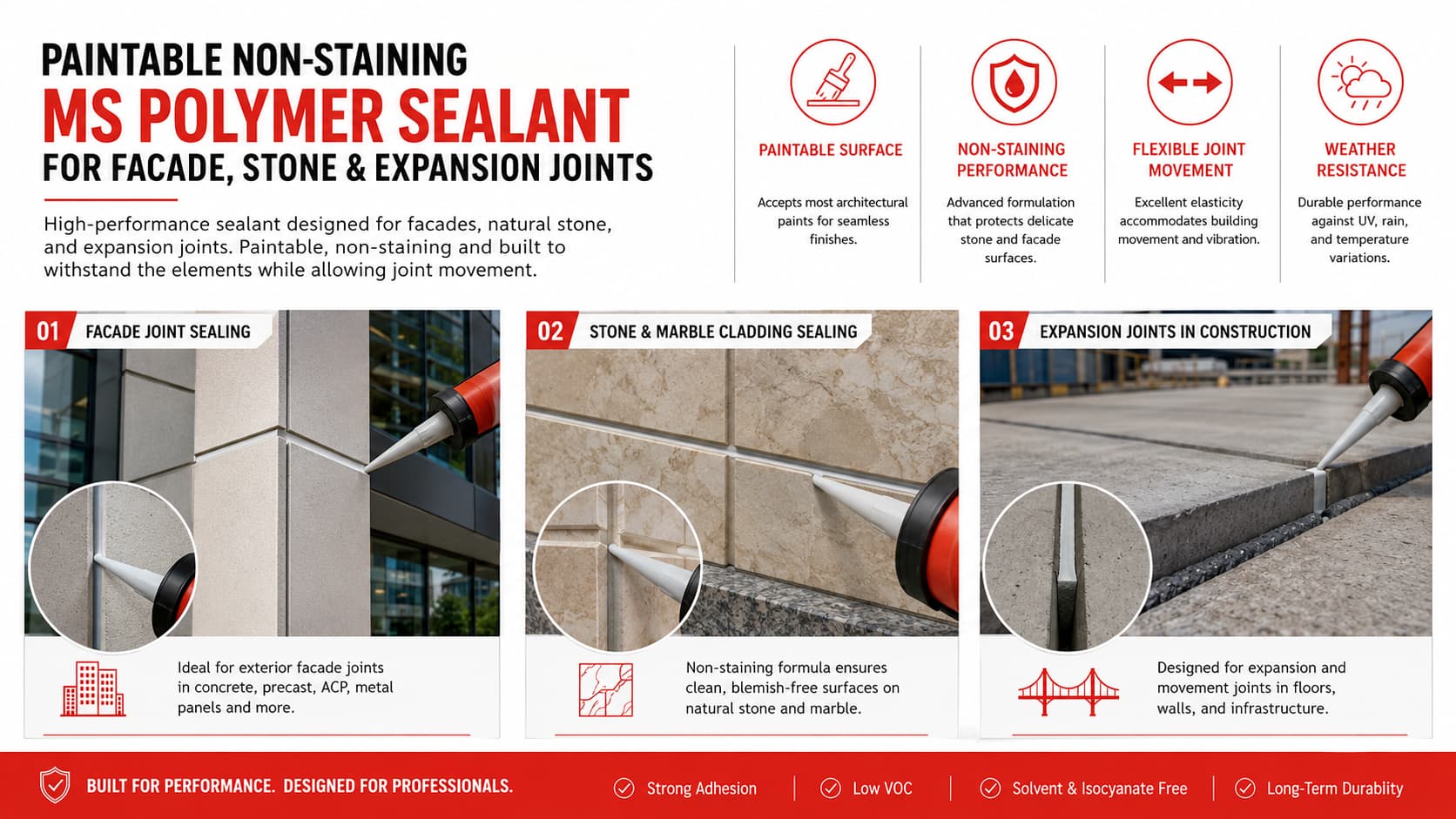
Paintable Surface
Many MS polymer sealants accept water-based architectural paint directly, unlike silicone, which typically causes paint to bead or peel. This matters for expansion joints that need to disappear into a painted facade. See why MS polymer sealant works for paintable and non-staining joints.
Non-Staining on Many Stone and Facade Applications
Some standard silicones can contain free-moving silicone oils that migrate into porous stone like granite or limestone, leaving permanent shadowing around the joint. Many non-staining MS polymer formulations are designed to avoid migrating oils, making them a better choice where visual integrity on high-value stone cladding matters.
Isocyanate-Free and Low Odor
This makes MS polymer sealant a common choice for hospitals, cleanrooms, and high-density residential projects where indoor air quality standards are strict.
Good UV and Weather Resistance
The siloxane crosslinks formed during curing help improve weathering and durability compared with many purely organic sealant systems.
Broad adhesion, including many damp substrates: Many MS polymer sealants can bond to damp or non-porous substrates without a primer, which reduces downtime on job sites where surfaces cannot always be bone-dry. That said, field testing is still recommended for critical structural or high-movement joints — do not assume primer-free adhesion without checking the specific product's TDS.
Where to Use MS Polymer Sealant
| Application | Typical Substrates | Why MS Polymer Works |
|---|---|---|
| Facade and expansion joints | Concrete, metal panels, stone | Paintability plus movement capability. |
| Stone and marble sealing | Granite, marble, limestone | Lower staining risk than many silicone formulas. |
| Window and door installation | Aluminum, glass, concrete | Broad adhesion and weather resistance. |
| Flooring and warehouse joints | Concrete floors | Flexibility and abrasion resistance, depending on grade. |
| Automotive and transportation | Metal panels, composites | Vibration resistance and elastic bonding. |
| Marine sealing | Decks, hull interfaces | Water and weather resistance, depending on formulation. |
Because it combines strong initial grab with long-term flexibility, MS polymer sealant is also used for precast concrete expansion joints on high-rise panels, and for bonding body panels in buses, caravans, and trains where vibration resistance and noise damping matter. For the mobility sector specifically, see The Role of MS Polymer Sealant in Automotive and Marine Industries.
When Not to Use MS Polymer Sealant
MS polymer sealant is versatile, but it is not a universal substitute for every joint or every other sealant chemistry. Check these limits before specifying it:
- Do not default to it for structural glazing unless the specific product is explicitly certified for structural glass applications.
- Do not use it for permanent underwater immersion unless the TDS specifically states suitability for continuous submersion.
- Do not exceed the product's stated temperature range — check the TDS rather than assuming general "good weather resistance" covers extreme heat or cold.
- Do not apply to untested plastics, oily surfaces, or contaminated substrates without a compatibility test — adhesion failure is more likely on surfaces the product has not been validated against.
- Do not substitute the technology name for engineering specification — "MS polymer" describes a chemistry family, not a guarantee that any specific product meets your project's movement class, certification, or load requirements.
How to Read an MS Polymer Sealant TDS
For a specifying engineer or a procurement officer, the Technical Data Sheet is the document that actually determines fitness for purpose — not the marketing copy.
| TDS Item | Why It Matters |
|---|---|
| Movement capability | Determines whether the product is suitable for expansion joints and how much joint movement it can absorb. |
| Modulus | Low modulus suits movement joints with less stress on the bond line; higher modulus suits structural bonding. |
| Elongation at break | Shows how far the sealant can stretch before failure. |
| Tensile strength | Relevant for bonding and structural panel assembly. |
| Shore A hardness | Affects flexibility versus abrasion resistance; higher hardness suits floor joints under forklift traffic. |
| Skin-over time | Affects installation speed and job site scheduling. |
| Cure depth at 24h | Affects how quickly a joint can be exposed to service conditions. |
| VOC / odor | Relevant for indoor use and green building certification requirements. |
How to Choose an MS Polymer Sealant Manufacturer
For a distributor or specifier, your reputation depends on what is actually inside the cartridge. Before committing to a supplier, verify:
- Raw material purity — formulations should not be extended with heavy mineral oil or solvent dilution, which may cause volume shrinkage after curing and pull the sealant away from joint edges.
- Low shrinkage — check the stated shrinkage rate on the product TDS; many quality MS polymer formulations are specified at low single-digit shrinkage levels.
- Relevant documentation — ISO management certificates, CE/EN 15651-related documentation, ASTM C920-based test reports, LEED/VOC documentation, or other project-specific documents where applicable.
- TDS/SDS/test report availability on request, without delay.
- Batch-to-batch consistency — automated filling and mixing reduces the risk of human error between production runs.
- OEM/ODM formulation support, if you need a private label line or region-specific formulation.
- Packaging flexibility — cartridge, sausage, or drum packaging depending on your application, whether manual or automated dispensing.
- Export support — commercial documentation for your destination market.
For a full walkthrough of these criteria, see our Sourcing Guide: How to Choose a Reliable MS Polymer Sealant Manufacturer. For projects where low-VOC and isocyanate-free materials are a compliance requirement, our analysis on why MS polymer sealant supports green building goals covers the sustainability angle in more depth.
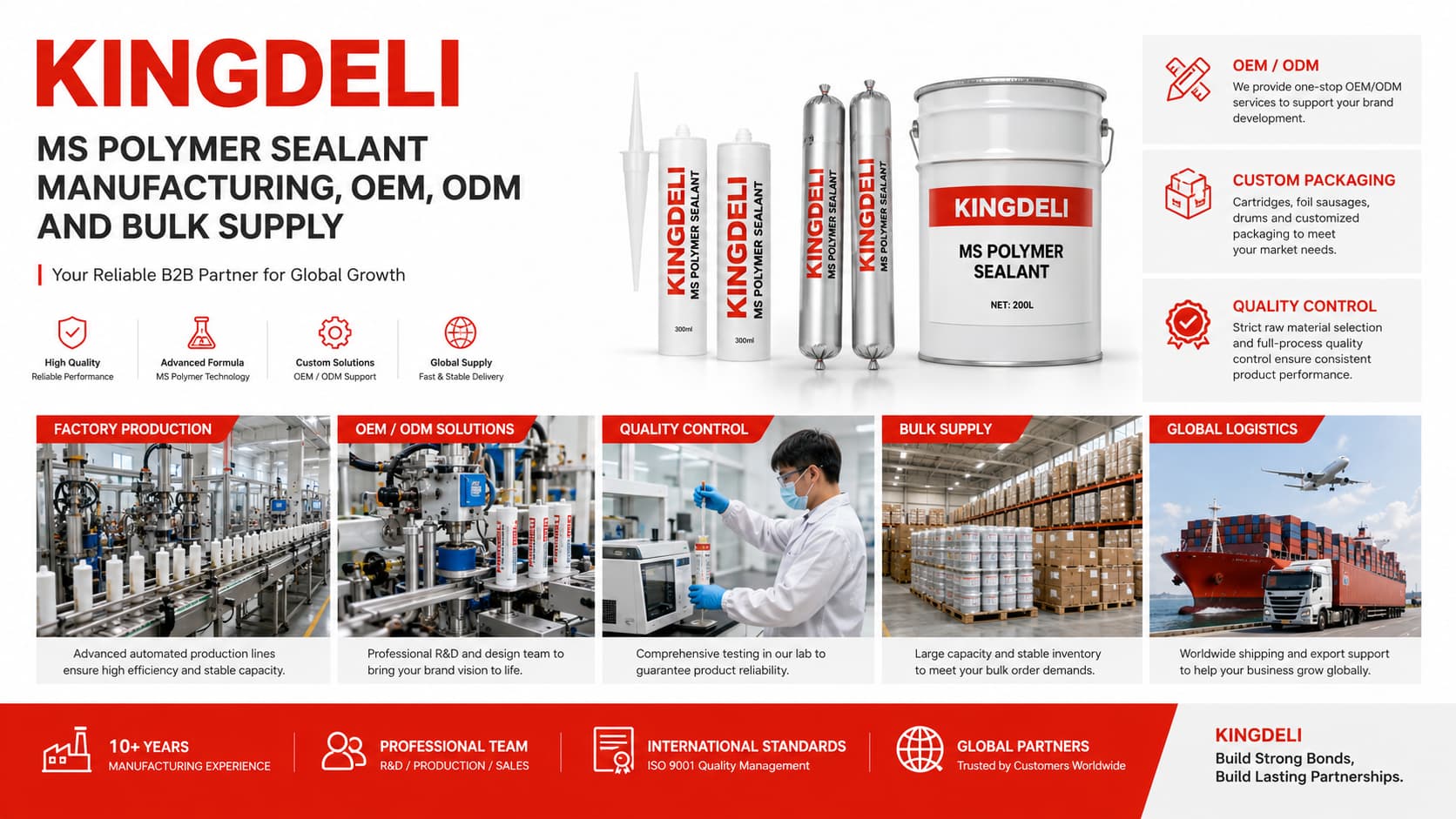
Why Source MS Polymer Sealant from KINGDELI
KINGDELI manufactures MS polymer sealant and adhesive formulations at a 66,000 m2 fully automated production facility, with an annual capacity exceeding 100,000 tons. For distributors and specifiers evaluating a supplier, our support includes:
- A dedicated MS Polymer Sealant/Adhesive product range, including formulations for paintable facade joints, structural bonding, and anti-microbial interior applications.
- OEM/ODM support — formulation and packaging adjusted to your target application and market.
- Flexible packaging — cartridge, sausage foil, or drum formats for both manual and automated dispensing.
- Full documentation — TDS, SDS, available test reports, and relevant compliance documents on request.
- Batch consistency from automated production, reducing the mixing variability that may cause shrinkage and adhesion issues in lower-quality alternatives.
- Bulk supply support for distributors and large-volume B2B orders.
Suitable for general bonding and sealing where clear appearance and long-term reliability are required. View HY995 product details.
Designed for interior applications needing Class 20 movement capability and mildew resistance. View HY997 product details.
Ready to Specify or Source MS Polymer Sealant?
Send us your substrate, joint size, movement requirement, paintability needs, destination market, and monthly order volume — our technical team can recommend the right formulation and packaging.
Reach out through our OEM/ODM page for custom formulation, or our Bulk Order Inquiry page for volume pricing and lead times.
Conclusion
MS polymer sealant earns its place in modern construction and industrial bonding by solving specific problems that silicone and polyurethane do not fully address on their own: paintability, low odor, and reduced staining risk on stone. It is not a universal replacement for every sealant chemistry, and the right choice still depends on your substrate, movement requirements, and the specific product's TDS — not the "MS polymer" label alone.
As a manufacturer operating since 1998, KINGDELI produces MS polymer sealant formulations under ISO-certified management systems and supports both standard and OEM/private label supply for distributors sourcing at scale.
Frequently Asked Questions
What is MS polymer sealant?
MS polymer sealant is a one-component, moisture-curing hybrid sealant built on Modified Silane polymer technology. It combines silicone-like weather resistance with polyurethane-like bonding strength while remaining paintable and low-odor.
What does MS mean in MS polymer?
MS stands for Modified Silane — a polyether polymer backbone terminated with silane functional groups that cross-link through a moisture-cure reaction.
Is MS polymer sealant better than silicone?
It depends on the application. MS polymer is generally the better choice when paintability, non-staining performance on stone, or isocyanate-free formulation matters. Silicone remains excellent for glass and glazing where UV resistance and adhesion to non-porous surfaces are the priority.
Is MS polymer sealant paintable?
Many MS polymer sealant formulations accept water-based architectural paint directly, unlike silicone, which typically causes paint to peel or bead up. Always confirm paintability on the specific product's TDS.
Can MS polymer sealant be used on damp surfaces?
Many formulations can bond to damp substrates without a primer, which is useful on job sites where surfaces cannot always be fully dry. For critical or high-movement joints, field testing is still recommended before relying on primer-free application.
Does MS polymer sealant stain stone or marble?
Many non-staining MS polymer formulations are designed to avoid the migrating oils that can cause staining in some silicone sealants, making them a common choice for granite, marble, and limestone applications.
Is MS polymer sealant waterproof?
Once fully cured, it forms a durable, flexible, water-resistant seal suitable for many wet environments. For continuous underwater immersion, confirm suitability on the specific product's TDS rather than assuming general water resistance is sufficient.
Can MS polymer sealant replace polyurethane sealant?
In many construction joint applications, yes — particularly where paintability, lower odor, or isocyanate-free formulation is required. For heavy structural bonding on porous industrial substrates, polyurethane may still be the better fit; compare movement class and tensile strength on both TDS before switching.
How do I choose the right MS polymer sealant for construction?
Start with your substrate and required movement class, then check the product's modulus, elongation, Shore A hardness, and shrinkage rate on the TDS. Confirm relevant compliance documents or test reports if your project has certification requirements.
Does KINGDELI support OEM/ODM MS polymer sealant supply?
Yes. KINGDELI supports OEM/ODM formulation and private label packaging for distributors, alongside standard bulk supply from our 66,000 m2 manufacturing facility.





Whatsapp: +8618825946249
Kingdeli
Kingdeli
Kingdeli
Kingdeli
Kingdeli