


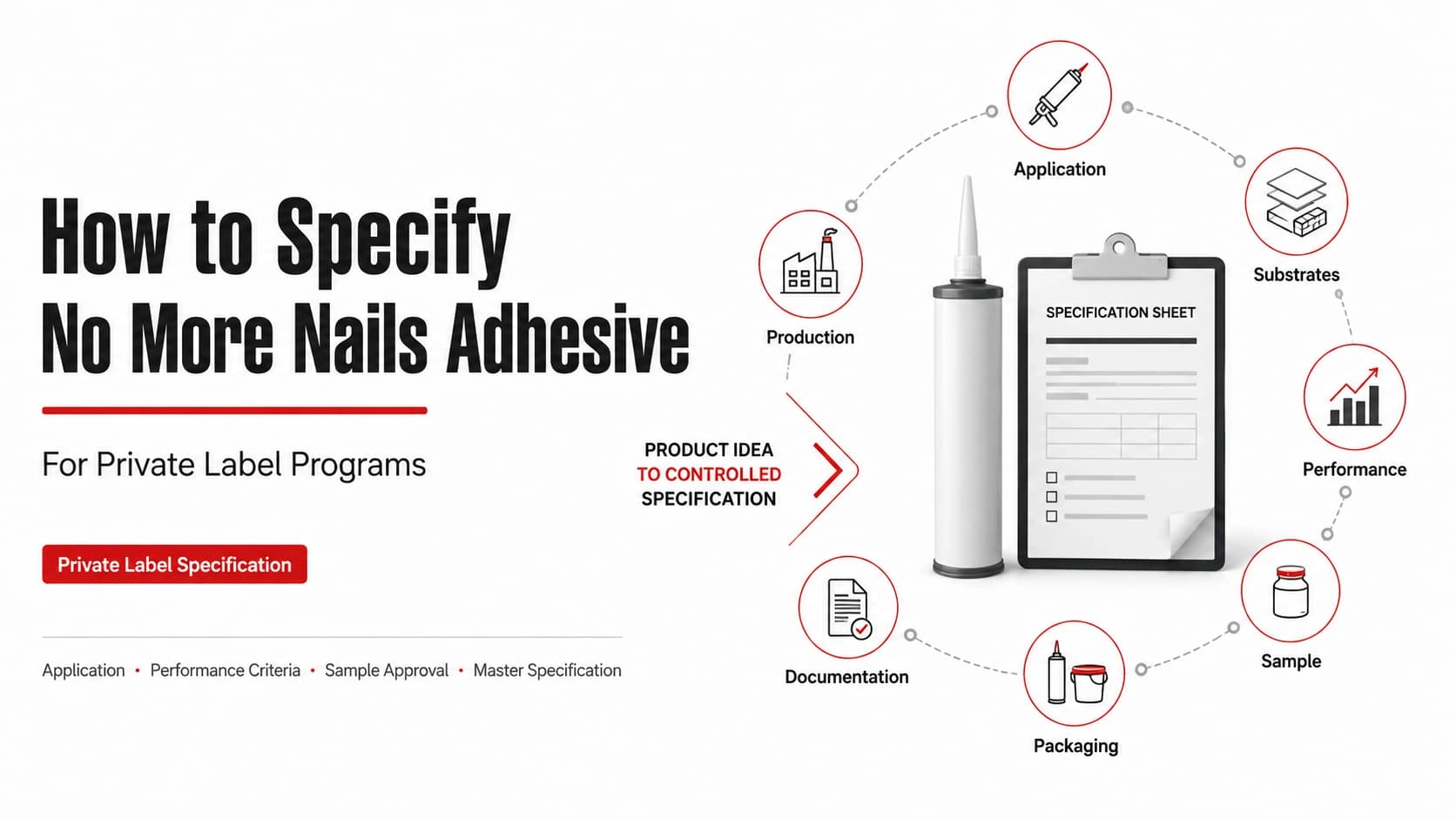
How to Specify No More Nails Adhesive for Private Label Programs
- What Should a Private-Label No More Nails Specification Include?
- Start With the Market Positioning, Not the Formula
- Define the Target Market
- Define the Sales Channel
- Define the Product Positioning
- Define the Actual Bonding Application
- Identify the Substrates
- Define the Bond Geometry and Installation Method
- Define the Service Environment
- Define the Product and Formulation Requirements
- Specify the Chemistry Only When It Is a Real Requirement
- Define Color and Appearance
- Define the Required Application Behavior
- Turn Performance Targets Into Measurable Acceptance Criteria
- Build the Sample and Validation Plan
- Decide What the Sample Represents
- Define the Validation Conditions Before Testing
- Record the Sample Approval
- Control Packaging, Branding, and Documentation
- Define the Packaging and Branding Requirements
- Keep Product Approval and Packaging Approval Separate
- Define the Required Technical Documentation
- Define Destination-Market Requirements
- Create the Approved Master Specification
- Keep Formula Approval and Artwork Approval Separate
- Define Which Changes Require Reapproval
- Use the Master Specification for Repeat Orders
- Define the Repeat-Order Reference
- Define Incoming Inspection
- Manage Changes Over Time
- What Information Should You Send Before Requesting a Private-Label Quote?
- Market Information
- Application Information
- Product Requirements
- Packaging and Branding
- Validation and Documentation
- Commercial Project Information
- Common Private-Label Specification Mistakes to Avoid
- Specifying “No More Nails” Without Defining the Application
- Using Marketing Words Instead of Acceptance Criteria
- Approving a Sample Without Defined Test Conditions
- Approving Artwork Before Product Requirements Are Stable
- Failing to Establish a Controlled Master Specification
- Related No More Nails and Private-Label Resources
- FAQ: Private-Label No More Nails Adhesive Specification
- Should I specify the adhesive chemistry or the application first?
- What documents should be confirmed before mass production?
- When should a private-label No More Nails specification be revised?
- Build a Product That Can Be Repeated, Not Just Sampled
- Ready to Define Your Private-Label No More Nails Project?
A private-label No More Nails adhesive specification should begin with the target market and the real bonding application, then translate those needs into measurable product requirements, substrate compatibility, application behavior, packaging, documentation, sample acceptance criteria, and repeat-production controls.
Buyers should not define the project with the words “No More Nails” alone. The exact chemistry and performance profile need to be confirmed for the product being developed, so the specification should explain what the adhesive is expected to do and how that performance will be evaluated.
Quick Answer:
A useful private-label specification follows three principles: application first, measurable acceptance criteria, and an approved master specification that controls the final product for production and repeat orders.
- Application first: define the actual substrates, installation method, and service conditions before deciding what the product must achieve.
- Measurable criteria: replace vague terms such as “strong,” “fast,” and “high grab” with defined acceptance conditions.
- Approved master specification: connect the approved product, performance criteria, sample, packaging, artwork, and documentation to one controlled reference.
The objective is not simply to obtain a sample that looks acceptable. It is to create a product that can be sampled, tested, approved, manufactured, inspected, and repeated consistently.
What Should a Private-Label No More Nails Specification Include?
A private-label No More Nails specification should connect the target market and application with measurable product requirements, substrate compatibility, application behavior, packaging, documentation, validation criteria, and repeat-production controls.
| Specification Area | What the Buyer Defines | Project Output |
|---|---|---|
| Market | Target country, channel, positioning | Commercial target |
| Application | Substrates, installation method, service conditions | Application profile |
| Product | Chemistry if fixed, color, consistency, handling | Product target |
| Performance | Relevant measurable criteria | Acceptance criteria |
| Validation | Test conditions and pass/fail requirements | Approved sample |
| Packaging | Container, nominal content, branding, SKU | Commercial package |
| Documentation | Technical, safety, test and market requirements | Product records |
| Production control | Approved references and revision rules | Master specification |
An approved master specification is the controlled reference that defines the final private-label product for production and repeat orders. It should connect the approved product or formulation version with measurable acceptance criteria, the approved sample, packaging and artwork revisions, and the required documentation.
This distinction matters because a quotation, artwork file, test result, or sample alone does not fully define the commercial product.
Start With the Market Positioning, Not the Formula
Before discussing formulation details, define what commercial product the private-label program is intended to create.
Define the Target Market
The project specification should identify the destination market before the adhesive and artwork are finalized.
- Destination country or region
- Target buyer
- Retail, distributor, or professional channel
- Private-label or distributor brand
- Intended product positioning
The target market can influence product expectations, labeling, documentation, packaging, and commercial presentation.
A retail DIY product and a professional distribution product may therefore require different project briefs even if both are described generally as No More Nails adhesives.
Define the Sales Channel
The sales channel should also be part of the project specification.
A retail SKU may place more emphasis on:
- Individual product identification
- Barcode control
- Shelf communication
- Consumer-facing application information
A professional or contractor-oriented product may place greater emphasis on:
- Dispensing behavior
- Installation workflow
- Package handling
- Distribution efficiency
The manufacturer needs to understand how the commercial product will be sold and used, not only what name will appear on the label.
Define the Product Positioning
A benchmark product can help communicate the intended market position, but the project specification should identify which benchmark characteristics actually matter.
Instead of requesting:
“Make it the same as Product X.”
the specification should identify relevant target characteristics, such as:
- Application behavior
- Initial grab
- Working or repositioning time
- Cure development
- Substrate compatibility
- Appearance
- Packaging
- Intended service conditions
A benchmark is most useful when it helps define a target performance profile rather than acting as an undefined request to copy another product.
Define the Actual Bonding Application
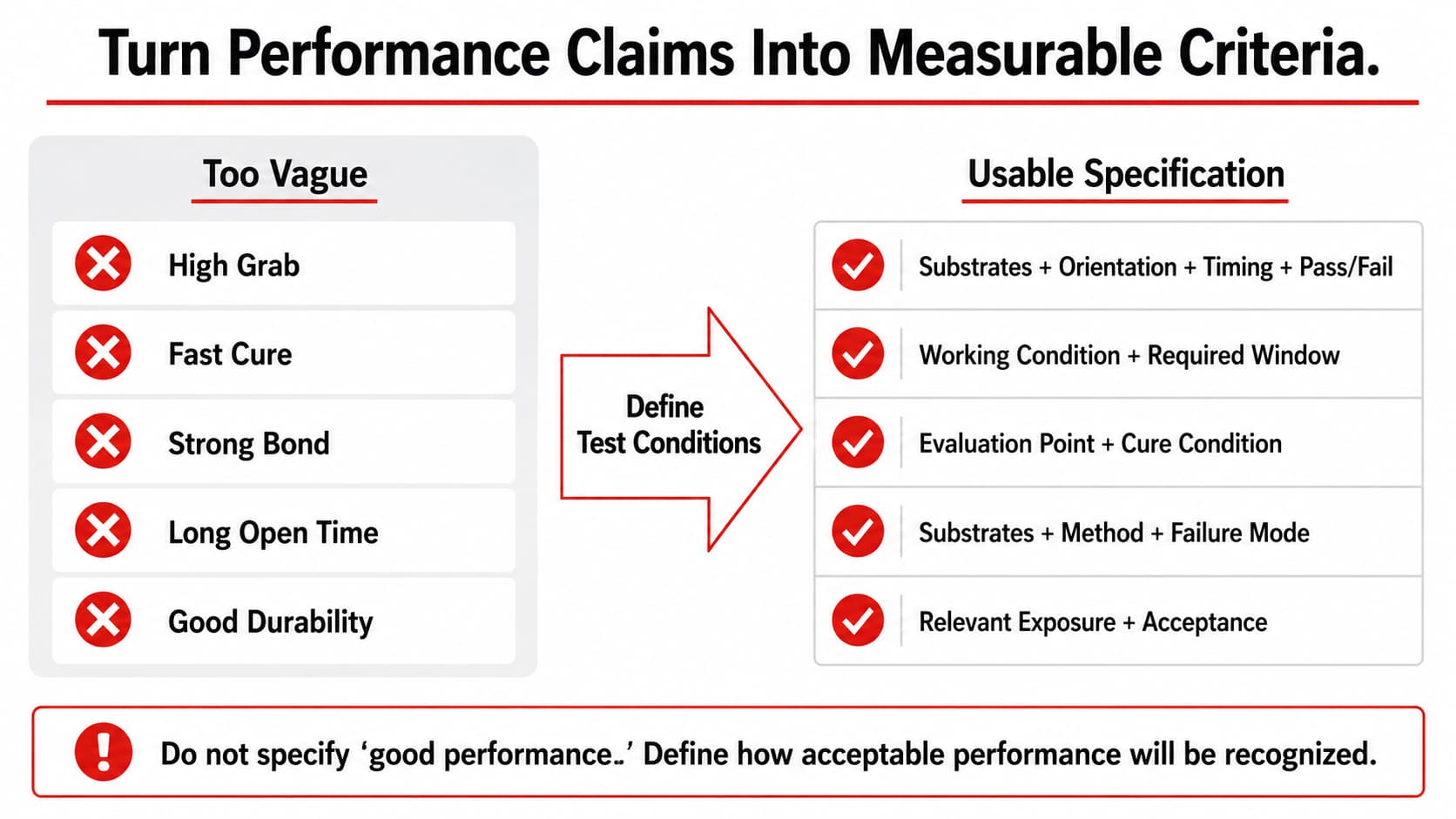
Private-label No More Nails development should begin with the real bonding application rather than with a product name or an assumed formulation. The project specification should define the substrates, surface conditions, bond geometry, installation method, and service environment first because these conditions determine which product characteristics and validation criteria actually matter.
Identify the Substrates
Broad descriptions such as “wood to wall” are often too vague for product development.
The specification should identify representative materials as clearly as practical, including:
- Substrate material
- Coating or finish
- Porosity
- Surface treatment
- Moisture condition
- Expected surface preparation
A coated panel and an unfinished porous board may behave differently in bonding tests even though both could be described casually as “wood.” Representative test materials are therefore more useful than generic material categories.
Define the Bond Geometry and Installation Method
Application geometry can affect practical adhesive behavior. The project brief can identify:
- Bead, spot, or broader-area application
- Vertical or horizontal installation
- Approximate bond geometry
- Expected bond-line thickness where relevant
- Whether clamping or temporary support is used
- Whether repositioning is required
- When the assembly needs to be handled
The objective is to describe the real installation workflow so the product can be evaluated in the right context.
Define the Service Environment
Depending on the intended use, the specification may include:
- Indoor or outdoor exposure
- Dry, humid, or moisture-exposed conditions
- Expected temperature conditions
- Movement in the bonded assembly
- Load direction
- Long-term or intermittent exposure
Environmental requirements should only be added where they are relevant to the real application and should later be validated for the exact formulation.
Define the Product and Formulation Requirements
Once the application is clear, the project can define which product characteristics need to be controlled.
Specify the Chemistry Only When It Is a Real Requirement
Private-label buyers do not always need to specify adhesive chemistry in advance.
If chemistry is a fixed project requirement, it should be stated clearly. Otherwise, the manufacturer can evaluate a formulation approach against the defined substrates, application method, performance targets, market requirements, and packaging constraints.
“No More Nails” should therefore be treated as a commercial product description or project category, not as a complete chemistry specification.
Define Color and Appearance
Color and appearance may matter for branding, application, or customer expectations. The project specification can identify:
- Required color
- Target color reference where available
- Expected paste appearance
- Appearance characteristics relevant to the commercial SKU
KINGDELI's OEM and ODM adhesive services support formulation customization, color matching, and specification customization based on project requirements. The exact formulation and achievable target still need to be confirmed during technical evaluation and sample development.
Define the Required Application Behavior
Application behavior can be just as important as laboratory bond results. Depending on the project, the specification may need to identify expectations for:
- Consistency
- Extrusion behavior
- Non-sag behavior
- Spreadability
- Handling during installation
These should be linked to the actual application rather than converted into arbitrary numerical limits without a valid reason or test method.
Turn Performance Targets Into Measurable Acceptance Criteria
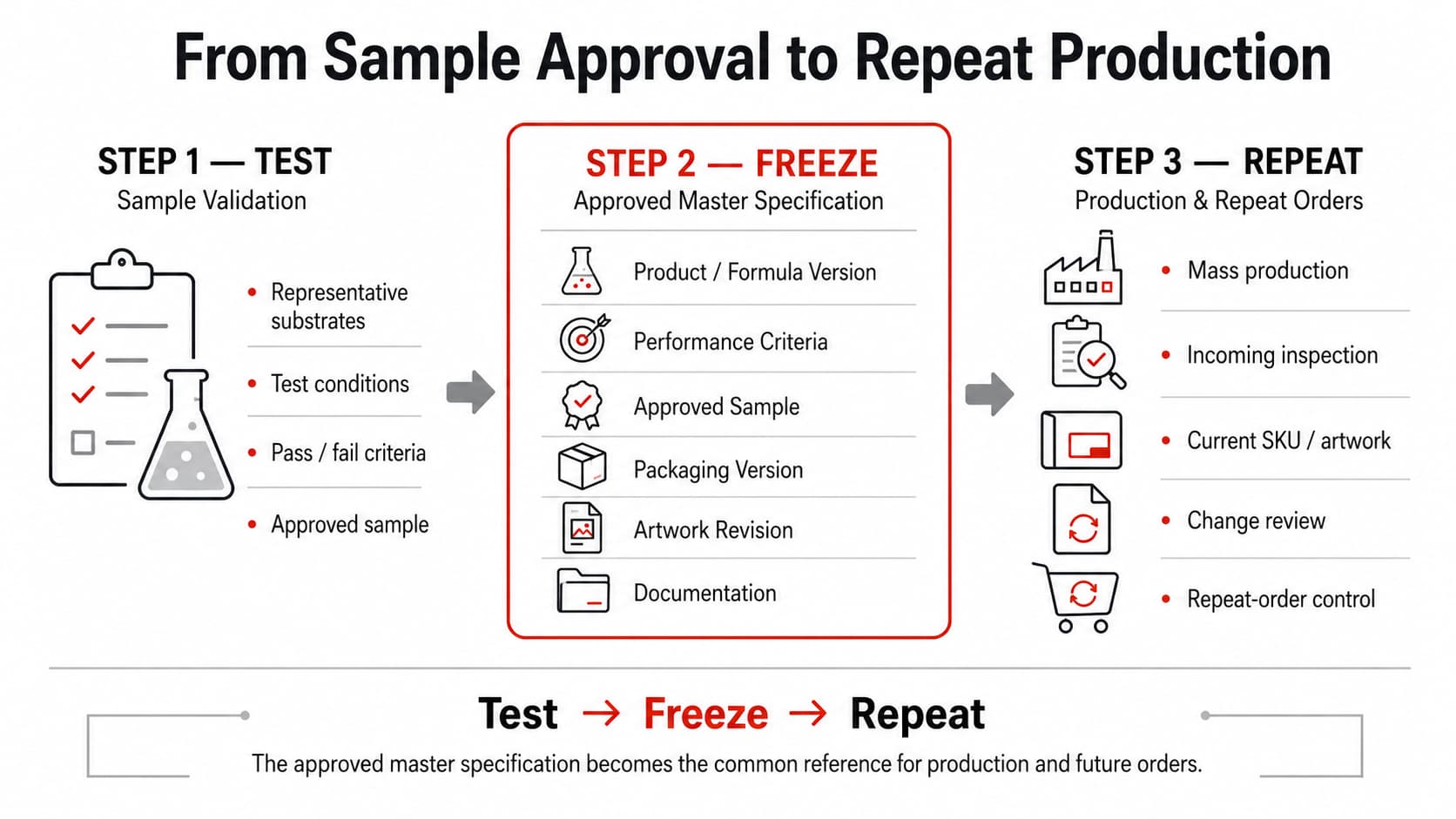
A useful private-label specification converts marketing terms such as “high grab,” “fast cure,” or “strong bond” into measurable acceptance criteria. Each critical requirement should define the relevant application condition, test method or observation point, and pass/fail requirement so that samples can be compared on the same basis.
| Weak Requirement | Specification Should Define |
|---|---|
| High grab | Substrates, orientation, timing, load or displacement condition |
| Long open time | Required working or repositioning window under agreed conditions |
| Fast cure | Required handling or evaluation point and cure condition |
| Strong bond | Substrates, preparation, cure, test method, acceptance and failure mode |
| Good durability | Relevant exposure, test condition and pass/fail requirement |
The purpose is not to create unnecessary laboratory complexity. The specification should measure the characteristics that actually influence the buyer's application.
If repositioning is important during installation, the project should define the required working window. If early handling strength matters, the required evaluation point should be stated. If bond strength is critical, the substrates, curing conditions, method, and failure mode should be defined along with the acceptance result.
Durability testing should follow the same principle. Water, heat, cold, humidity, aging, or freeze-thaw exposure should only be included when those conditions are relevant to the intended use.
Do not specify “good performance.” Specify how acceptable performance will be recognized.
Build the Sample and Validation Plan
The sample stage answers one question:
Does the proposed product meet the agreed project requirements?
It should not yet be used as the only long-term production control.
Decide What the Sample Represents
The approval record should identify what each sample represents. Questions can include:
- Does it use the intended formulation?
- Is the color final or provisional?
- Does it represent the target application behavior?
- Is the packaging final or temporary?
- Is the sample being reviewed for technical approval, commercial approval, or both?
This prevents a passed sample from creating assumptions about elements that were not actually approved.
Define the Validation Conditions Before Testing
Private-label samples should be evaluated against criteria agreed before testing.
Representative substrates, surface preparation, application method, curing conditions, and pass/fail requirements should be defined in advance so that approval is based on repeatable evidence rather than subjective impressions.
The validation plan can focus on requirements such as:
- Dispensing and application behavior
- Initial grab
- Working time
- Cure development
- Adhesion
- Failure mode
- Substrate compatibility
- Relevant environmental exposure
The exact methods should be agreed for the project rather than treated as universal requirements.
Record the Sample Approval
Once a sample passes, the approval should be documented clearly.
The approved sample can become part of the project reference, but it should be connected to the written specification rather than replacing it.
The sample answers: What passed?
The master specification answers: What exactly is approved for production?
Control Packaging, Branding, and Documentation
Packaging and documentation are part of the private-label commercial specification, but they should remain separate from formula and technical-performance approval.
Correct artwork does not prove that the adhesive meets its performance requirements, and a technically approved adhesive does not automatically mean the final commercial package is ready for production.
Define the Packaging and Branding Requirements
At specification level, the buyer should identify the main commercial packaging requirements, such as:
- Primary container
- Nominal content
- Nozzle or closure
- Branding
- Artwork
- Barcode and SKU
- Carton requirements
- Approved packaging version
For detailed container, artwork, barcode, batch/date coding, carton, physical sample, and revision checks, use the No More Nails adhesive packaging approval checklist.
Keep Product Approval and Packaging Approval Separate
A private-label project can have several approval tracks at different stages. For example:
- Technical performance may be approved while artwork is still under revision.
- Artwork may be approved while technical validation remains open.
- The formulation may remain unchanged while packaging is revised.
The approval record should show which elements are final and which remain open before production begins.
Define the Required Technical Documentation
The project specification should identify which product documents are needed before launch or mass production. Depending on the formulation and destination market, these may include:
- Technical data
- Safety information
- Test evidence
- Approved product specifications
KINGDELI's OEM/ODM support includes documentation such as TDS, MSDS, and test reports. The exact documents required and available should still be confirmed for the individual formulation and target market.
Define Destination-Market Requirements
Destination-market requirements should be identified before final product and artwork approval because documentation, labeling, and permissible claims can vary by product and market.
The buyer should verify the applicable requirements for the exact formulation and destination rather than assuming that one private-label specification can be used unchanged in every market.
Product claims should also remain aligned with verified product evidence. Terms such as “waterproof,” “exterior,” “fast cure,” or other performance claims should only be used when they are supported for the exact formulation and intended market.
Create the Approved Master Specification
An approved master specification is the controlled reference that defines the private-label product for production and repeat orders. It should connect the approved product or formulation version with measurable acceptance criteria, approved sample, packaging and artwork revisions, and required documentation.
| Specification Area | Controlled Reference |
|---|---|
| Product identity | Product or project code |
| Formula | Approved formulation or version |
| Color | Approved target or reference |
| Application | Defined intended use |
| Performance | Agreed measurable criteria |
| Sample | Approved sample reference |
| Packaging | Approved packaging specification |
| Artwork | Approved artwork revision |
| Documentation | Applicable product documents |
| Acceptance | Agreed validation criteria |
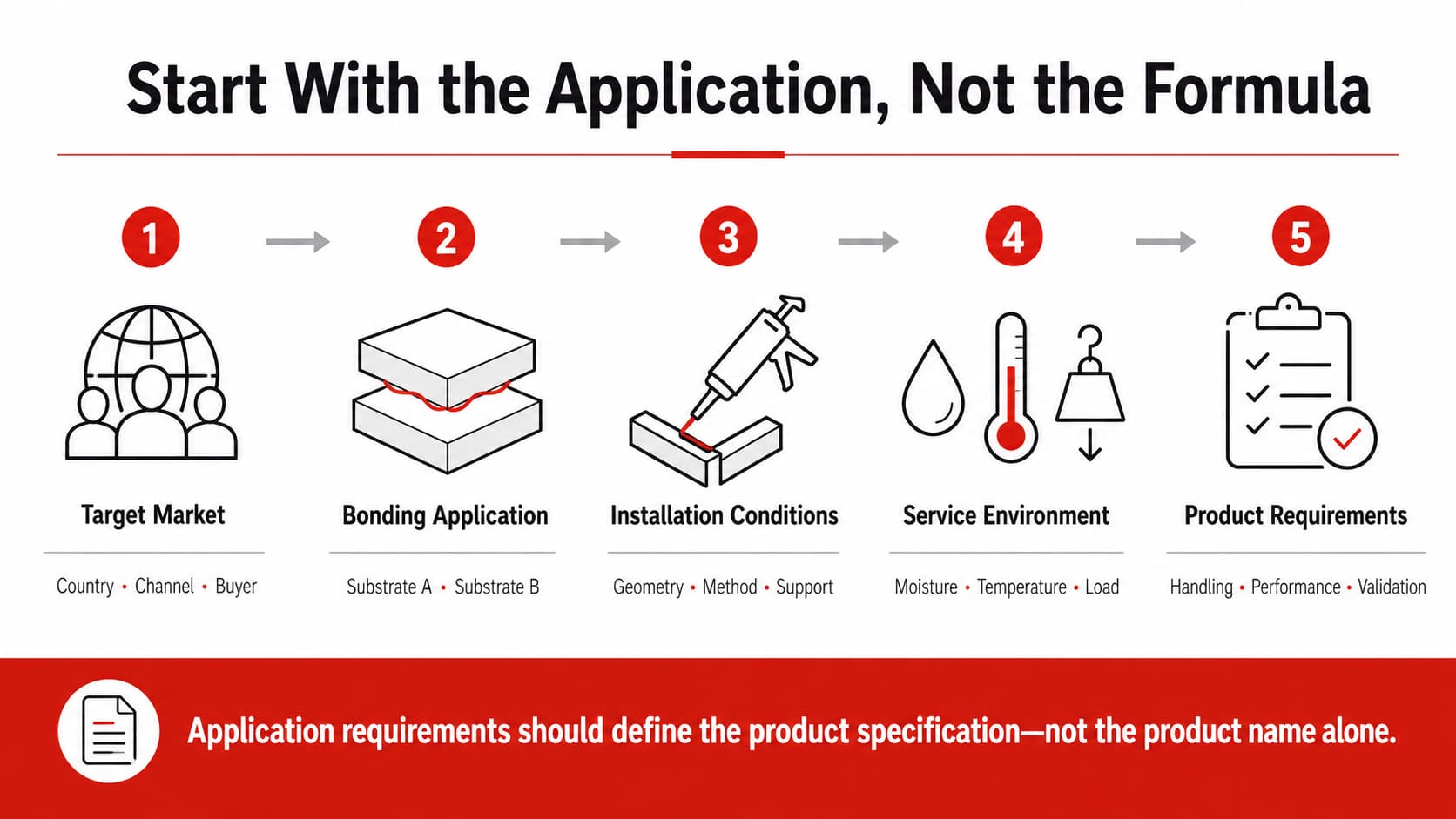
The master specification is what turns the approved development work into a production control.
Keep Formula Approval and Artwork Approval Separate
Formula approval and artwork approval should be treated as different controls.
A buyer may approve technical performance while packaging remains under revision. Artwork may also be approved while technical validation remains incomplete.
Mass production should therefore follow the complete agreed approval status rather than either decision alone.
KINGDELI's current OEM/ODM process includes requirement consultation, technical evaluation, sample development, confirmation of formula, packaging, artwork and order details, followed by mass production and quality inspection. This makes the confirmation stage an important transition between development and production.
Define Which Changes Require Reapproval
The project specification should define which later changes require review. Possible examples include:
- Formulation changes
- Performance-relevant material changes
- Color changes
- Packaging component changes
- Nozzle or closure changes
- Artwork revisions
- Barcode changes
- Carton changes
The required review level should be agreed for the individual private-label program.
Use the Master Specification for Repeat Orders
The repeat-order stage answers a different question from sample validation:
Is later production still aligned with the approved commercial product?
Repeat orders should refer back to the approved master specification, current artwork, and current packaging version rather than relying only on the first quotation or the physical sample.
Define the Repeat-Order Reference
Relevant references may include:
- Product or formulation version
- Approved performance criteria
- Packaging version
- Artwork revision
- SKU
- Applicable documentation
This creates a common commercial reference for the buyer and manufacturer.
Define Incoming Inspection
Incoming inspection can focus on the requirements that matter to the buyer's QA process, such as:
- Correct product and SKU
- Packaging version
- Artwork
- Batch or lot identification
- Visible appearance
- Selected product checks
Sampling methods and acceptance levels should follow the buyer's own QA requirements and the agreed product specification.
Manage Changes Over Time
A private-label specification is not complete when the first sample passes. It should define which product, packaging, and documentation references control later orders and how significant changes are reviewed before future production batches. This is what turns an approved sample into a repeatable commercial program.
What Information Should You Send Before Requesting a Private-Label Quote?
Before requesting a private-label No More Nails quotation, buyers should provide enough information to define the product rather than only asking for a price. Useful inputs include the target market, bonding application, substrates, performance requirements, preferred packaging, branding, validation criteria, documentation needs, expected order quantity, and shipment destination.
Market Information
- Target country or region
- Sales channel
- Buyer type
- Brand or product positioning
Application Information
- Substrate A
- Substrate B
- Surface condition
- Installation method
- Intended service environment
Product Requirements
- Chemistry, if already fixed
- Color
- Required application behavior
- Relevant working-time requirement
- Initial-grab requirement
- Cure requirement
- Adhesion or bond criteria
- Relevant durability requirements
Packaging and Branding
- Preferred package format
- Nominal content
- Nozzle or closure
- Branding requirements
- Artwork requirements
- Barcode or SKU
- Carton requirements
Validation and Documentation
- Representative test substrates
- Proposed validation method
- Acceptance criteria
- Required technical or safety documentation
- Destination-market requirements
Commercial Project Information
- Expected first-order quantity
- Estimated ongoing volume, if known
- Shipment destination
- Desired launch timing
The quantity provided by the buyer is a project input and should not be confused with a manufacturer-confirmed MOQ.
KINGDELI's OEM/ODM process begins with requirement consultation and technical evaluation, followed by sample development. A structured project brief gives that discussion a clearer starting point.
Common Private-Label Specification Mistakes to Avoid
Specifying “No More Nails” Without Defining the Application
A product name is not a complete specification. Without representative substrates, installation conditions, and service requirements, the project does not clearly identify which product characteristics matter.
Using Marketing Words Instead of Acceptance Criteria
Terms such as “premium,” “strong,” “fast,” or “high grab” can communicate general intent, but they should not replace measurable approval criteria. Critical requirements need defined conditions and pass/fail expectations.
Approving a Sample Without Defined Test Conditions
A sample that feels acceptable during one informal trial may not provide a repeatable basis for comparison. Testing becomes more useful when substrates, preparation, cure conditions, and acceptance criteria are agreed in advance.
Approving Artwork Before Product Requirements Are Stable
If the technical product remains under development, claims and other artwork content may still change. Keeping technical approval and artwork approval separate reduces unnecessary rework.
Failing to Establish a Controlled Master Specification
A successful first sample does not automatically create a repeatable private-label program. Production and repeat orders should refer to an identifiable approved specification that connects the product, acceptance criteria, sample, packaging, artwork, and documentation.
The most common private-label specification problems are problems of ambiguity: unclear applications, subjective performance language, uncontrolled approvals, and production without a stable master reference.
Related No More Nails and Private-Label Resources
Review KINGDELI's No More Nails adhesive range for the relevant product category.
For detailed packaging approval, read the No More Nails Adhesive Packaging Checklist for Importers and Retail Distributors.
For broader private-label sourcing considerations, see Can an Adhesive and Sealant Manufacturer Support Private Labeling, Packaging, and Global Shipping?
To understand KINGDELI's customization process, visit KINGDELI OEM & ODM adhesive services.
FAQ: Private-Label No More Nails Adhesive Specification
Should I specify the adhesive chemistry or the application first?
Define the application first unless chemistry is already a fixed project requirement. The substrates, installation method, service environment, and measurable performance targets give the manufacturer the context needed to evaluate an appropriate formulation approach.
What documents should be confirmed before mass production?
The required documentation depends on the product and destination market. Buyers may need product-specific technical and safety documentation, relevant test evidence, and the approved commercial specification. KINGDELI's OEM/ODM support currently includes TDS, MSDS, and test reports, with the exact documents to be confirmed for the individual product.
When should a private-label No More Nails specification be revised?
A private-label specification should be reviewed when a change could affect the approved product, its use, commercial identification, or verification basis. Depending on the project, this may include changes to formulation, performance-relevant materials, color, packaging components, artwork, barcode, or required documentation. The project should define which changes trigger technical review, commercial approval, or renewed sample validation.
Build a Product That Can Be Repeated, Not Just Sampled
A strong private-label No More Nails specification does more than help a manufacturer produce the first sample.
It defines the real application, converts important expectations into measurable acceptance criteria, identifies what product and packaging have been approved, and creates a master specification that can control production and repeat orders.
Define the application → set measurable criteria → validate the sample → freeze the approved master specification → use that reference for mass production and repeat orders.
For buyers preparing a private-label No More Nails project, the next step is to organize the application, performance, packaging, validation, documentation, and commercial information into a structured project brief before technical evaluation and sample development begin.
Ready to Define Your Private-Label No More Nails Project?
Prepare your target market, bonding application, substrates, required performance, packaging preferences, branding information, validation criteria, documentation requirements, expected order quantity, and shipment destination. KINGDELI can then evaluate the project through its OEM/ODM process before sample development and final production approval.
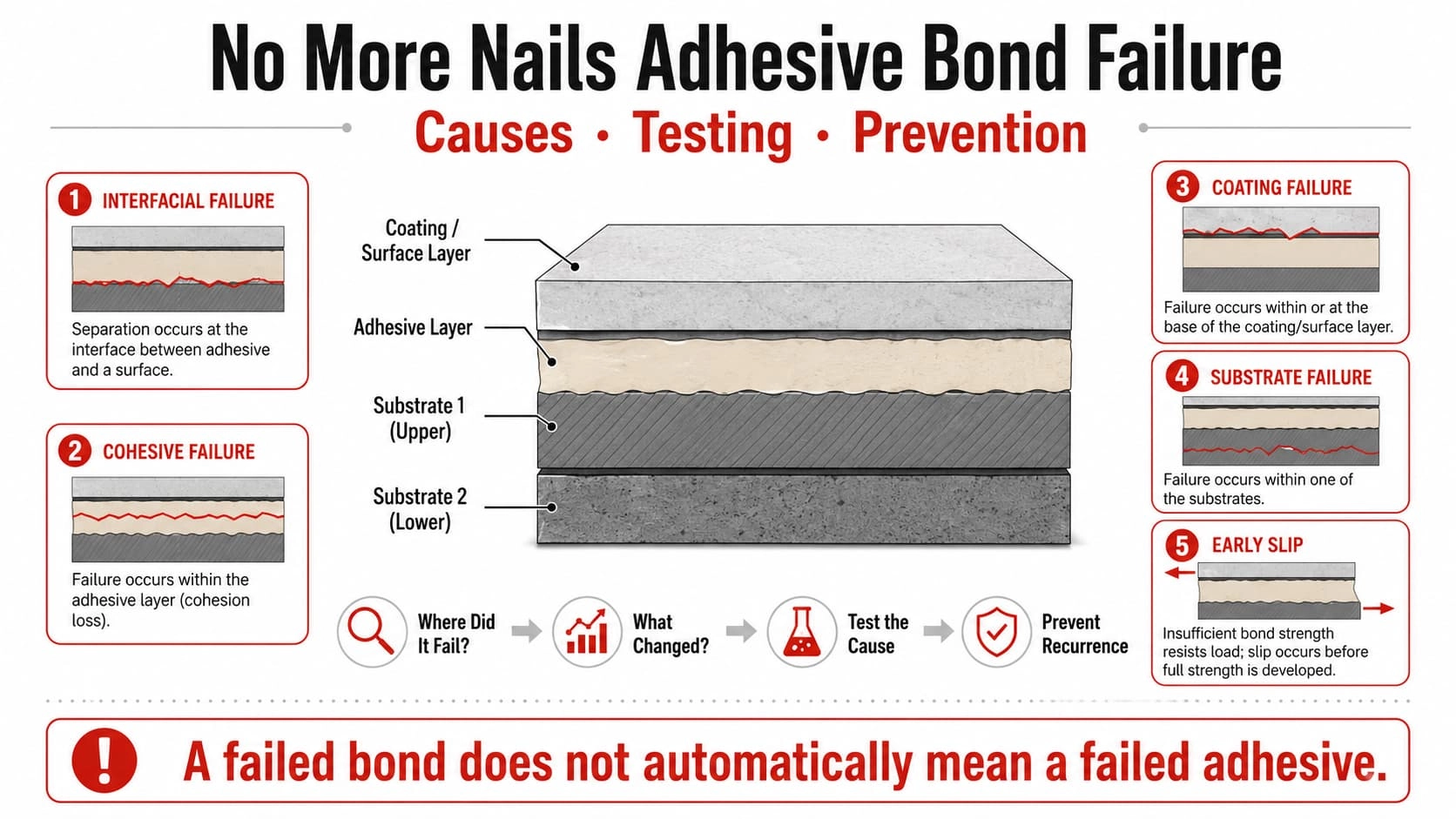
No More Nails Adhesive Bond Failure: Causes, Testing, and Prevention
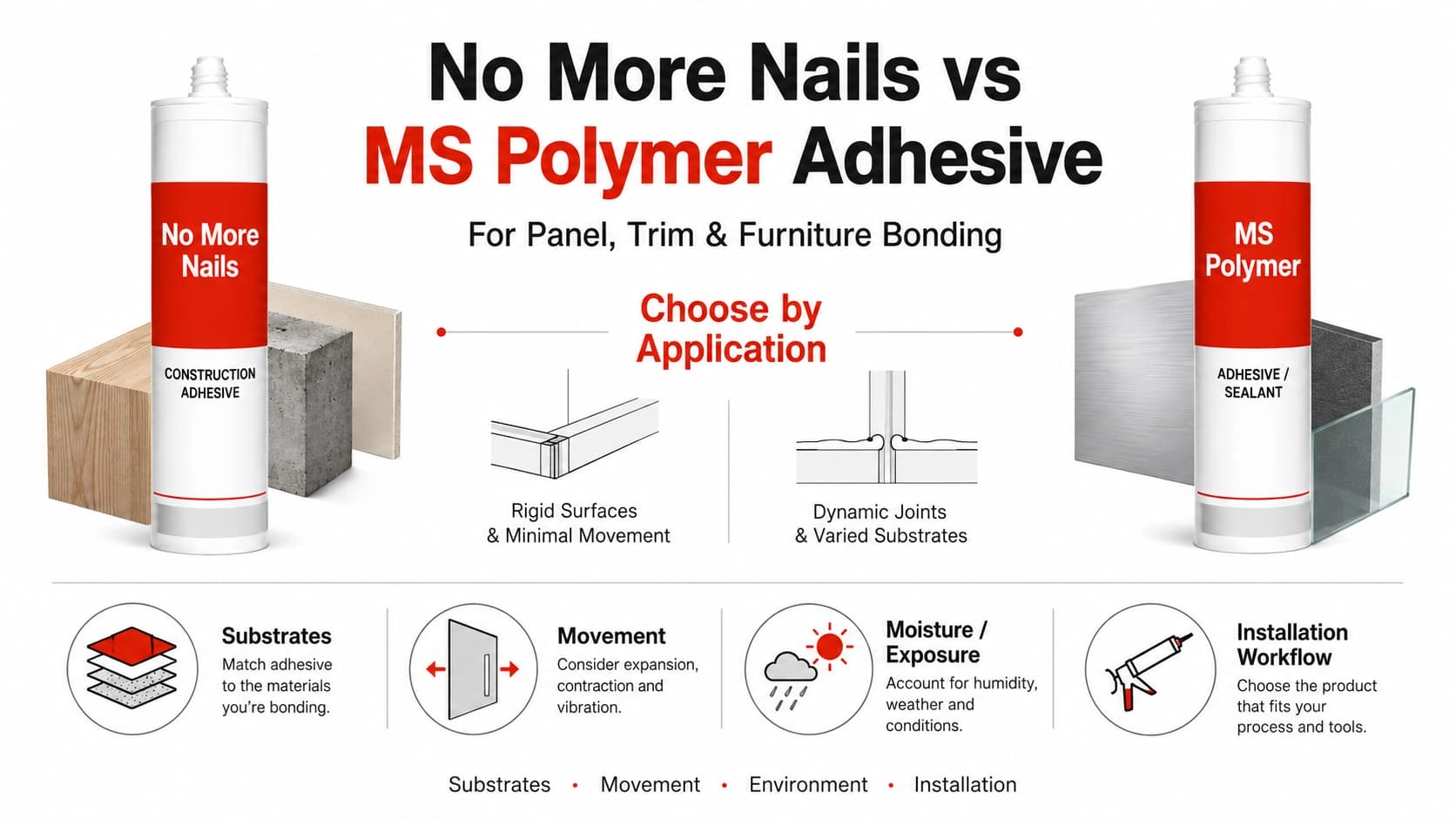
No More Nails vs MS Polymer Adhesive for Panel, Trim, and Furniture Bonding
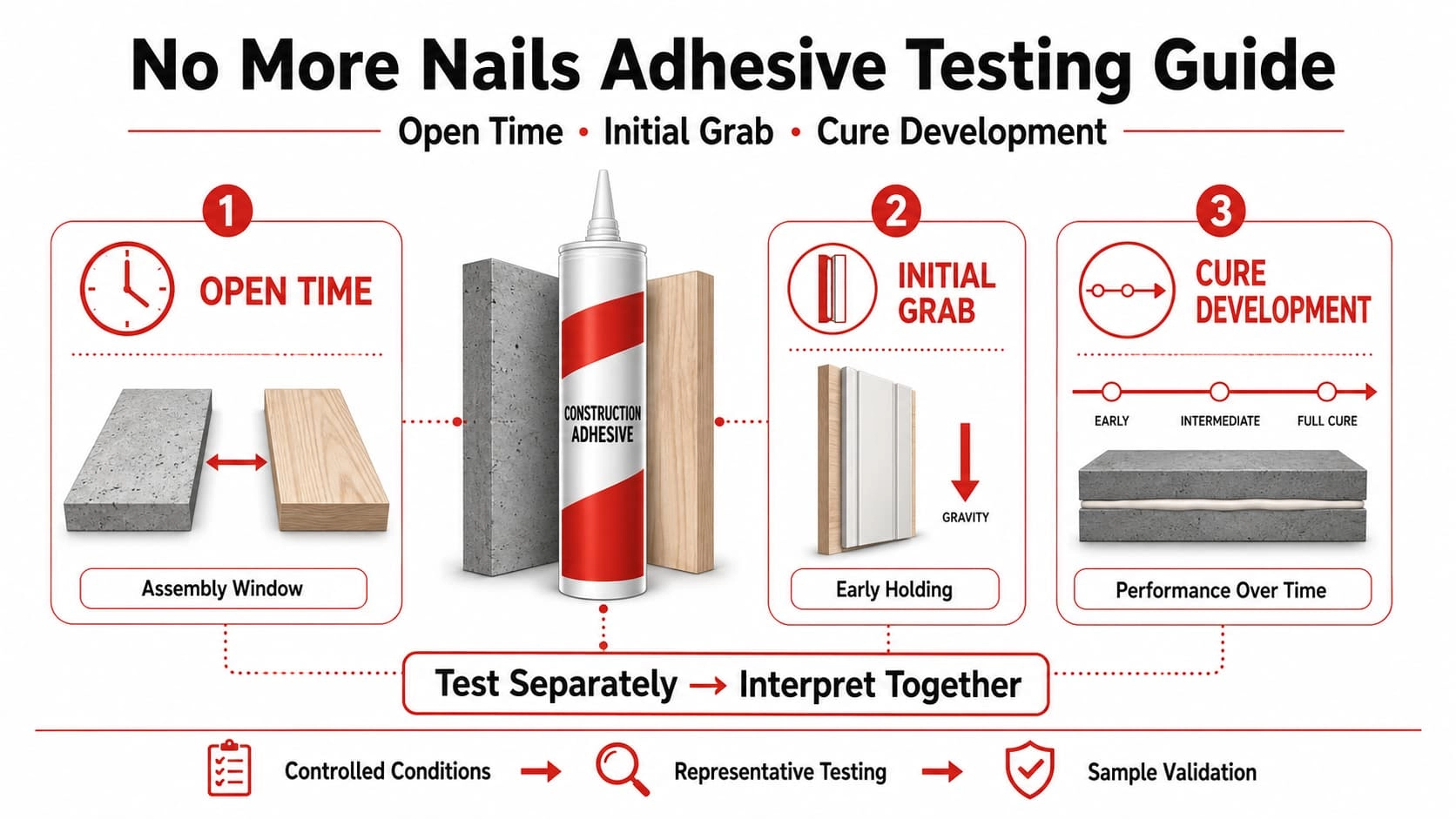
No More Nails Adhesive Open Time, Grab Strength, and Cure Testing Guide
How to Specify No More Nails Adhesive for Private Label Programs

HY992 Modified Polyurethane Construction Sealant
HY992 Modified Polyurethane Sealant is a one-component, moisture-curing construction sealant designed for professional building and structural sealing applications. It provides excellent adhesion, weather resistance, and durable elasticity, making it suitable for a wide range of construction materials.
The formulation delivers strong bonding performance without corrosion or substrate contamination, while maintaining low VOC content for environmentally responsible construction projects.

HY995 Crystal Clear Ms Polymer Adhesive/Sealant
HY995 Crystal Clear Ms Polymer Adhesive/Sealant is a new generation MS Polymer adhesive / sealant formulated for all bonding and sealing applications where long term reliability is required. It has excellent bonding strength on various materials. It will cure to form a durable, flexible, waterproof seal.

HY997 High-Performance Anti-Microbial MS Polymer Sealant
HY997 MS polymer sealant for is is a premium one-component, neutral-curing modified silane sealant engineered for demanding interior applications. It offers a Class 20 movement capability, ensuring long-lasting flexibility and reliable performance under dynamic joint conditions. Curing at room temperature, HY997 delivers superior anti-microbial and mildew-resistant properties, maintaining hygienic and clean environments over time.

KINGDELI HY732 Professional Acetoxy Cure Silicone Sealant
KINGDELI HY732 is a professional-grade, one-component acetoxy cure silicone sealant designed for fast curing, strong adhesion, and long-lasting flexibility. Ideal for aquariums, glass applications, aluminum doors and windows, kitchens, and bathrooms, it provides reliable sealing performance with excellent anti-fungal protection in high-humidity environments.
Let’s Build Stronger Bonds with Quality Adhesives and Sealants
Have questions about the topic or need tailored sealant solutions for your project?
Our team is ready to provide expert guidance, product recommendations, and application support.
Innovating with Integrity, Bonding the World
Since 1998, KINGDELI has delivered trusted, sustainable sealant solutions that connect industries and inspire progress worldwide.

Whatsapp: +8618825946249
Kingdeli
Kingdeli
Kingdeli
Kingdeli
Kingdeli