


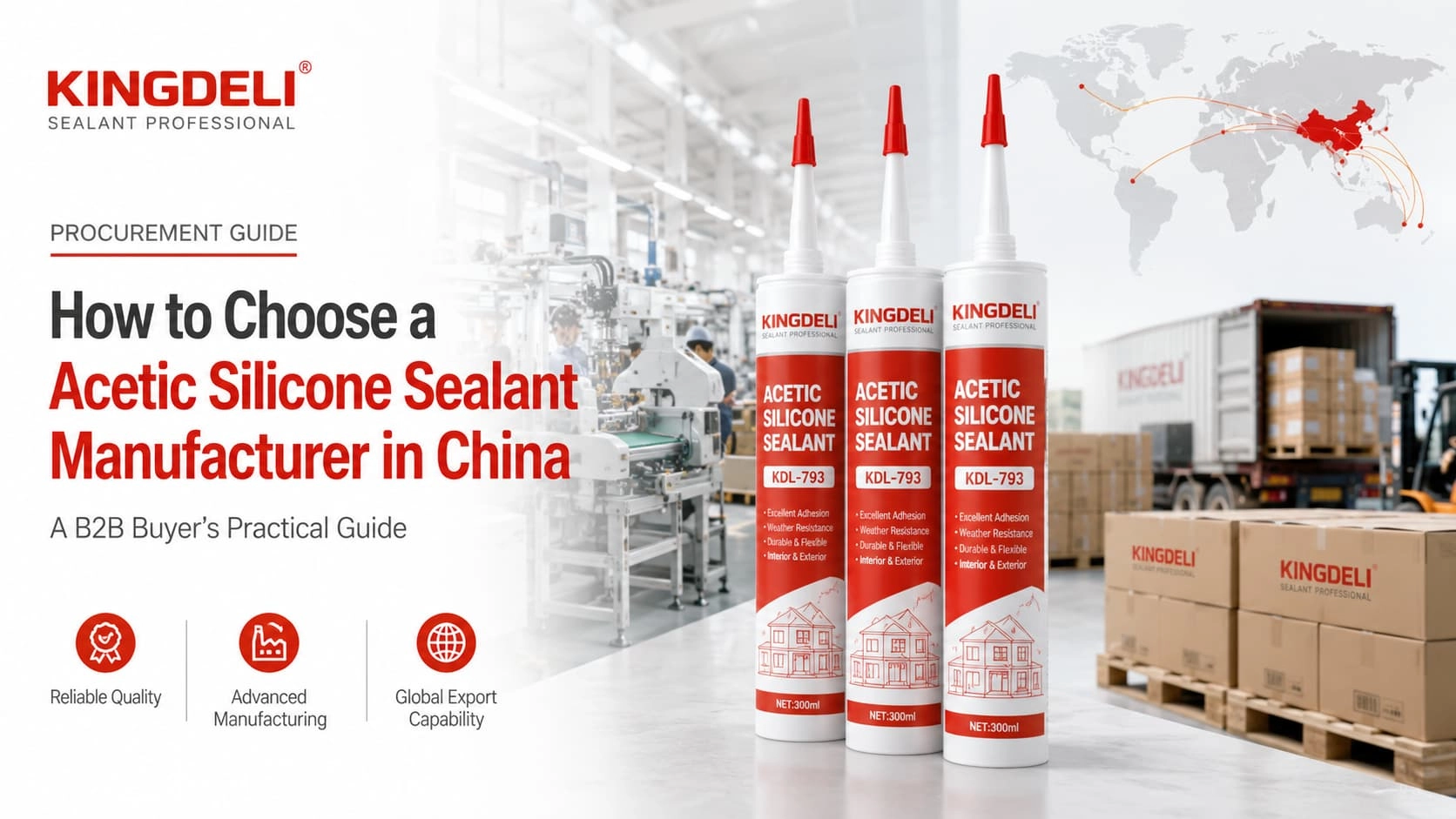
How to Choose an Acetic Silicone Sealant Manufacturer in China
This guide is written for importers, distributors, private label brands, and construction material buyers evaluating Chinese acetic silicone sealant suppliers. It covers quality signals, technical specifications, OEM/ODM considerations, factory audit questions, and common pitfalls to avoid.
Quick Buyer Summary: What Makes a Reliable Acetic Silicone Sealant Manufacturer?
Before diving into the detail, here is a fast reference for what to check across six key sourcing dimensions:
Solid content, shrinkage, curing speed, tensile strength, UV resistance — request TDS and COA for each batch
Automated filling lines, annual output, batch stability records, QC instrumentation
ISO 9001, CE EN 15651, ASTM C920, REACH, SDS — ask for copies, not just claims
Private label cartridge printing, carton design, color matching, formulation adjustment
SDS, Certificate of Origin, REACH compliance, proper palletizing for sea freight
Missing TDS, high shrinkage, abnormal density, no COA, slow or evasive technical communication
Why Source Acetic Silicone Sealant from China?
China's silicone sealant industry has developed a mature, end-to-end supply chain over the past two decades — from processing of base siloxane polymers through to automated cartridge filling and palletizing for export. This infrastructure allows buyers to access consistent product quality at manufacturing scale that is difficult to match in most other markets.
The more important question for a B2B buyer isn't whether to source from China, but how to distinguish a well-run factory from one that relies on aggressive pricing over product integrity. The sections below are designed to help you do exactly that.
What Is Acetic Silicone Sealant Used For?
Acetic silicone sealant — also called acetoxy silicone or acid-cure silicone — releases acetic acid (the compound that gives it its distinctive vinegar odor) as it reacts with moisture in the air. This curing mechanism gives it strong adhesion to non-porous, smooth surfaces.
| Substrate / Application | Acetic Silicone Suitable? | Notes |
|---|---|---|
| Glass | Yes — primary use | Excellent adhesion to silica surface |
| Glazed ceramic tiles | Yes | Fast curing, strong bond to non-porous surface |
| Aquariums | Yes | Watertight seal for glass-to-glass joints |
| Anodized / coated aluminum | Yes, with coating | Bare aluminum should use neutral cure to avoid corrosion |
| Kitchen and bathroom sealing | Yes | Suitable for smooth, non-porous surfaces |
| Bare metals (copper, brass, zinc) | No | Acetic acid can corrode bare metal surfaces |
| Mirrors | No | Acetic acid attacks silver backing — use neutral cure |
| Concrete, marble, limestone | No | Alkaline reaction causes adhesion failure and efflorescence |
When evaluating a supplier, ask whether they also offer a neutral cure silicone sealant range for substrates where acetic products would not be appropriate. A manufacturer with both ranges is better positioned to support a broader distributor product line. For more on the difference between the two systems, see our acetic vs. neutral cure silicone guide.
Key Acetic Silicone Sealant Specifications Buyers Should Check
A TDS (Technical Data Sheet) should accompany every product sample. If a supplier cannot provide one, that alone is a red flag. Below are the parameters that matter most for bulk buyers:
| Specification | Why It Matters |
|---|---|
| Appearance | Checks color consistency and cartridge stability — should be uniform on arrival |
| Skin-over time | Affects installation speed; critical for glass processing and high-volume glazing |
| Tack-free time | Determines when the surface can be handled without damage in production or on-site |
| Density (g/mL) | Helps detect excessive filler or plasticizer dilution — abnormally low density is a warning sign |
| Shore A hardness | Indicates the firmness of the cured rubber — too low may mean over-diluted formula |
| Tensile strength | Relates to bond durability under stress and wind load |
| Elongation at break | Shows flexibility after curing — important for joints subject to thermal movement |
| Shrinkage rate | Critical for preventing cracking or loss of seal — high shrinkage is a major quality failure mode |
| UV and weather resistance | Determines long-term outdoor performance on windows, facades, and exposed glass joints |
| Shelf life | Important for distributors managing inventory — confirm storage temperature requirements |
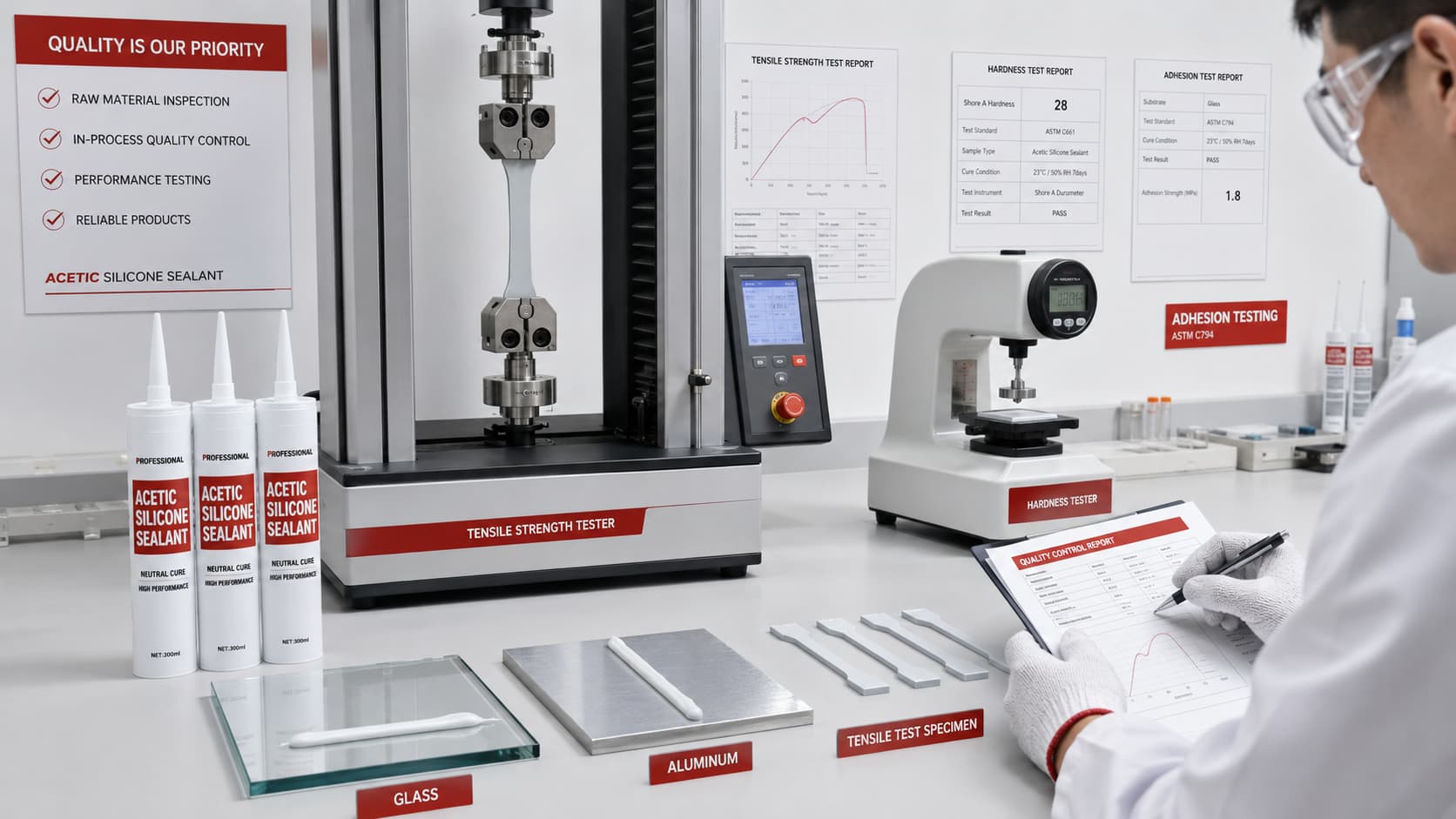
Request a Product Sample with TDS and COA
KINGDELI provides product samples with full technical documentation for qualified importers, distributors, and OEM buyers. Tell us your application, target market, and preferred cartridge format.
Request a Sample →Core Factors for Evaluating an Acetic Silicone Sealant Manufacturer
Raw Material Purity and Formula Stability
The foundation of a quality acetic sealant is a high-purity base polymer — typically 107 RTV silicone rubber. The most common way substandard manufacturers cut costs is by adding excessive amounts of white oil (mineral plasticizer) to extend the product. This lowers the effective silicone polymer content, which leads to high shrinkage on curing, reduced tensile strength, and poor long-term adhesion — particularly visible on glass after months of UV exposure. A well-run factory tests raw materials using instruments such as gas chromatography and rheometers before they reach production, ensuring batch-to-batch consistency.
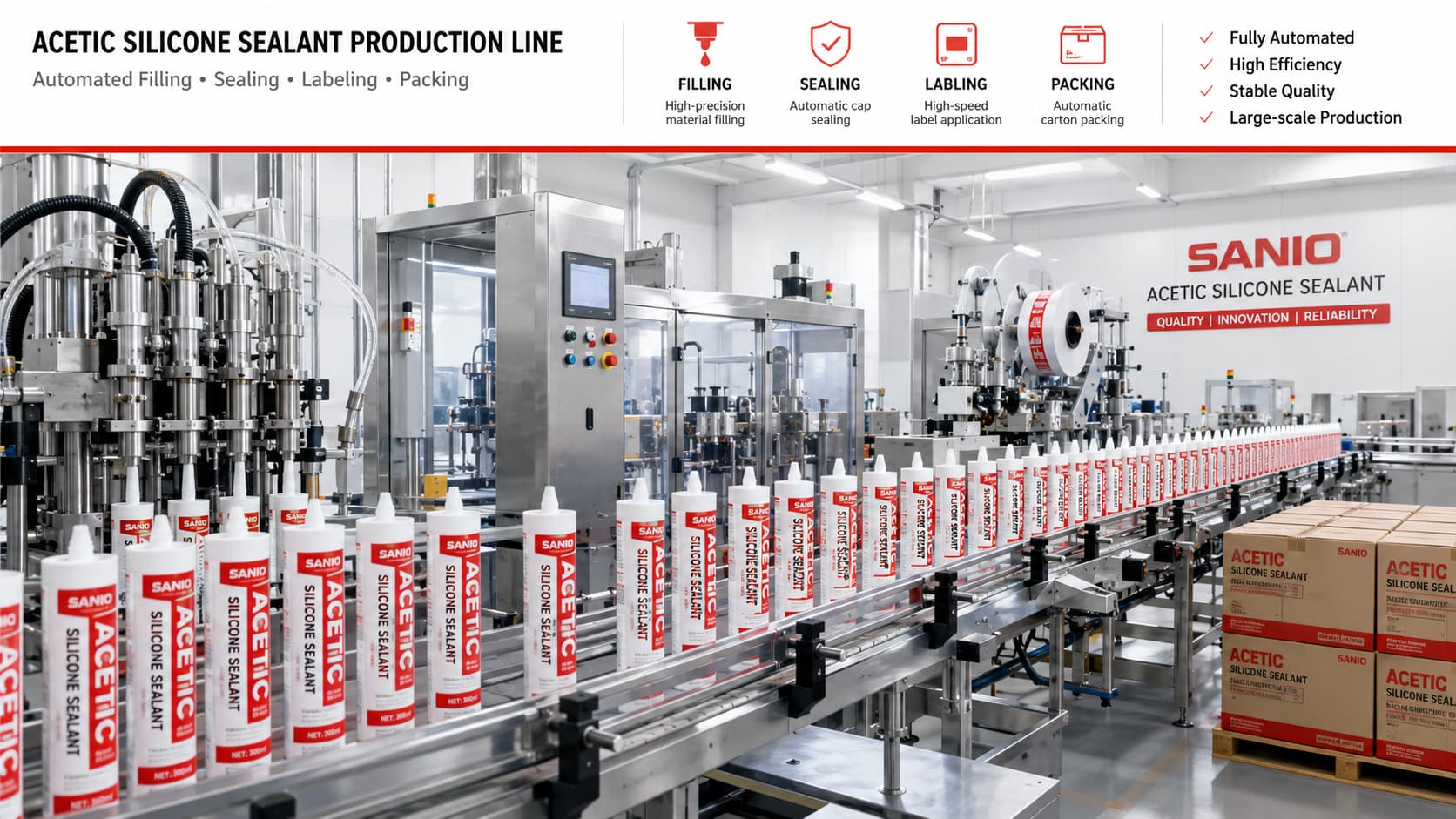
Production Capacity and Automated Filling Lines
For volume buyers, supply reliability is as important as product quality. A factory relying on manual batch mixing cannot deliver the same consistency as one operating continuous twin-screw extruders and automated cartridge-filling lines. Ask about annual capacity, lead time for a container-load order, and how they handle a surge in volume without compromising batch quality. A supplier who can give you specific numbers — not just "large capacity" — is generally more credible.
Quality Control and Batch Traceability
Ask the factory how they trace a failed batch back to its raw material lot. A QC-serious manufacturer maintains production records that link each cartridge batch to a specific raw material delivery, mixing log, and test result. This traceability matters if you ever need to file a quality claim or identify the source of a consistency issue across multiple orders.
International Certifications and Compliance
Look for ISO 9001 (quality management system) as a baseline. Product-level certifications depend on your destination market: CE EN 15651 for Europe, ASTM C920 for North America, and REACH documentation if you're importing to the EU. Ask for the actual certificate and its current validity date — not just a logo on a catalog page. Most quality suppliers will also provide REACH declarations and SDS without being asked.
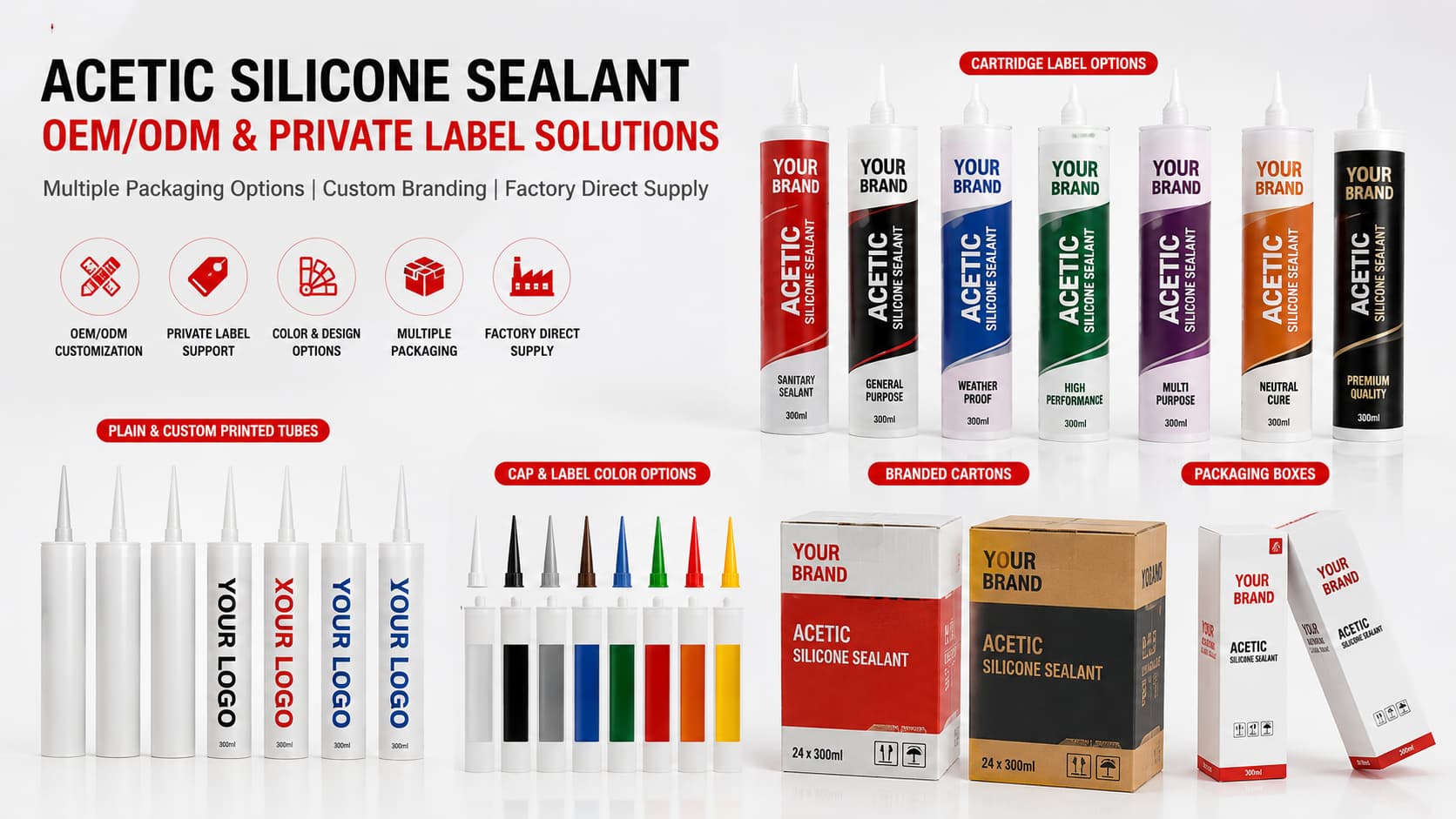
OEM/ODM and Private Label Packaging
If you're building a brand or private label program, confirm the supplier's OEM capability before requesting a sample. Key questions: What is the MOQ for a custom-printed cartridge? Can they match a specific sealant bead color? Can the formula be adjusted for higher humidity or colder climates? How are packaging samples approved? A supplier with real OEM experience will have a defined sampling and approval process rather than improvising each request. KINGDELI's OEM/ODM program covers custom cartridge printing, carton design, and formulation tuning.
Export Documentation and Logistics Support
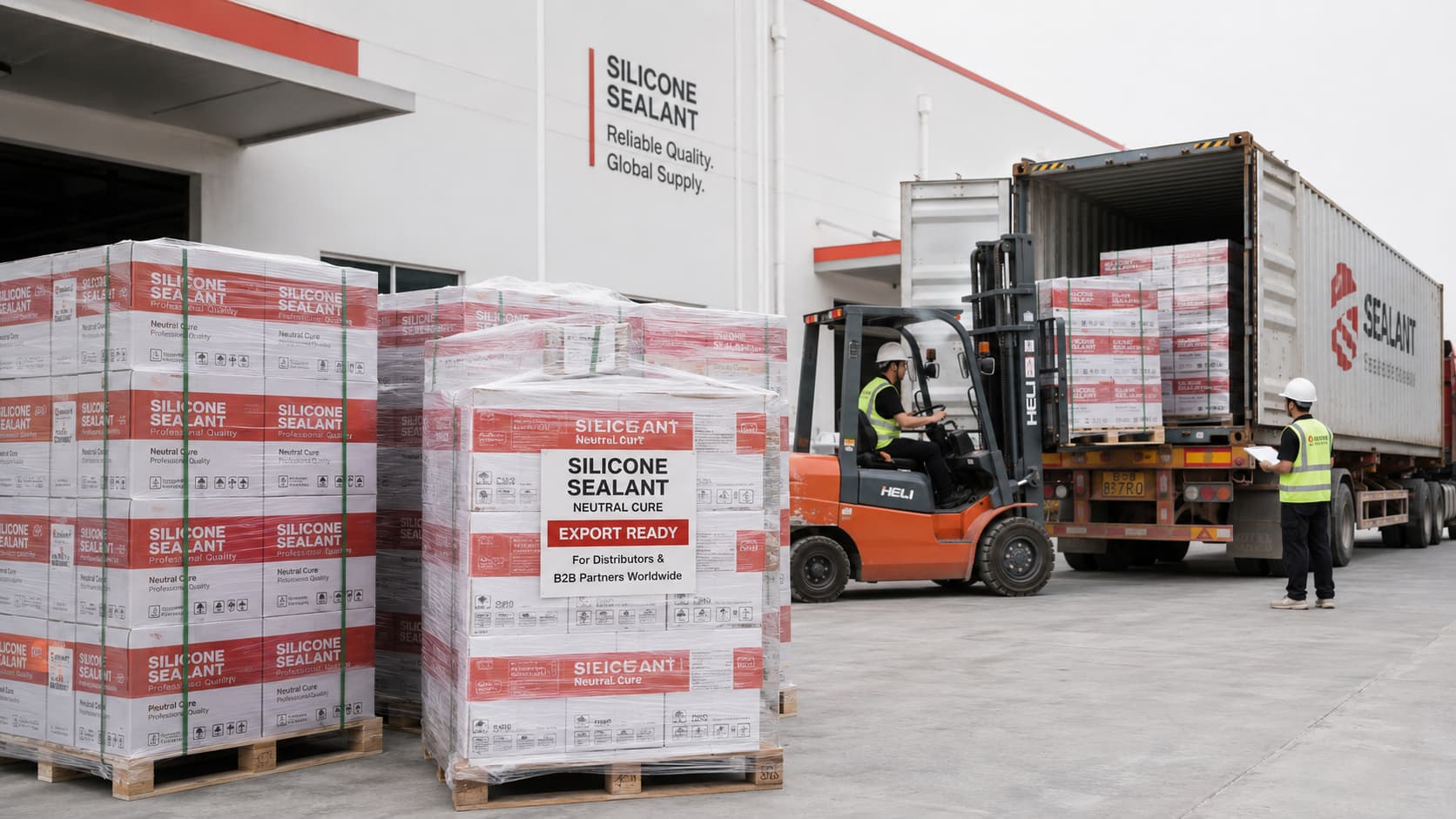
Chemical exports require a specific document set: SDS (Safety Data Sheet) formatted to your destination country's standard, Certificate of Origin, packing lists that correctly classify the product under HS codes, and for EU markets, a REACH declaration. A supplier who has exported to your region before will have most of this ready. Ask specifically about how they palletize cartridge cartons for sea freight — poor stacking or insufficient blocking can result in significant product damage on long voyages.
Factory Audit and Order Checklist for Bulk Buyers
Use this checklist when evaluating a new supplier before placing your first container-load order.
Request product samples alongside the corresponding TDS and COA — do not test a sample without the documentation
Confirm raw material sourcing: ask which grade of 107 RTV silicone rubber base is used and whether white oil content is disclosed
Verify ISO 9001 certificate validity and ask for product-level test reports (CE / ASTM as applicable to your market)
Request a SDS (Safety Data Sheet) formatted for your destination country
Ask for a packaging sample (printed cartridge + outer carton) if placing an OEM order
Clarify lead time for a full container-load order versus a smaller trial order
Confirm container loading plan: number of cartons, pallet configuration, and whether mixed SKUs are supported
Ask how batch failures are handled — does the supplier offer replacement or credit, and what documentation is required?
Test the sample against the TDS values — especially shrinkage, density, and tack-free time — before committing to volume
Evaluate communication quality: can the technical team discuss Shore A hardness, tensile strength, and elongation clearly?
Common Pitfalls to Avoid When Selecting a Chinese Supplier
Choosing Only by the Lowest Price
The cheapest quote almost always reflects a formulation compromise somewhere — most often excess white oil or low-quality base polymer. A cartridge that pumps well out of the tube but shrinks, cracks, or loses adhesion after three months will cost far more in customer complaints, warranty claims, and brand damage than the few cents per cartridge saved at the sourcing stage. Always ask for a density reading and shrinkage data when comparing quotes from different suppliers.
Accepting Products Without TDS or COA
If a supplier cannot provide a Technical Data Sheet for the product and a Certificate of Analysis per batch, you have no verified basis for the performance claims they make. This is not a minor documentation gap — it's a sign that quality testing may not be systematic. Do not place a bulk order on the basis of a verbal assurance.
Ignoring Shrinkage and Filler Content
High shrinkage after cure is one of the most common failure modes in lower-quality acetic sealants. It occurs when volatile solvents or excessive plasticizer evaporates during the curing process, reducing volume. The result is a seal that cracks, pulls away from the substrate, or loses elasticity prematurely. Test the sample in your actual application conditions before bulk ordering.
Overlooking Technical Communication Quality
If the supplier's sales contact cannot explain Shore A hardness, tooling time, modulus, or elongation at break with confidence — and instead only talks about price per cartridge — they likely cannot accurately translate your technical requirements to their production team. For OEM programs or specialized applications, this gap will cause problems at some point in the supply relationship.
Ready to Evaluate KINGDELI as Your Acetic Sealant Supplier?
Send us your target application, destination market, required product format, and annual volume. Our technical team will respond with product recommendations, TDS documentation, and factory-direct pricing.
Start a Bulk Order Inquiry →Why KINGDELI Is a Reliable Acetic Silicone Sealant Manufacturer in China
KINGDELI has manufactured silicone sealants in Foshan, Guangdong since 1998 — one of China's primary chemical manufacturing regions — and currently operates a 66,000m² production facility with an annual capacity of 100,000 tons.
66,000m² production facility in Foshan, Guangdong with automated filling and packaging lines
100,000 tons annual output across silicone, polyurethane, MS polymer, and acrylic sealant categories
ISO 9001 certified manufacturing, CE-compliant products, full SDS and COA documentation per batch
Custom cartridge printing, carton design, color matching, and formulation adjustment for climate and substrate requirements
KINGDELI's acetic silicone sealant range includes products engineered for glass glazing, window and door manufacturing, aquarium sealing, and bathroom and kitchen applications. For glass-specific programs, our glass glazing silicone sealant range covers both acetic and neutral cure systems depending on the substrate mix. Global distributor partners and importers can also access our OEM/ODM program for private label supply under their own brand.
Acetic Silicone Sealant Range
For glass, glazed ceramic, aquariums, coated aluminum, and smooth non-porous surfaces. Fast curing, UV-resistant, available in multiple colors.
View range →Glass Glazing Silicone Sealant
Engineered specifically for glazing contractors, window manufacturers, and facade assembly — acetic and neutral cure options available.
View range →Neutral Silicone Sealant Range
For metal, stone, concrete, mirrors, and mixed-substrate construction applications where acetic acid would cause corrosion or adhesion failure.
View range →OEM / Private Label Program
Custom printed cartridges, carton design, color matching, and formulation adjustment for distributors, importers, and retail brands.
Learn more →Published by KINGDELI, established 1998. This guide is written for B2B buyers evaluating Chinese acetic silicone sealant suppliers. It reflects the evaluation criteria KINGDELI's own export team applies when onboarding new distributor partners. For application-specific guidance, contact our technical team directly.
FAQ
How do I choose an acetic silicone sealant manufacturer in China?
Evaluate raw material purity, production automation level, batch consistency records, third-party certifications (ISO 9001, CE, ASTM C920), OEM/private label capability, and export documentation experience. Request a TDS, SDS, and COA before placing a bulk order.
What documents should a silicone sealant supplier provide?
A reliable supplier should provide a Technical Data Sheet (TDS), Safety Data Sheet (SDS), Certificate of Analysis (COA), ISO certification copies, CE or ASTM test reports where applicable, and a Certificate of Origin for export.
What specifications should I check before bulk ordering acetic silicone sealant?
Key parameters include skin-over time, tack-free time, Shore A hardness after cure, tensile strength, elongation at break, shrinkage rate, density, UV/weather resistance, shelf life, and movement capability. A reputable manufacturer will provide these on a TDS for each specific product.
Can I order private label acetic silicone sealant from China?
Yes. Most established manufacturers offer OEM and ODM services covering private label cartridge printing, custom carton design, sealant color matching, and minor formulation adjustments for climate or substrate requirements. Request a packaging sample and MOQ confirmation before committing.
What packaging options are available for bulk silicone sealant?
Common options include 300ml plastic cartridges, 600ml sausage foil packs, and 200L/1000L drum formats. Manufacturers supporting OEM programs can customize cartridge printing, shrink-wrap labeling, and outer carton design.
How can I avoid low-quality or over-diluted silicone sealant?
Request a density test result and shrinkage rate from the COA. Excessive white oil dilution typically shows up as abnormally low density, high shrinkage after cure, and poor long-term adhesion. Test a sample against the TDS values before bulk ordering.
What applications are suitable for acetic silicone sealant?
Acetic silicone is generally well-suited for glass, glazed ceramic, aquariums, anodized or coated aluminum, and kitchen and bathroom sealing. It is generally not recommended for bare metals, mirrors, concrete, marble, or limestone.
What is the typical MOQ for OEM silicone sealant?
MOQ depends on product type and packaging format. Standard cartridge products typically start at a full pallet or part-container, while fully custom OEM programs with new formulations generally require higher minimums. Contact the manufacturer with your target volume to confirm.
How do I request samples before placing a bulk order?
Contact the supplier with your target application, required cartridge format, and any specific performance requirements. A reputable manufacturer will ship a sample together with the corresponding TDS and COA so you can test it against your specifications before committing to volume.
What is the difference between acetic silicone sealant and neutral silicone sealant?
Acetic silicone releases acetic acid during curing, which gives it strong adhesion to glass and non-porous surfaces but makes it unsuitable for bare metals, mirrors, and alkaline substrates. Neutral silicone releases a non-corrosive alcohol or oxime instead, making it safer for metals, stone, concrete, and mixed-substrate assemblies. See our full acetic vs. neutral silicone comparison guide.
Ready to Source Acetic Silicone Sealant from KINGDELI?
Share your application, target market, required product specification, and annual volume. KINGDELI's export team will respond with product recommendations, TDS documentation, and factory-direct pricing.
Send an Inquiry →





Whatsapp: +8618825946249
Kingdeli
Kingdeli
Kingdeli
Kingdeli
Kingdeli