











Supplier Audit Checklist for Polyurethane Windshield Adhesives

- Quality and Compliance Checklist for Automotive Glass Bonding Compounds
- Regulatory and Standards Verification
- Material Specification and Formulation Controls
- Third-Party and In-House Testing Protocols
- Operational and Process Audit Items for Urethane Windshield Bonding
- Manufacturing Line Controls and Traceability
- Environmental and Cleanroom Requirements
- Process Validation and Continuous Improvement
- Supplier Capability, Risk Management, and Commercial Continuity
- Capacity, Lead Time, and Scalability
- Supply Chain Resilience and Raw Material Sourcing
- Packaging, Logistics, and Storage Validation
- Performance Verification: Laboratory and Field Validation
- Pre-Qualification and OEM Compatibility Testing
- Failure Modes, Warranty Data, and Historical Performance
- Sustainability, Health & Safety Considerations
- Frequently Asked Questions
Comprehensive audit guidance for procurement and quality teams assessing suppliers of automotive urethane glass bonding compounds, emphasizing regulatory conformity, process controls, mechanical and environmental testing, supply continuity, and factory-level quality systems to mitigate installation failures and warranty risk while aligning material specifications with vehicle OEM glazing requirements and relevant standards such as polyurethane chemistry, ISO 9001 quality management, and ASTM testing protocols.
Quality and Compliance Checklist for Automotive Glass Bonding Compounds
Regulatory and Standards Verification
Confirm the supplier maintains up-to-date certifications for quality and environmental systems. Required credentials typically include ISO 9001 for quality management and ISO 14001 for environmental controls; suppliers should also provide test evidence aligned with recognized bodies such as ASTM or SAE for bond strength and weathering. Cross-check claim documentation against external registries and request copies of latest audit reports and non-conformance records to validate continuous compliance.
Material Specification and Formulation Controls
Request detailed formulation documentation including cure mechanism (e.g., moisture-curing urethane), VOC content, adhesion promoters, and compatibility statements for common glass coatings and primer systems. Approved supplier dossiers must include technical data sheets (TDS), safety data sheets (SDS), and certificate of analysis (CoA) for representative batches showing critical properties: tensile strength, elongation at break, Shore hardness, modulus, and glass transition temperature where applicable.
Third-Party and In-House Testing Protocols
Evaluate the supplier’s laboratory capabilities and independent lab relationships. Essential tests include lap shear and tensile adhesion on pre-treated glass and primers, dynamic peel tests, thermal cycling, humidity exposure, and UV/accelerated weathering. Confirm test methods reference recognized standards (for example, ASTM D1002 for lap shear and ASTM D4587 for accelerated weathering) and ensure statistically valid sampling plans are used for lot release.
Operational and Process Audit Items for Urethane Windshield Bonding
Manufacturing Line Controls and Traceability
Inspect production lines for automated dosing accuracy, mixing homogeneity, and contamination controls. A reliable supplier should have batch-level traceability from raw materials to finished cartridges or drums, unique batch identifiers, and retained sample policies. Automated dispensing and closed transfer systems reduce operator variability and particulate ingress, improving consistency across production lots.
Environmental and Cleanroom Requirements
Because moisture-sensitive chemistries can cure prematurely, factory environmental controls are critical. Evaluate HVAC performance, humidity stabilization, desiccant storage, and material handling that prevents moisture exposure. For high-reliability automotive applications, verify dedicated zones for primer application and a documented prevention plan for moisture-related defects.
Process Validation and Continuous Improvement
Process validation should include capability studies (Cp/Cpk) for key variables such as viscosity, extrusion rate, and cure time. Confirm corrective action and preventive action (CAPA) mechanisms are in place and that suppliers use statistical process control (SPC) to monitor drift. Evidence of lean manufacturing practices and uptime metrics supports predictable delivery and reduced nonconformance rates.
Supplier Capability, Risk Management, and Commercial Continuity
Capacity, Lead Time, and Scalability
Assess installed capacity, typical lead time variances, and surge capabilities. Buyers should request demonstrated annual output figures and contingency plans for demand spikes. Cross-check production capacity with physical plant size and automation level; suppliers with fully automated lines and multi-shift operations typically provide greater throughput reliability.
Supply Chain Resilience and Raw Material Sourcing
Investigate the provenance of critical raw inputs: polyols, isocyanates (or alternative chemistries for low-VOC formulations), and specialty adhesion enhancers. Evaluate multi-sourcing strategies, vendor qualification processes, and safety stocks. Visibility into upstream suppliers and substitution plans reduces exposure to single-source disruptions.
Packaging, Logistics, and Storage Validation
Confirm packaging formats (cartridges, sausages, bulk drums, or IBCs) match customer dispensing systems and shelf-life requirements. Inspect cold-chain or humidity-protective packing where necessary and validate transport condition monitoring for long-distance shipments. Clear shelf-life labeling, lot codes, and instructions for on-site storage are essential for maintaining bond quality after delivery.
Performance Verification: Laboratory and Field Validation
Pre-Qualification and OEM Compatibility Testing
Require suppliers to provide pre-qualification reports demonstrating compatibility with OEM glazing substrates and coatings, including adhesion with common primer systems and anti-reflective or hydrophobic coatings. Field trials should include full vehicle-level crash and NVH (noise, vibration, and harshness) validation when applicable to ensure the bonding compound meets structural and safety requirements.
Failure Modes, Warranty Data, and Historical Performance
Request supplier failure analysis reports and warranty claim statistics. A transparent supplier will provide root-cause analysis for past failures, corrective measures taken, and metrics that demonstrate trend improvements. Buyers should prioritize suppliers that share longitudinal reliability datasets and have low warranty incidence for windshield adhesion failures.
Sustainability, Health & Safety Considerations
Inspect VOC performance, low-emission formulations, and worker exposure controls. For markets with strict environmental regulation, confirm compliance labeling and low-VOC certifications. Also verify that SDS documentation, emergency response plans, and occupational exposure limits are communicated and enforced at the facility.
| Dimension | Manual Quality Control | Automated Inline Monitoring |
|---|---|---|
| Sampling frequency | Periodic, often batch-based (e.g., 1 sample/lot) | Continuous data capture with high temporal resolution |
| Detection speed | Delayed (hours to days) | Immediate (real-time alerts) |
| Repeatability | Operator dependent | High repeatability with instrument calibration |
| Upfront cost | Lower capital cost, higher labor | Higher capital investment, lower per-unit QA cost |
| Best use case | Low-volume or early-stage suppliers | High-volume automotive suppliers needing 24/7 assurance |
Supplier evaluation should balance the economics of quality assurance with operational risk: high-value automotive projects often justify investment in automated inline monitoring to reduce latent defect risk and warranty exposure.
Since its establishment in 1998, KINGDELI has stood as a global leader in the high-performance sealant, adhesive, and coating industry. Headquartered in Foshan, China, our state-of-the-art 66,000 m² facility is powered by fully automated production lines with an annual capacity exceeding 100,000 tons, ensuring a consistent and robust supply for partners worldwide.As a recognized National High-Tech Enterprise and a key contributor to the National Standard GB/T 29755-2013, we unite advanced manufacturing power with technical excellence. Our comprehensive product portfolio—spanning Neutral & Acetic Silicone, Polyurethane, MS Polymer, and No More Nails adhesives—is engineered to meet strict international standards, including ISO 9001, ISO 14001, CE, and ASTM.With over 27 years of industry expertise and a trusted presence in 50+ countries, KINGDELI is more than a manufacturer; we are a dedicated solution provider. We offer end-to-end OEM/ODM support, sustainable low-VOC formulations, and professional technical service. At KINGDELI, we are driven by innovation and integrity, building trust and sealing the future for customers around the globe.
Our recommended product set for glazing and structural bonding projects includes neutral silicone sealant, acetic silicone sealant, Acrylic Sealant, silicone glazing sealant, No More Nails adhesive, Polyurethane Sealant, MS polymer Sealant, RTV Gasket Maker, Epoxy Tile Grout, and Self-Leveling Sealant, each available in customer-specific formulations and packaging options to support installation workflows and on-site dispensing systems.
Operational teams responsible for procurement and supplier qualification should use this checklist as a minimum baseline: verify certifications, confirm lab capabilities and validated test data, inspect production controls and environmental conditioning, confirm supply chain redundancy, and require demonstrable field performance or OEM endorsements. Supplement audits with witness testing during a production run and insist on contractually bound quality KPIs and penalty clauses to protect vehicle programs.
Authoritative sources and standards referenced in developing this checklist include polyurethane technical context, ISO 9001 guidance on quality systems, and testing frameworks available from ASTM International. For automotive-specific safety and regulatory expectations, consult industry guidance from the Society of Automotive Engineers (SAE) and national transport authorities for crashworthiness and glazing integrity.
Implementation tip: create a supplier audit scorecard with weighted criteria—technical validation (40%), production & traceability (25%), supply resilience (15%), sustainability & HSE (10%), and commercial terms (10%). Use this quantified approach to compare multiple vendors and justify supplier selection with objective metrics tied to program risk tolerance.
To schedule a factory audit, request batch-level technical documentation, or discuss tailored low-VOC structural bonding compounds for automotive glazing, contact KINGDELI’s technical sales team through the corporate contact channels provided on the company website.
Frequently Asked Questions
What certifications should a supplier of windshield bonding urethane provide?
Suppliers should provide ISO 9001 certification for quality management, ISO 14001 for environmental management where applicable, and test reports referencing ASTM or SAE methods for adhesion and durability. Additionally, supplier-specific audit reports and third-party laboratory validations increase confidence.
How is batch traceability for automotive bonding compounds typically maintained?
A robust traceability system uses unique batch identifiers tied to raw material lot codes, retained sample policies, digital batch records, and chain-of-custody documentation for packaging and shipping, enabling root-cause analysis in case of field failures.
Which tests are essential to validate an auto glass bonding material before approval?
Essential tests include lap shear and tensile adhesion tests on primed glass, dynamic peel tests, thermal cycling, humidity exposure, UV/accelerated weathering, and full-vehicle compatibility trials for structural bonding and crash performance when required.
What production controls reduce variability in urethane glazing adhesives?
Automated metering and mixing systems, closed material handling to prevent moisture ingress, SPC for key variables (viscosity, extrusion rate), environmental controls (stable humidity and temperature), and inline monitoring significantly reduce process variability.
How should buyers evaluate supplier resilience and capacity for large automotive programs?
Evaluate demonstrated annual output, surge capacity, multi-shift operations, contingency sourcing of critical raw materials, safety stock policies, and documented business continuity plans. Evidence of automated high-throughput production and multi-sourcing reduces program disruption risk.
Curing Times and Temperature Effects for Self-Leveling Sealants
Silicone Sealant for Windows and Doors: Samples, Lead Times, Risks
Best acrylic sealant for glass manufacturers and supplier brands in Automotive Solutions
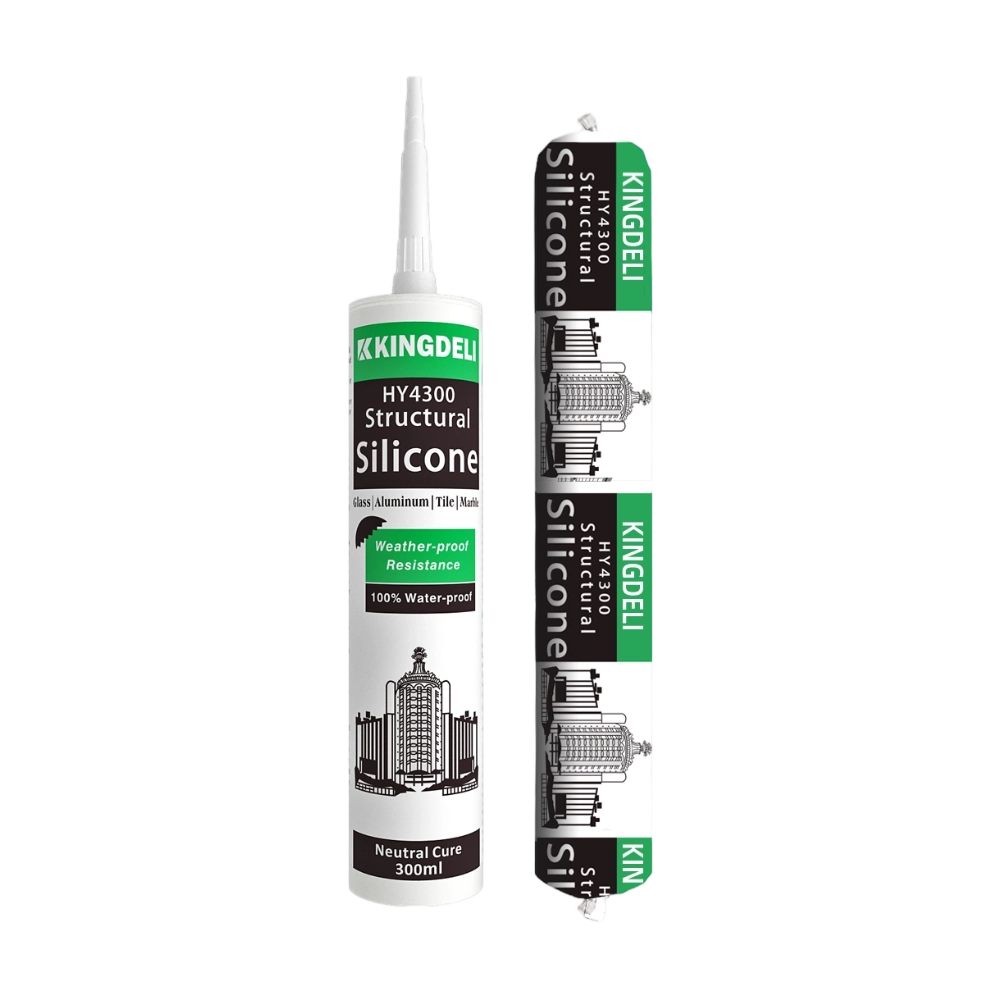
HY-4300 Structural Silicone Sealant — High-Strength Silicone for Structural Glazing

HY992 Modified Polyurethane Construction Sealant
HY992 Modified Polyurethane Sealant is a one-component, moisture-curing construction sealant designed for professional building and structural sealing applications. It provides excellent adhesion, weather resistance, and durable elasticity, making it suitable for a wide range of construction materials.
The formulation delivers strong bonding performance without corrosion or substrate contamination, while maintaining low VOC content for environmentally responsible construction projects.

HY995 Crystal Clear Ms Polymer Adhesive/Sealant
HY995 Crystal Clear Ms Polymer Adhesive/Sealant is a new generation MS Polymer adhesive / sealant formulated for all bonding and sealing applications where long term reliability is required. It has excellent bonding strength on various materials. It will cure to form a durable, flexible, waterproof seal.

HY997 High-Performance Anti-Microbial MS Polymer Sealant
HY997 MS polymer sealant for is is a premium one-component, neutral-curing modified silane sealant engineered for demanding interior applications. It offers a Class 20 movement capability, ensuring long-lasting flexibility and reliable performance under dynamic joint conditions. Curing at room temperature, HY997 delivers superior anti-microbial and mildew-resistant properties, maintaining hygienic and clean environments over time.

KINGDELI HY732 Professional Acetoxy Cure Silicone Sealant
KINGDELI HY732 is a professional-grade, one-component acetoxy cure silicone sealant designed for fast curing, strong adhesion, and long-lasting flexibility. Ideal for aquariums, glass applications, aluminum doors and windows, kitchens, and bathrooms, it provides reliable sealing performance with excellent anti-fungal protection in high-humidity environments.
Let’s Build Stronger Bonds with Quality Adhesives and Sealants
Have questions about the topic or need tailored sealant solutions for your project?
Our team is ready to provide expert guidance, product recommendations, and application support.
Innovating with Integrity, Bonding the World
Since 1998, KINGDELI has delivered trusted, sustainable sealant solutions that connect industries and inspire progress worldwide.

Whatsapp: +8618825946249
Kingdeli
Kingdeli
Kingdeli
Kingdeli
Kingdeli