











Neutral Silicone Sealant Buyer’s Guide for Construction Projects

- Selecting Neutral-Cure Silicone for Construction Joints
- Why I choose a neutral silicone sealant for sensitive substrates
- Chemistry and cure mechanisms I rely on
- Performance attributes I specify
- Specifying, Testing and On-Site QA for Sealant Performance
- Substrate preparation and compatibility checks I insist on
- Field testing protocols I use
- Joint design rules I apply
- Procurement, Storage and Application Best Practices
- Sourcing and packaging considerations
- Storage, handling and shelf life practices I enforce
- Health, safety and VOC compliance I check
- Why KINGDELI solutions reduce project risk and lifecycle cost
- Manufacturing scale and quality assurance I trust
- Standards, certifications and technical depth I require
- Product breadth and on-the-ground support I recommend
- Frequently Asked Questions
I write from 15+ years specifying sealants and adhesives on commercial buildings and infrastructure: this neutral silicone sealant buyer’s guide distills what I look for when I prescribe a product for glazing, curtain wall joints, metal-to-glass interfaces, and sensitive substrates — covering chemistry, cure profiles, joint design, compatibility issues, VOC/safety considerations, testing, and procurement. The guide emphasizes real-world decision criteria (adhesion to anodized aluminum, corrosion risk, movement capability, skin time and full cure, and lifecycle maintenance), cites international quality and chemical safety references such as Silicone - Wikipedia, ISO 9001, and ECHA, and concludes with how KINGDELI’s scale, standards, and product range translate into lower project risk and consistent supply.
Selecting Neutral-Cure Silicone for Construction Joints
Why I choose a neutral silicone sealant for sensitive substrates
In my experience, the phrase neutral silicone sealant signals a critical property: it cures without releasing acetic acid. That makes it my default for anodized aluminum, stainless steel, and certain metals where corrosive by-products would be unacceptable. On projects where longevity and low corrosion risk matter, specifying a neutral cure reduces callbacks and maintenance cycles versus acetic-cure alternatives. I also weigh movement accommodation — many neutral silicones offer +/-25% or more, which meets most facade movement requirements.
Chemistry and cure mechanisms I rely on
Neutral silicones cure by moisture in air via non-acetic chemistries (commonly oxime, alkoxy, or alkyl-alkoxy variants), producing non-corrosive by-products such as alcohols or ketoximes. Understanding this helps me avoid substrate staining and galvanic corrosion. For background chemistry and differences, I refer to the material overview on Silicone - Wikipedia. When I specify a neutral silicone sealant I ask suppliers for the specific neutral curing mechanism to confirm compatibility with finishes and coatings.
Performance attributes I specify
When writing specifications I require clear numeric performance metrics: tensile strength, elongation at break, movement capability, adhesion to prepared substrates, and service temperature. Typical service ranges for neutral silicones are roughly -50°C to +150°C, and typical skin times are 5–30 minutes with full cure at approximately 24 hours per 3–5 mm depth under standard conditions. I always require manufacturer-backed test data and project-specific adhesion tests if the substrate or coating system is new to the project.
Specifying, Testing and On-Site QA for Sealant Performance
Substrate preparation and compatibility checks I insist on
Good adhesion starts with surface prep: contaminants, primers, and old sealant residues must be addressed. I specify solvent wipe, mechanical cleaning or grit blasting where appropriate, followed by primer trials. For each job I run a small mock-up and peel tests to verify adhesion; when the sealant manufacturer corroborates compatibility with anodized aluminum or painted steel it reduces risk. I also ask for documented compatibility with common paints and coatings to avoid adhesion loss or blush.
Field testing protocols I use
I require adhesion and elongation checks on site and recommend periodic inspection intervals post-installation. Where project specifications call for standardized testing, I reference internationally accepted practices — and I confirm the product has third-party test reports aligned with ASTM procedures as applicable (see ASTM Standards). These controls catch problems early and protect warranty obligations.
Joint design rules I apply
I design joints to control sealant depth-to-width ratios (usually 1:2 or as manufacturer recommends) and to ensure proper tooling and backing material use (closed-cell polyethylene backer rods are typical). Correct joint ratio and tooling ensure the neutral silicone sealant performs to specified movement capability and avoids three-sided adhesion, which can cause premature failure.
Procurement, Storage and Application Best Practices
Sourcing and packaging considerations
When procuring neutral silicone sealant I evaluate supply chain reliability and batch traceability. I require shelf-life information (typically 12–24 months if stored per manufacturer guidance) and packaging that supports jobsite handling (cartridges, sausages, or bulk). I also compare cure profiles between product SKUs to match application speed needs, especially for large glazing programs where cure speed affects scheduling.
Storage, handling and shelf life practices I enforce
I store sealants in a cool, dry place away from direct sunlight. Most neutral silicone sealants remain stable at 5–25°C; extremes shorten shelf life. On projects I log lot numbers and expiry dates so we can rotate stock and avoid installation of out-of-spec material — this reduces the risk of adhesion issues that show up months later.
Health, safety and VOC compliance I check
Low-VOC formulations are now standard in many jurisdictions. I check regulatory and safety data sheets and cross-reference chemical safety information at ECHA and workplace guidance on OSHA where applicable. When specifying for occupied buildings I prioritize low-VOC, low-odor neutral silicone sealant options and require that the manufacturer provide VOC test data and emission certificates.
| Property | Neutral Silicone Sealant | Acetic Silicone Sealant | Polyurethane Sealant |
|---|---|---|---|
| Cure by/By-product | Moisture cure (alkoxy/oxime) – non-acidic by-products (alcohols/oximes) | Moisture cure – acetic acid (vinegar odor) | Moisture cure – urethane linkages; may produce low-molecular volatiles |
| Corrosion risk on metals | Low | Higher (can corrode sensitive metals) | Low to moderate; substrate primers often required |
| Paintability | Generally not paintable; special formulations exist | Not paintable | Typically paintable after cure |
| Movement capability | High (often ±25% or higher) | Moderate to high | Moderate (good mechanical strength) |
| Typical service temperature | -50°C to +150°C (typical) | -40°C to +120°C (typical) | -40°C to +90°C (typical) |
| Common uses | Glazing, metal-to-glass, sensitive metals, sanitary joints | Bathrooms, sanitary, non-metallic joints | Concrete joints, expansion joints needing paintability |
Why KINGDELI solutions reduce project risk and lifecycle cost
Manufacturing scale and quality assurance I trust
Procurement decisions should factor in supplier stability. Since its establishment in 1998, KINGDELI has stood as a global leader in the high-performance sealant, adhesive, and coating industry. Headquartered in Foshan, China, our state-of-the-art 66,000 m² facility is powered by fully automated production lines with an annual capacity exceeding 100,000 tons, ensuring a consistent and robust supply for partners worldwide.
Standards, certifications and technical depth I require
As a recognized National High-Tech Enterprise and a key contributor to the National Standard GB/T 29755-2013, we unite advanced manufacturing power with technical excellence. Our comprehensive product portfolio—spanning Neutral & Acetic Silicone, Polyurethane, MS Polymer, and No More Nails adhesives—is engineered to meet strict international standards, including ISO 9001, ISO 14001, CE, and ASTM. I rely on suppliers that provide test reports, material safety data sheets, and documented QA processes aligned with ISO 9001 expectations to reduce specification risk on projects.
Product breadth and on-the-ground support I recommend
In practice I specify neutral silicone sealant alongside complementary products for complex building envelopes: acetic silicone sealant for certain sanitary applications, Acrylic Sealant for paintable trim, silicone glazing sealant for structural glass joints, No More Nails adhesive for interior fixtures, Polyurethane Sealant and MS polymer Sealant for concrete and expansion joints, RTV Gasket Maker for custom flanged seals, Epoxy Tile Grout for durable joints, and Self-Leveling Sealant for horizontal movement joints. KINGDELI’s portfolio and OEM/ODM capabilities let me standardize across projects and get technical responses quickly when mock-ups uncover unexpected substrate issues.
With over 27 years of industry expertise and a trusted presence in 50+ countries, KINGDELI is more than a manufacturer; we are a dedicated solution provider. We offer end-to-end OEM/ODM support, sustainable low-VOC formulations, and professional technical service. At KINGDELI, we are driven by innovation and integrity, building trust and sealing the future for customers around the globe.
In my contracts I require traceability to batch numbers, manufacturer certificates, and clear warranty terms; KINGDELI’s automated production and certification profile make these deliverables straightforward and auditable on large programs. That consistency saves project teams time and cost during testing and commissioning phases.
On technical support I expect timely site assistance for priming, adhesion troubleshooting, and mock-up testing; KINGDELI offers these services to ensure the neutral silicone sealant and complementary products perform as specified across climates and substrates.
If you want a proven neutral silicone sealant and a supplier with documented quality systems and global logistics, evaluate KINGDELI’s technical datasheets, compatibility matrices, and field support as part of your procurement checks.
Contact KINGDELI’s technical team for product data sheets, third-party test reports, and mock-up support to validate performance on your specific substrates and coatings.
Frequently Asked Questions
What is a neutral silicone sealant and how does it differ from acetic silicone?
A neutral silicone sealant cures by moisture using non-acidic cure chemistries (oxime/alkoxy) and does not release acetic acid; this makes it suitable for metals and sensitive substrates. Acetic silicone cures release acetic acid (vinegar odor) and can corrode certain metals.
When should I specify a neutral silicone sealant for a construction project?
I specify neutral silicone sealant for metal-to-glass interfaces, anodized aluminum, stainless steel, and other sensitive substrates where corrosion and staining must be avoided, and where high movement capability and long service temperature range are required.
How do I verify adhesion and compatibility on site?
Run a small mock-up and on-site peel or adhesion tests per project protocol, review manufacturer adhesion data, and confirm primer requirements; I also require third-party test reports aligned with ASTM procedures when applicable.
Are neutral silicone sealants paintable and what are the typical service temperatures?
Most silicones (including many neutral silicones) are not paintable unless they are formulated specifically to accept coatings; typical service temperature ranges for neutral silicones are approximately -50°C to +150°C, but you should confirm on the product datasheet.
How should neutral silicone sealant be stored and what is the shelf life?
Store in a cool, dry place away from direct sunlight, typically between 5–25°C; most neutral silicone sealants have a shelf life of 12–24 months if stored per manufacturer instructions, and lot numbers/expiry dates should be tracked on projects.
Top 10 ms polymer sealant Manufacturers and Supplier Brands in Hardware and Building Materials
OEM/ODM ms polymer adhesive sealant Manufacturers and Suppliers
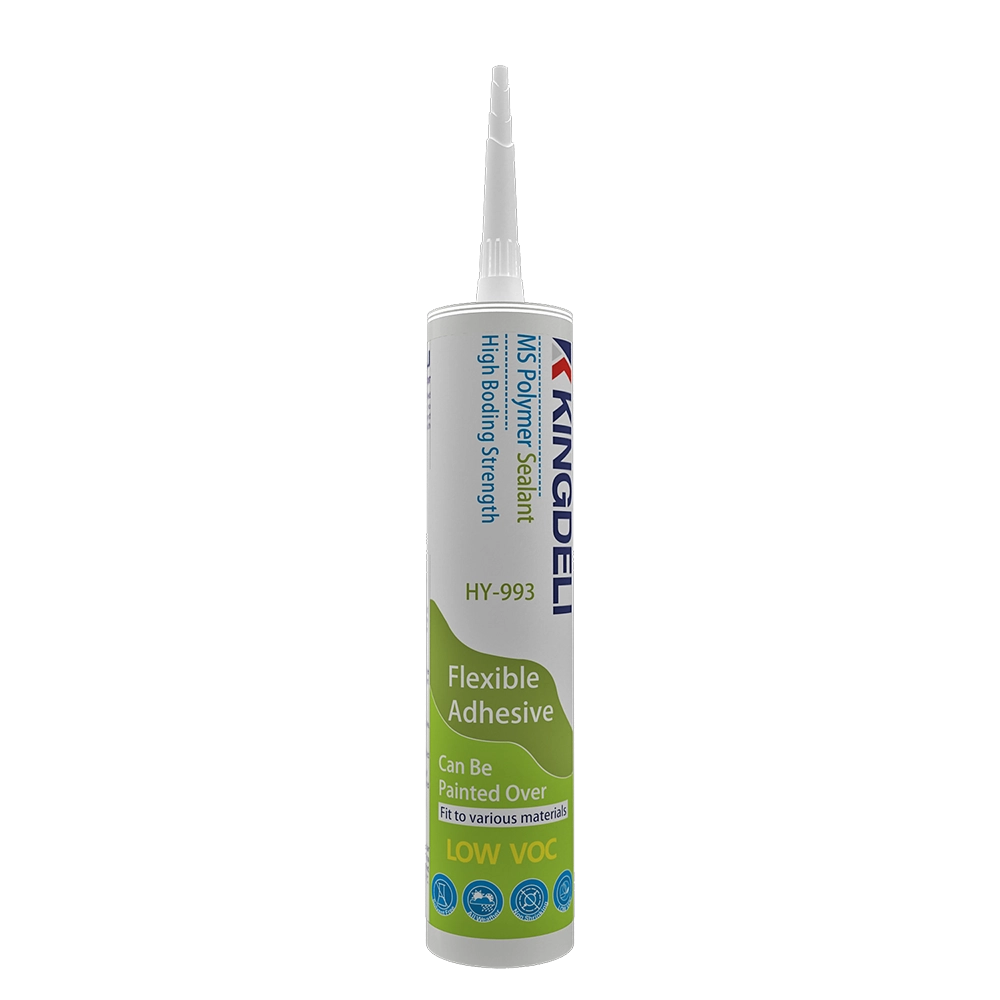
HY993 High-Strength MS Polymer Adhesive Sealant | KINGDELI
OEM/ODM silicone rtv sealant Manufacturers and Suppliers

HY992 Modified Polyurethane Construction Sealant
HY992 Modified Polyurethane Sealant is a one-component, moisture-curing construction sealant designed for professional building and structural sealing applications. It provides excellent adhesion, weather resistance, and durable elasticity, making it suitable for a wide range of construction materials.
The formulation delivers strong bonding performance without corrosion or substrate contamination, while maintaining low VOC content for environmentally responsible construction projects.

HY995 Crystal Clear Ms Polymer Adhesive/Sealant
HY995 Crystal Clear Ms Polymer Adhesive/Sealant is a new generation MS Polymer adhesive / sealant formulated for all bonding and sealing applications where long term reliability is required. It has excellent bonding strength on various materials. It will cure to form a durable, flexible, waterproof seal.

HY997 High-Performance Anti-Microbial MS Polymer Sealant
HY997 MS polymer sealant for is is a premium one-component, neutral-curing modified silane sealant engineered for demanding interior applications. It offers a Class 20 movement capability, ensuring long-lasting flexibility and reliable performance under dynamic joint conditions. Curing at room temperature, HY997 delivers superior anti-microbial and mildew-resistant properties, maintaining hygienic and clean environments over time.

KINGDELI HY732 Professional Acetoxy Cure Silicone Sealant
KINGDELI HY732 is a professional-grade, one-component acetoxy cure silicone sealant designed for fast curing, strong adhesion, and long-lasting flexibility. Ideal for aquariums, glass applications, aluminum doors and windows, kitchens, and bathrooms, it provides reliable sealing performance with excellent anti-fungal protection in high-humidity environments.
Let’s Build Stronger Bonds with Quality Adhesives and Sealants
Have questions about the topic or need tailored sealant solutions for your project?
Our team is ready to provide expert guidance, product recommendations, and application support.
Innovating with Integrity, Bonding the World
Since 1998, KINGDELI has delivered trusted, sustainable sealant solutions that connect industries and inspire progress worldwide.

Whatsapp: +8618825946249
Kingdeli
Kingdeli
Kingdeli
Kingdeli
Kingdeli