











Market Trends: Forecasts and Opportunity in PU Windshield Supply

- Market Forces Reshaping Automotive Windshield Bonding
- Vehicle complexity is increasing material-performance expectations
- Replacement glazing creates recurring regional demand
- Regulation and vehicle safety raise the cost of nonconformance
- Forecast Signals and Commercial Opportunities in PU Supply
- Growth is likely to favor qualified, flexible suppliers
- Low-emission and safer chemistry are becoming procurement differentiators
- Digital documentation and traceability strengthen buyer confidence
- How Buyers Can Build a Resilient Windshield Adhesive Program
- Define a qualification protocol before requesting quotations
- Balance regional logistics with formulation shelf life
- Measure supplier value through operational outcomes
- KINGDELI Capabilities for Global Sealants and Adhesives Procurement
- Manufacturing scale supports continuity and customization
- Quality systems and standards support international projects
- Low-VOC development and international service create additional value
- Frequently Asked Questions
The market for polyurethane windshield bonding systems is moving from a commodity purchasing model toward a performance-led supply strategy. Vehicle manufacturers, glass processors, collision-repair networks, distributors, and fleet operators increasingly require materials that support structural integrity, rapid vehicle release, compatibility with coated glass and sensors, lower emissions, and dependable global availability. Demand is supported by continued vehicle production, replacement glazing, electric and connected vehicles, and the increasing technical complexity of windscreen installation. For procurement teams, the opportunity is not simply to source a cartridge or sausage pack; it is to establish a validated supply chain covering formulation, application equipment, quality documentation, logistics, and field support.
Market Forces Reshaping Automotive Windshield Bonding
Vehicle complexity is increasing material-performance expectations
Modern windshields are no longer passive transparent panels. They may carry cameras, rain sensors, heating elements, head-up display components, antenna systems, acoustic layers, and solar-control coatings. The bonding compound must therefore maintain a stable interface between glass, paint, metal, and treated surfaces while avoiding movement that could affect sensor calibration. Adhesive selection has become part of the vehicle safety and electronics integration process rather than an isolated consumables decision.
Electric vehicles add another layer of demand. Their quiet cabins make wind noise, water ingress, and vibration more noticeable, while lightweight body structures can impose different tolerance and deformation conditions. A suitable moisture-curing polyurethane formulation should provide controlled modulus, durable elasticity, strong adhesion, and predictable cure behavior across the installation environment. Buyers should require application data that reflects actual glass, coating, substrate, humidity, temperature, and bead geometry rather than relying only on generic tensile values.
Replacement glazing creates recurring regional demand
Original equipment production attracts attention because of its scale, but replacement glazing provides a recurring revenue stream for distributors and service networks. Replacement demand is influenced by road conditions, weather, vehicle age, insurance practices, fleet utilization, and the availability of qualified technicians. A supplier that can support multiple pack sizes, private labeling, technical documentation, and stable regional inventory can create stronger value than a low-price source with inconsistent lead times.
Repair operators also prioritize safe drive-away time. Faster curing can improve workshop throughput, but speed must not be treated as an isolated purchasing criterion. The installation system must be evaluated alongside primer flash-off, ambient humidity, temperature, bead dimensions, glass positioning, vehicle movement, and the manufacturer’s recommended minimum drive-away time. Buyers should distinguish between a product’s tack-free time, cure rate, and validated safe return-to-service requirements.
Regulation and vehicle safety raise the cost of nonconformance
Windshield retention contributes to occupant protection and vehicle body performance. Automotive glazing requirements are addressed in regulatory frameworks such as UNECE Regulation No. 43, while quality management expectations for automotive supply chains are commonly structured around IATF 16949. These references do not replace application validation, but they demonstrate why traceability, change control, documented testing, and process discipline matter.
Technical buyers should also review the relationship between adhesive performance and the complete glazing system. Surface preparation, primer selection, glass frit, paint condition, corrosion protection, bead placement, tooling, and technician training can materially influence results. A technically strong material cannot compensate for contaminated substrates or an uncontrolled installation process.
Forecast Signals and Commercial Opportunities in PU Supply
Growth is likely to favor qualified, flexible suppliers
Public market forecasts differ because analysts define the category in different ways, combining or separating original equipment, aftermarket, glass bonding, and broader automotive adhesives. A more reliable planning method is to track observable demand signals: vehicle production volumes, vehicle parc age, collision frequency, windshield replacement rates, electric vehicle adoption, glazing content per vehicle, and regional repair capacity. The International Energy Agency’s Global EV Outlook documents the continuing expansion of electric mobility, a trend that supports ongoing demand for specialized vehicle assembly and repair materials.
For suppliers, the strongest opportunity lies in combining product breadth with application competence. OEM programs may require customized rheology, robotic dispensing behavior, accelerated curing, packaging automation, and extensive validation. Aftermarket customers may value easy extrusion, broad substrate compatibility, long shelf life, convenient packaging, and technical guidance. Distributors need reliable minimum order quantities, multilingual documentation, consistent labeling, and predictable replenishment. One formulation and one sales model rarely serve every segment effectively.
Low-emission and safer chemistry are becoming procurement differentiators
Environmental and occupational requirements are influencing adhesive specifications. Low-VOC, solvent-reduced, and safer handling systems can help manufacturers and repair facilities improve workplace conditions and meet sustainability objectives. However, environmental claims should be supported by safety data sheets, technical data sheets, test reports, and clearly defined measurement methods. The ISO 14001 environmental management standard provides a recognized framework for systematic environmental management, but it is not a substitute for product-specific emissions or performance evidence.
Procurement teams should compare total installed cost rather than unit price. A slightly higher-priced sealant may reduce rework, glass breakage, technician downtime, warranty exposure, inventory complexity, and vehicle waiting time. The commercial calculation should include usable yield per pack, waste at the nozzle, storage losses, primer consumption, labor minutes, return rates, and the cost of a failed installation.
Digital documentation and traceability strengthen buyer confidence
Automotive customers increasingly expect lot identification, production records, shelf-life visibility, change notifications, and rapid response to nonconformities. Digital technical files can make it easier to connect a batch number with formulation version, manufacturing date, test results, and shipment details. For multinational buyers, documentation should be available in the languages and formats required by local operations, customs authorities, auditors, and downstream customers.
A supplier evaluation should include a technical dossier containing technical data sheets, safety data sheets, adhesion test methods, cure profiles, storage conditions, packaging specifications, compatibility guidance, quality certificates, and recommended installation procedures. Where the product is used in a safety-critical glazing application, the buyer should request validation on representative substrates and define approval criteria before commercial rollout.
| Procurement factor | Basic sourcing approach | Performance-led sourcing approach | Business impact |
|---|---|---|---|
| Product selection | Compares price and package size | Reviews modulus, adhesion, cure, compatibility, and validated application data | Reduces rework and warranty risk |
| Quality control | Relies on incoming visual inspection | Requires batch traceability, defined release tests, and change control | Improves consistency across locations |
| Supply planning | Places irregular spot orders | Uses demand forecasts, safety stock, and agreed replenishment rules | Protects workshop and assembly-line continuity |
| Sustainability | Uses broad environmental claims | Requests documented VOC, packaging, and environmental management information | Supports credible compliance reporting |
| Technical support | Receives a product datasheet only | Receives substrate guidance, troubleshooting, training, and implementation support | Accelerates qualification and reduces installation errors |
How Buyers Can Build a Resilient Windshield Adhesive Program
Define a qualification protocol before requesting quotations
Before comparing suppliers, project owners should document the actual application: glass type, ceramic frit, painted body substrate, existing adhesive residue, bead dimensions, dispensing method, ambient conditions, required open time, drive-away target, packaging format, and expected monthly volume. The protocol should identify acceptance limits for adhesion, cohesive failure, sag resistance, extrusion force, cure depth, hardness development, and appearance.
Testing should include production-representative surfaces. Laboratory panels can screen candidates, but pilot installations are necessary to expose issues such as primer interaction, nozzle stringing, trapped air, uneven bead height, slow curing in dry climates, or excessive skin formation during line stoppages. Approval should cover both initial performance and accelerated aging, including heat, humidity, water exposure, and cyclic temperature conditions where appropriate.
Balance regional logistics with formulation shelf life
Moisture-curing products are sensitive to packaging integrity and storage conditions. Buyers should confirm recommended temperature ranges, transport controls, shelf life, pallet configuration, container closure, and the supplier’s approach to expired or damaged inventory. Regional warehouses can shorten replenishment time, but they also require disciplined stock rotation and lot management.
Global programs benefit from a supply agreement that defines forecast windows, minimum order quantities, emergency allocation, quality claims, technical escalation, and notification periods for formulation or packaging changes. These provisions are especially valuable when one adhesive system is approved across several plants or repair networks.
Measure supplier value through operational outcomes
Supplier performance should be reviewed using measurable indicators: on-time-in-full delivery, batch acceptance rate, complaint closure time, installation failure rate, usable yield, technical response time, and total cost per completed vehicle. This approach converts a material purchase into a continuous improvement program. It also helps management compare a global manufacturer, a regional converter, and a local distributor on a consistent basis.
KINGDELI Capabilities for Global Sealants and Adhesives Procurement
Manufacturing scale supports continuity and customization
At KINGDELI, our manufacturing platform is designed for customers that require dependable volume, repeatable quality, and responsive product development. Established in 1998 and headquartered in Foshan, China, our 66,000 m² facility uses fully automated production lines with annual capacity exceeding 100,000 tons. This scale supports stable supply for automotive, construction, industrial, glazing, and distribution partners while providing a foundation for OEM and ODM programs.
Our technical portfolio includes Polyurethane Sealant for demanding elastic bonding and sealing applications, MS polymer Sealant for primerless or low-odor project requirements where suitable, and silicone glazing sealant for weather-resistant glass and façade interfaces. Neutral silicone sealant and acetic silicone sealant serve different curing and adhesion needs, while Acrylic Sealant, No More Nails adhesive, RTV Gasket Maker, Epoxy Tile Grout, and Self-Leveling Sealant extend procurement options across building maintenance, assembly, and finishing applications.
Quality systems and standards support international projects
KINGDELI is recognized as a National High-Tech Enterprise and contributed to the National Standard GB/T 29755-2013. Our management and product systems are aligned with internationally recognized requirements including ISO 9001, ISO 14001, CE, and ASTM-related specifications where applicable to the product and market. Such credentials should be reviewed together with product-specific technical data, test reports, and the customer’s application validation protocol.
Our quality approach emphasizes controlled raw materials, automated production, batch identification, laboratory testing, and documented release procedures. For buyers managing multiple regions, this structure can simplify supplier consolidation without removing the need for local approval and installation verification. Technical service can also support packaging selection, private labeling, application guidance, troubleshooting, and market-specific documentation.
Low-VOC development and international service create additional value
Our team develops sustainable low-VOC formulations and supports customers seeking improved handling and environmental performance without compromising the practical requirements of their application. With more than 27 years of industry expertise and a presence in over 50 countries, KINGDELI combines manufacturing capacity with export experience, OEM/ODM support, and professional technical service.
For a buyer assessing a windshield bonding material or broader sealants and adhesives portfolio, the relevant question is whether the supplier can support the full commercial lifecycle: qualification, packaging, compliance files, forecast management, production consistency, shipment execution, and post-sale problem solving. KINGDELI’s broad product range and integrated manufacturing structure are intended to help distributors, project owners, and industrial customers reduce sourcing complexity while maintaining application-specific performance controls.
Contact KINGDELI to discuss windshield bonding requirements, OEM/ODM development, or a broader sealants and adhesives supply program tailored to your market.
Frequently Asked Questions
What factors are driving demand for polyurethane windshield bonding systems?
Demand is supported by vehicle production, replacement glazing, electric and connected vehicles, repair-network expansion, and the increasing technical complexity of windshields with cameras, sensors, heating elements, and acoustic layers.
What should buyers evaluate when selecting an automotive windshield adhesive?
Buyers should evaluate modulus, adhesion, cure behavior, primer compatibility, substrate compatibility, extrusion, storage stability, VOC profile, packaging, documentation, batch traceability, technical support, and validated performance under representative installation conditions.
Why is safe drive-away time important in windshield replacement?
Safe drive-away time affects workshop throughput and vehicle safety. Buyers should distinguish tack-free time and cure rate from the validated minimum time before the vehicle can safely return to service under specified temperature, humidity, bead, and installation conditions.
How can procurement teams reduce supply-chain risk for windshield adhesives?
Teams can reduce risk by using demand forecasts, regional safety stock, stock rotation, defined shelf-life controls, agreed replenishment rules, supplier change notifications, emergency allocation procedures, and documented quality and technical escalation processes.
Are low-VOC formulations becoming more important in adhesive procurement?
Yes. Environmental and occupational requirements are increasing interest in low-VOC and solvent-reduced systems. Buyers should verify claims through safety data sheets, technical data sheets, test reports, and clearly defined measurement methods.
What advantages does KINGDELI offer to global sealants and adhesives buyers?
KINGDELI offers a 66,000 m² facility, automated production lines, annual capacity exceeding 100,000 tons, more than 27 years of industry expertise, presence in over 50 countries, OEM/ODM support, low-VOC formulation development, professional technical service, and a portfolio covering polyurethane, silicone, MS polymer, acrylic, construction, and industrial products.
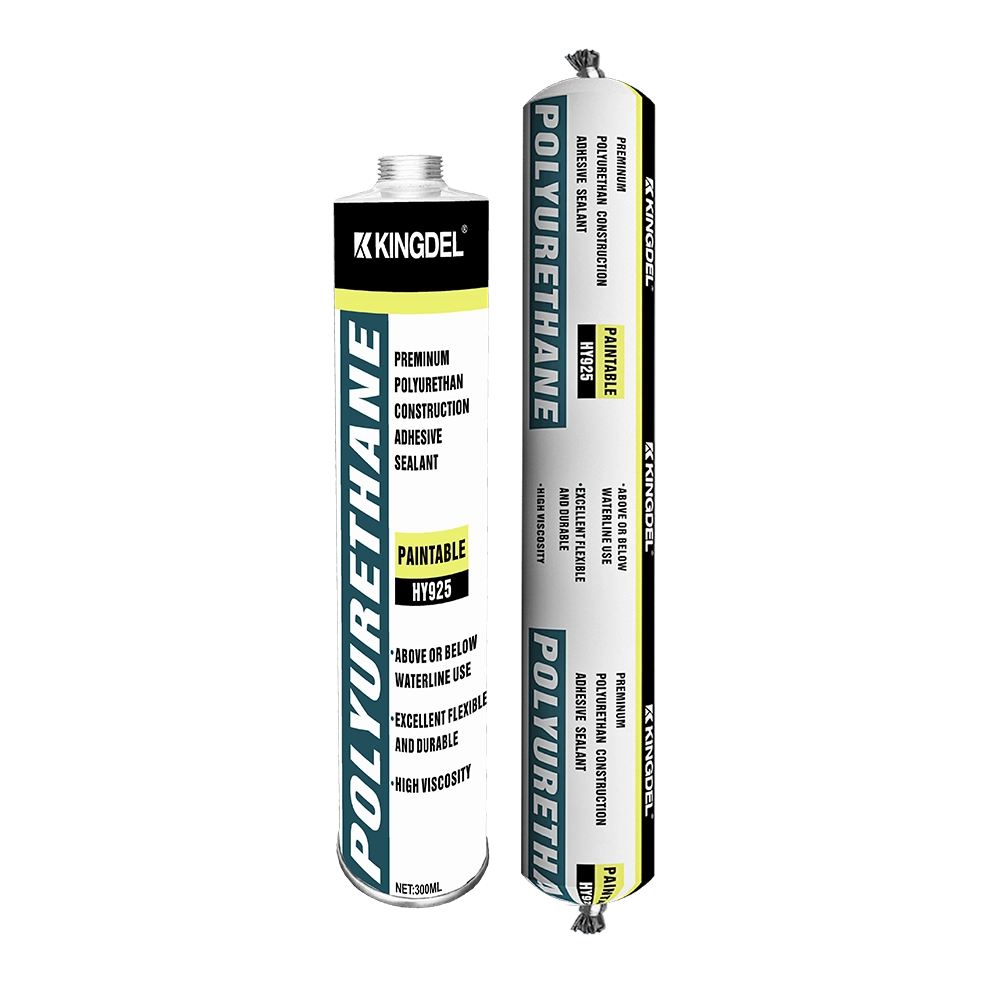
HY925 Polyurethane Sealant for Construction - KINGDELI
Glass Glazing Silicone Sealant: Buyer's Guide for Architects
Shelf Life, Storage, and Handling of Silicone Glazing Sealants
Packaging, Labeling and Logistics for Bulk PU Adhesive Shipments

HY992 Modified Polyurethane Construction Sealant
HY992 Modified Polyurethane Sealant is a one-component, moisture-curing construction sealant designed for professional building and structural sealing applications. It provides excellent adhesion, weather resistance, and durable elasticity, making it suitable for a wide range of construction materials.
The formulation delivers strong bonding performance without corrosion or substrate contamination, while maintaining low VOC content for environmentally responsible construction projects.

HY995 Crystal Clear Ms Polymer Adhesive/Sealant
HY995 Crystal Clear Ms Polymer Adhesive/Sealant is a new generation MS Polymer adhesive / sealant formulated for all bonding and sealing applications where long term reliability is required. It has excellent bonding strength on various materials. It will cure to form a durable, flexible, waterproof seal.

HY997 High-Performance Anti-Microbial MS Polymer Sealant
HY997 MS polymer sealant for is is a premium one-component, neutral-curing modified silane sealant engineered for demanding interior applications. It offers a Class 20 movement capability, ensuring long-lasting flexibility and reliable performance under dynamic joint conditions. Curing at room temperature, HY997 delivers superior anti-microbial and mildew-resistant properties, maintaining hygienic and clean environments over time.

KINGDELI HY732 Professional Acetoxy Cure Silicone Sealant
KINGDELI HY732 is a professional-grade, one-component acetoxy cure silicone sealant designed for fast curing, strong adhesion, and long-lasting flexibility. Ideal for aquariums, glass applications, aluminum doors and windows, kitchens, and bathrooms, it provides reliable sealing performance with excellent anti-fungal protection in high-humidity environments.
Let’s Build Stronger Bonds with Quality Adhesives and Sealants
Have questions about the topic or need tailored sealant solutions for your project?
Our team is ready to provide expert guidance, product recommendations, and application support.
Innovating with Integrity, Bonding the World
Since 1998, KINGDELI has delivered trusted, sustainable sealant solutions that connect industries and inspire progress worldwide.

Whatsapp: +8618825946249
Kingdeli
Kingdeli
Kingdeli
Kingdeli
Kingdeli