


Custom Silicone Sealant Packaging, Formula, and Label Requirements

- How to Engineer a Market-Ready Silicone Sealant Program
- Start with the performance brief, not the label design
- Select the correct curing technology
- Build a validation plan before commercial launch
- Packaging Architecture and Label Control for Sealants and Adhesives
- Choose the package according to channel and dispensing equipment
- Control shelf life, traceability, and transport information
- Make the label technically useful and legally defensible
- OEM/ODM Manufacturing Controls That Protect Buyer ROI
- Use documented quality systems and measurable release criteria
- Evaluate supplier capability beyond unit price
- Why KINGDELI is positioned for customized sealant programs
- Frequently Asked Questions
Custom silicone sealant programs require coordinated decisions about chemistry, packaging, and communication. A private label silicone sealant is not simply a standard cartridge with a new logo: buyers must define the intended substrate, joint movement, curing environment, shelf life, package format, label claims, and destination-market obligations before production begins. Neutral-cure and acetic-cure systems behave differently, while cartridges, sausages, tubes, pails, and drums create different filling, storage, dispensing, and logistics requirements. A reliable specification therefore combines formulation engineering, packaging validation, artwork control, technical documentation, and batch-level quality assurance.
How to Engineer a Market-Ready Silicone Sealant Program
Start with the performance brief, not the label design
The first procurement document should define the application rather than begin with branding. Relevant parameters include substrate type, joint width and depth, expected movement, exposure to ultraviolet radiation, temperature range, humidity, immersion, chemical contact, paintability, curing speed, tooling time, and required service life. A façade glazing project may prioritize adhesion to glass, aluminum, and coated substrates, whereas a sanitary application may require resistance to moisture and fungal growth. A distributor serving general construction may need a balanced product with broad adhesion, easy extrusion, and a competitive cost structure.
Buyers should also distinguish between product claims and verified performance. Terms such as weatherproof, high modulus, low modulus, fast curing, non-corrosive, low VOC, mold resistant, and paintable should be supported by test methods, technical data, and clearly stated limitations. The ISO 11600 standard provides an important reference framework for building and civil engineering sealants, including classification by application and performance. It should not be treated as a universal approval for every end use; the complete project specification still determines the appropriate testing plan.
Select the correct curing technology
Neutral silicone is commonly selected where low odor, reduced risk of corrosion, and compatibility with sensitive materials are important. It can be suitable for many metals, concrete, masonry, coated surfaces, plastics, and glass, subject to adhesion testing. Neutral systems may include oxime, alkoxy, or other cure technologies, and each chemistry can have different odor, cure rate, adhesion, and regulatory characteristics. The exact formulation should be matched to the target market and substrate combination rather than selected only by a generic product name.
Acetic silicone releases acetic acid during cure and is often valued for fast skin formation, strong adhesion to glass, and familiar handling characteristics. However, its acidic cure by-products can be unsuitable for certain metals, alkaline substrates, electronics, natural stone, or sensitive coatings. The label should identify compatible and incompatible materials in practical language. For high-consequence glazing, curtain wall, aquarium, or industrial applications, a supplier should provide adhesion data, modulus information, movement capability, and project-specific compatibility guidance.
Build a validation plan before commercial launch
A robust approval process normally includes accelerated aging, adhesion testing on actual substrates, extrusion-force measurement, skin and tack-free time, through-cure evaluation, hardness, tensile and elongation testing, movement capability, packaging compatibility, and storage stability. Testing should cover production batches rather than relying only on a laboratory development sample. For international distribution, retain samples and establish a documented change-control process for raw materials, pigments, fillers, catalysts, packaging components, and artwork.
Packaging compatibility is particularly important for moisture-curing products. A small leak, weak foil seal, poor nozzle fit, or excessive headspace can introduce moisture and cause premature skinning or loss of extrusion quality. Distribution simulation should consider hot containers, cold warehouses, vibration, compression, pallet stacking, and extended transit. The product should be tested in the final commercial package, not only in a laboratory cartridge.
Packaging Architecture and Label Control for Sealants and Adhesives
Choose the package according to channel and dispensing equipment
Standard plastic or aluminum cartridges are widely used for construction and retail channels because they fit common manual, pneumatic, and battery-powered caulking guns. Sausage packs can reduce package weight and material consumption, but they require compatible dispensing tools and careful end-seal design. Tubes work well for small repair formats, while pails and drums support high-volume industrial application through pumps or automated equipment. The selected format affects filling speed, transport density, waste generation, worker productivity, and customer experience.
Package engineering should define barrel material, plunger geometry, nozzle design, foil or membrane construction, cap fit, label stock, adhesive, ink resistance, and carton configuration. A label that looks acceptable at room temperature may wrinkle in a humid warehouse or detach from a dusty cartridge surface. Artwork should reserve space for mandatory warnings, batch coding, barcode quiet zones, technical icons, and local-language content. Color consistency also matters for distributors managing multiple grades such as neutral silicone sealant, acetic silicone sealant, glazing products, acrylic sealant, and polyurethane sealant.
Control shelf life, traceability, and transport information
Every unit should carry a legible batch or lot code that links the finished product to raw materials, filling records, laboratory release results, and packaging records. A clear manufacture date or expiry date supports distributor inventory rotation and reduces disputes about aged stock. Storage instructions should state the recommended temperature range, protection from moisture, and any restrictions on freezing, direct sunlight, or prolonged heat exposure.
Secondary packaging should protect cartridges from deformation and nozzle damage. Carton marks may need to identify product code, color, quantity, gross weight, lot number, handling symbols, and destination requirements. Pallet specifications should account for stacking height and compression strength. For export shipments, the commercial team should confirm whether the product is regulated as dangerous goods, whether transport documents are required, and whether the safety data sheet is available in the destination language.
Make the label technically useful and legally defensible
A professional sealant label normally includes product identity, primary use, compatible substrates, application instructions, curing information, storage conditions, net content, batch identification, manufacturer or responsible supplier details, and safety statements. The label should direct users to the technical data sheet and safety data sheet when detailed information cannot fit on the package. Hazard communication must follow the rules applicable to the destination market; the United Nations Globally Harmonized System of Classification and Labelling of Chemicals is a recognized international reference, but local implementation may differ.
Claims require disciplined review. “Low VOC” may depend on a specific test method and jurisdiction. “Mold resistant” does not mean permanently immune to biological growth under all conditions. “Paintable” may require the use of a compatible water-based or solvent-based coating after full cure, and many silicone products are not readily paintable. “Food contact,” “potable water,” “fire rated,” or “structural glazing” claims should never appear without relevant approvals and documented test evidence. Regulatory specialists should review final artwork before printing, especially when products are sold across multiple countries.
| Decision area | Neutral-cure silicone | Acetic-cure silicone | Buyer validation priority |
|---|---|---|---|
| Typical benefit | Broad material compatibility and low-corrosion potential | Fast cure profile and strong adhesion to many glass surfaces | Confirm performance on actual substrates |
| Odor and cure by-product | Generally mild to moderate, depending on chemistry | Acetic odor during cure | Evaluate occupied-space and worker requirements |
| Substrate caution | Some formulations may need primers or special preparation | May be unsuitable for sensitive metals, alkaline materials, or certain coatings | Obtain compatibility data and conduct field trials |
| Packaging sensitivity | Moisture exposure can affect shelf life and cure quality | Moisture exposure can also cause premature skinning or performance loss | Run final-package stability and transit testing |
| Label requirement | Use-specific instructions, limitations, safety data, and traceability | Include acidic-cure warnings where relevant | Complete regional regulatory and claims review |
The comparison is a formulation-selection guide, not a universal product ranking. Cure chemistry, additives, fillers, pigments, package construction, and manufacturing controls can materially change performance. Buyers should request a technical data sheet, safety data sheet, certificate of analysis, and representative samples before approving a product for a major channel or project.
OEM/ODM Manufacturing Controls That Protect Buyer ROI
Use documented quality systems and measurable release criteria
Private-label procurement becomes more reliable when the supplier converts the commercial brief into a controlled product specification. That specification should identify viscosity or extrusion behavior, density, color tolerance, skin time, cure rate, hardness, adhesion targets, movement capability, shelf life, package dimensions, filling weight, and acceptable defect limits. Incoming raw-material inspection, in-process checks, finished-goods testing, and retained-sample management create evidence that each shipment conforms to the approved standard.
Quality certification is valuable when it reflects active process control rather than a logo placed on marketing material. ISO 9001 quality management principles support documented processes, customer focus, corrective action, and continual improvement. Environmental controls also matter as buyers respond to emissions, waste, and responsible manufacturing expectations; ISO 14001 provides a recognized framework for environmental management systems.
Evaluate supplier capability beyond unit price
A low ex-works price can be outweighed by inconsistent color, short shelf life, damaged cartridges, delayed artwork approval, or an inability to reproduce a successful trial batch. Total procurement cost should include tooling, minimum order quantity, packaging development, regulatory review, sample freight, inspection, rejected units, inventory exposure, and technical support. Buyers should ask how the manufacturer manages formula changes, alternate raw materials, production interruptions, nonconforming goods, and urgent replenishment.
Supplier qualification should also examine production capacity, laboratory resources, export experience, lead times, packaging options, and communication discipline. A capable partner can provide a staged launch: technical discovery, laboratory sample, package prototype, pilot batch, third-party or customer testing, artwork approval, mass production, pre-shipment inspection, and post-launch support. This reduces the risk of discovering a formulation or labeling problem after thousands of units have entered the channel.
Why KINGDELI is positioned for customized sealant programs
KINGDELI has operated since 1998 as a global manufacturer of high-performance sealants, adhesives, and coatings. Our headquarters and 66,000 m² manufacturing facility are located in Foshan, China, with fully automated production lines and annual capacity exceeding 100,000 tons. This scale supports stable supply planning for distributors, project owners, and brand owners while maintaining a structured approach to batch consistency and OEM/ODM execution.
Our technical portfolio covers neutral silicone sealant, acetic silicone sealant, acrylic sealant, silicone glazing sealant, No More Nails adhesive, polyurethane sealant, MS polymer sealant, RTV gasket maker, epoxy tile grout, and self-leveling sealant. This breadth allows buyers to consolidate related sealants and adhesives with one technical partner while selecting chemistry by substrate, movement, curing condition, and application method. Product development can include color matching, cartridge and sausage packaging, customized labels, cartons, documentation, and market-specific positioning.
As a recognized National High-Tech Enterprise and a contributor to National Standard GB/T 29755-2013, KINGDELI combines manufacturing infrastructure with technical development. Our systems and products are engineered with international requirements in mind, including ISO 9001, ISO 14001, CE, and ASTM-related expectations where applicable to the product and market. Compliance remains application-specific, so our team works with buyers to identify the tests, declarations, and documentation actually required for the intended destination.
More than 27 years of industry expertise and distribution across over 50 countries support practical export execution. Our OEM/ODM service includes low-VOC formulation options, package customization, technical data support, and professional service throughout development and commercialization. For procurement teams, the value is not only a branded cartridge; it is a controlled route from performance brief to repeatable production, compliant labeling, dependable delivery, and reduced total ownership risk.
Buyers preparing a custom program should provide the target countries, annual volume, package format, color range, substrates, application environment, performance claims, required certificates, and launch timetable. KINGDELI can then help define the appropriate chemistry, testing plan, package specification, and documentation package before commercial approval.
Contact KINGDELI to develop a compliant, performance-focused OEM/ODM sealant program or explore the full product portfolio for your target market.
Frequently Asked Questions
What information should buyers provide when ordering a custom silicone sealant?
Buyers should provide target countries, annual volume, package format, color range, substrates, application environment, performance claims, required certificates, and launch timetable so the supplier can define the chemistry, testing plan, packaging specification, and documentation package.
What is the main difference between neutral-cure and acetic-cure silicone?
Neutral-cure silicone is commonly selected for broader material compatibility and lower corrosion potential, while acetic-cure silicone offers a familiar fast-cure profile and strong adhesion to many glass surfaces but may be unsuitable for sensitive metals, alkaline materials, or certain coatings.
What should appear on a silicone sealant label?
A professional label normally includes product identity, primary use, compatible substrates, application instructions, curing information, storage conditions, net content, batch identification, manufacturer or responsible supplier details, and safety statements, with references to the technical data sheet and safety data sheet where needed.
Why is final-package testing important for moisture-curing sealants?
A weak foil seal, poor nozzle fit, package leak, or excessive headspace can introduce moisture and cause premature skinning or loss of extrusion quality, so the product should be tested in the final commercial package under storage and distribution conditions.
How can buyers compare OEM sealant suppliers beyond price?
Buyers should assess production capacity, laboratory resources, quality systems, export experience, lead times, minimum order quantities, packaging development, regulatory support, change control, nonconformance procedures, retained samples, and technical service in addition to unit price.
Does a paintable claim mean every silicone sealant can be coated?
No. Paintability depends on the formulation and coating system, and many silicone products are not readily paintable; any paintable claim should specify compatible coatings and the required curing condition, supported by technical evidence.
Sample Evaluation Protocol for B2B Buyers of PU Windshield Adhesives
OEM Construction Sealant: Formula, Packaging, and Private Label Options

HY682 Self-Leveling Polymer Waterproof Adhesive Sealant - KINGDELI
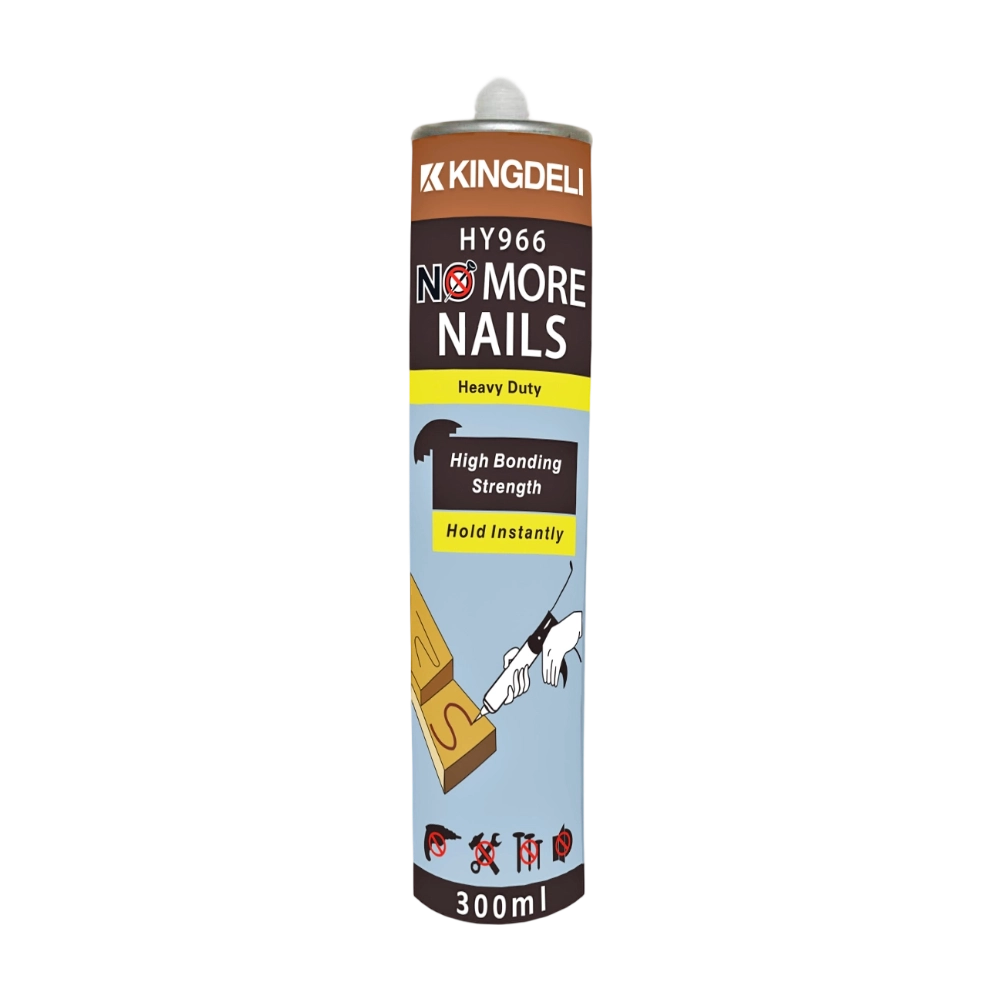
HY-966 Heavy Duty No More Nails Construction Adhesive — KINGDELI

HY992 Modified Polyurethane Construction Sealant
HY992 Modified Polyurethane Sealant is a one-component, moisture-curing construction sealant designed for professional building and structural sealing applications. It provides excellent adhesion, weather resistance, and durable elasticity, making it suitable for a wide range of construction materials.
The formulation delivers strong bonding performance without corrosion or substrate contamination, while maintaining low VOC content for environmentally responsible construction projects.

HY995 Crystal Clear Ms Polymer Adhesive/Sealant
HY995 Crystal Clear Ms Polymer Adhesive/Sealant is a new generation MS Polymer adhesive / sealant formulated for all bonding and sealing applications where long term reliability is required. It has excellent bonding strength on various materials. It will cure to form a durable, flexible, waterproof seal.

HY997 High-Performance Anti-Microbial MS Polymer Sealant
HY997 MS polymer sealant for is is a premium one-component, neutral-curing modified silane sealant engineered for demanding interior applications. It offers a Class 20 movement capability, ensuring long-lasting flexibility and reliable performance under dynamic joint conditions. Curing at room temperature, HY997 delivers superior anti-microbial and mildew-resistant properties, maintaining hygienic and clean environments over time.

KINGDELI HY732 Professional Acetoxy Cure Silicone Sealant
KINGDELI HY732 is a professional-grade, one-component acetoxy cure silicone sealant designed for fast curing, strong adhesion, and long-lasting flexibility. Ideal for aquariums, glass applications, aluminum doors and windows, kitchens, and bathrooms, it provides reliable sealing performance with excellent anti-fungal protection in high-humidity environments.
Let’s Build Stronger Bonds with Quality Adhesives and Sealants
Have questions about the topic or need tailored sealant solutions for your project?
Our team is ready to provide expert guidance, product recommendations, and application support.
Innovating with Integrity, Bonding the World
Since 1998, KINGDELI has delivered trusted, sustainable sealant solutions that connect industries and inspire progress worldwide.

Whatsapp: +8618825946249
Kingdeli
Kingdeli
Kingdeli
Kingdeli
Kingdeli