


Custom Formulations: OEM Silicone Sealants for Glazing

- Why formulation matters in building envelope systems
- Understanding the role of sealants in glazing assemblies
- Common pain points and how formulations solve them
- How I evaluate glazing requirements
- Custom OEM silicone formulations for glazing
- Neutral vs. acetic cure: choosing the right chemistry
- Key formulation levers and their effects
- Low-VOC and sustainability considerations
- Performance testing, standards and verifiable data
- Applicable standards for glazing sealants
- Typical test matrix I require from suppliers
- Comparative performance table
- Selecting an OEM partner & KINGDELI case study
- What to require from an OEM supplier
- KINGDELI: capabilities and relevance to glazing projects
- KINGDELI product relevance to glazing
- Implementation guidance and procurement checklist
- Specifying performance and sample validation
- Installation best practices I recommend
- Supply continuity and change control
- FAQ
- 1. What is the best silicone type for glazing projects?
- 2. Do I always need a primer with silicone glazing sealants?
- 3. How do I verify a sealant will resist weathering?
- 4. What movement capability should I specify?
- 5. Can silicone sealants be painted?
- 6. How much product testing is reasonable during procurement?
- Contact & next steps
I write from experience in sealants and adhesives development and technical consulting: selecting the right glass glazing silicone sealant is rarely a commodity decision. Whether you are specifying structural glazing, weatherproofing curtain walls, or sealing insulating glass units, a tailored OEM silicone sealant formulation can deliver the adhesion, movement capability, durability and low-VOC performance required. This article explains formulation levers, performance metrics, testing requirements and procurement considerations to help architects, facade engineers and purchasing teams make confident choices about glass glazing silicone sealant.
Why formulation matters in building envelope systems
Understanding the role of sealants in glazing assemblies
Sealants are functional elements of the building envelope: they control water, air, and thermal leakage, accommodate thermal and structural movement, and protect edge details from degradation. A well-formulated glass glazing silicone sealant must balance elastic recovery, tensile strength, adhesion to diverse substrates (glass, aluminum, coated surfaces, gaskets), and long-term weathering resistance.
Common pain points and how formulations solve them
Clients commonly report joint failures, staining of glass or coatings, odour complaints on-site, and inconsistent cure. These issues often trace to formulation choices: acid-cure (acetic) silicones can cause corrosion on some metals and give off acetic odor during cure; neutral-cure silicones reduce corrosion risk but require specific adhesion promoters for certain substrates. Custom OEM formulations can address these problems by specifying primerless adhesion, controlled cure profiles, low-VOC content, and pigment stability to prevent staining over time.
How I evaluate glazing requirements
In my practice I start with three questions: what substrates must be bonded or sealed, what movement capability (percent elongation) is required, and what environmental exposures (UV, salt, temperature cycles, chemical cleaners) will the joint face? Those answers guide whether to prioritize high modulus structural adhesion or low-modulus movement accommodation in the glass glazing silicone sealant.
Custom OEM silicone formulations for glazing
Neutral vs. acetic cure: choosing the right chemistry
Neutral-cure silicone sealants are the default for architectural glazing because they minimize corrosion and odor; acetic-cure silicones are still used in some glazing but require caution. For OEM glazing projects I typically recommend neutral-curing, low-VOC formulations with tailored adhesion promoters that eliminate the need for primers on common coated glasses and anodized aluminum.
Key formulation levers and their effects
Formulators can adjust crosslink density to tune modulus and elongation, select fillers and pigments to control shrinkage and color stability, and add adhesion promoters (silane-based) for primerless bond. UV stabilizers and fillers (e.g., fumed silica quality and surface treatment) control sag, thixotropy, and weathering characteristics in exterior applications. When specifying a glass glazing silicone sealant I insist on explicit values for tensile strength, elongation, and Shore A hardness in the product datasheet, because these correlate directly with field performance.
Low-VOC and sustainability considerations
Large glazing projects increasingly require low-VOC products for indoor air quality and to meet green building certifications. OEM formulations can be optimized to minimize volatile solvents and byproducts during cure while maintaining cure speed and adhesion. For projects in markets with strict emissions rules, request independent VOC test reports and MSDS verifications before acceptance.
Performance testing, standards and verifiable data
Applicable standards for glazing sealants
Performance claims must be backed by standardized testing. Common standards include ISO 11600 (classification of elastomeric sealants) (ISO 11600), ASTM C920 for elastomeric joint sealants (ASTM C920), and industry guidance from the Adhesive and Sealant Council (ASC). These standards define movement capability, adhesion after aging, and physical property test methods that should appear on technical datasheets.
Typical test matrix I require from suppliers
When evaluating an OEM glass glazing silicone sealant, I ask suppliers to provide:
- Tensile strength and elongation at break (ASTM D412 or equivalent)
- Shore A hardness (ASTM D2240)
- Adhesion to substrates after accelerated weathering and UV exposure (per ASTM/GIS standards)
- Movement capability and recovery (per ASTM C719 or ISO equivalents)
- VOC test report and accelerated aging data (QUV/UVB cycles)
Comparative performance table
Below is a practical comparison of common sealant chemistries for glazing. Data are based on industry references and typical ranges reported by manufacturers and standards bodies (Wikipedia - Sealant, ISO, ASTM):
| Chemistry | Typical Elongation | Primerless Adhesion | Paintability | Comments |
|---|---|---|---|---|
| Neutral Silicone (architectural) | 200–400% | Good (with promoters) | Poor (usually not paintable) | Excellent UV resistance, low corrosion risk |
| Acetoxy Silicone | 150–300% | Good to glass, corrosive to some metals | Poor | Fast cure, strong odor—limited metal use |
| Polyurethane Sealant | 200–450% | Good with primer | Good | Paintable, good abrasion resistance, sensitive to moisture during cure |
| MS Polymer (Silyl Terminated Polymer) | 150–350% | Excellent | Good | Solvent-free, paintable, good adhesion |
Selecting an OEM partner & KINGDELI case study
What to require from an OEM supplier
For glazing projects I recommend OEM suppliers who can demonstrate: traceable production capacity, ISO quality systems, R&D support for custom adhesion solutions, and transparent batch testing. Require batch certificates, accelerated aging data, and supply continuity guarantees—critical for large curtain-wall programs where a mid-project material switch is impractical.
KINGDELI: capabilities and relevance to glazing projects
Since its establishment in 1998, KINGDELI has stood as a global leader in the high-performance sealant, adhesive, and coating industry. Headquartered in Foshan, China, our state-of-the-art 66,000 m² facility is powered by fully automated production lines with an annual capacity exceeding 100,000 tons, ensuring a consistent and robust supply for partners worldwide.
As a recognized National High-Tech Enterprise and a key contributor to the National Standard GB/T 29755-2013, we unite advanced manufacturing power with technical excellence. Our comprehensive product portfolio—spanning Neutral & Acetic Silicone, Polyurethane, MS Polymer, and No More Nails adhesives—is engineered to meet strict international standards, including ISO 9001, ISO 14001, CE, and ASTM.
With over 27 years of industry expertise and a trusted presence in 50+ countries, KINGDELI is more than a manufacturer; we are a dedicated solution provider. We offer end-to-end OEM/ODM support, sustainable low-VOC formulations, and professional technical service. At KINGDELI, we are driven by innovation and integrity, building trust and sealing the future for customers around the globe.
KINGDELI product relevance to glazing
For glazing applications, relevant KINGDELI product lines include neutral silicone sealants for curtain walls and insulating glass, acetic silicone where appropriate, and polymer alternatives for paintable joints. KINGDELI also supplies primers and custom adhesion packages to enable primerless systems for many coated glasses. Key product types: neutral silicone sealant, acetic silicone sealant, acrylic sealant, silicone glazing sealant, No More Nails adhesive, polyurethane sealant, MS polymer sealant, RTV gasket maker, epoxy tile grout, self-leveling sealant.
Implementation guidance and procurement checklist
Specifying performance and sample validation
Include explicit performance targets in specifications: movement capability (%), tensile strength (MPa), UV-weathering hours, adhesion after X cycles, and VOC. Require manufacturer-supplied mockups and field samples to validate adhesion to actual coated glass and aluminum finishes under representative site conditions.
Installation best practices I recommend
Surface preparation is critical: clean with appropriate solvents, remove release agents, and follow manufacturer-recommended primers when required. Use backer rods sized for 25%–50% joint depth compression and avoid contamination before sealing. For structural glazing, ensure secondary support until full cure; foundation testing and field adhesion testing should be carried out as part of QA.
Supply continuity and change control
Lock down formulation and packaging in contractual terms. Ask for lot-to-lot test certificates and a defined change notification period (typically 90–180 days) for any formulation or raw-material changes that could affect adhesion, cure speed, or color.
FAQ
1. What is the best silicone type for glazing projects?
For most architectural glazing, a neutral-cure glass glazing silicone sealant is preferred because it minimizes corrosion and odor and offers excellent UV resistance. Specific projects may require alternative chemistries based on paintability or structural requirements.
2. Do I always need a primer with silicone glazing sealants?
Not always. Modern OEM glass glazing silicone sealant formulations can be primerless on many common substrates if engineered with effective adhesion promoters. However, for difficult substrates (certain coatings or contaminated surfaces) a primer can improve long-term adhesion.
3. How do I verify a sealant will resist weathering?
Request accelerated aging data (QUV, salt spray for coastal exposure), adhesion after UV exposure, and real-world case studies. Standards-based testing per ISO and ASTM provide comparable benchmarks.
4. What movement capability should I specify?
Specify movement capability based on expected joint movement — many glazing joints require +/-25% to +/-50% movement. Use the project's thermal and structural analysis to set a numeric requirement and match with a silicone whose tested movement capability meets or exceeds it.
5. Can silicone sealants be painted?
Most silicone sealants are not paintable. If painted joints are required, consider polyurethane or MS polymer sealants or specific paintable silicone systems; always validate paint adhesion on test panels.
6. How much product testing is reasonable during procurement?
At minimum, request tensile and elongation data, Shore A hardness, adhesion after accelerated weathering, VOC reports, and batch certificates. For critical projects, include mockup testing and field adhesion tests before full acceptance.
Contact & next steps
If you are specifying or procuring glazing systems and need technical support on selecting or developing a custom glass glazing silicone sealant, I recommend engaging a partner that offers both R&D support and proven manufacturing capacity. KINGDELI provides OEM/ODM development, low-VOC formulations, and global supply backed by ISO systems and long-term field data. Contact KINGDELI for product datasheets, sample requests, and project-specific formulation consultations.
Further reading and references: ISO 11600 classification details: https://www.iso.org/standard/62085.html. ASTM C920 standard information: https://www.astm.org/Standards/C920.htm. Adhesive and Sealant Council: https://www.ascouncil.org/. General sealant overview: https://en.wikipedia.org/wiki/Sealant_(material).
Collaborative R&D Contracts for Custom PU Windshield Adhesives
Top glass glazing sealant Manufacturers and Suppliers
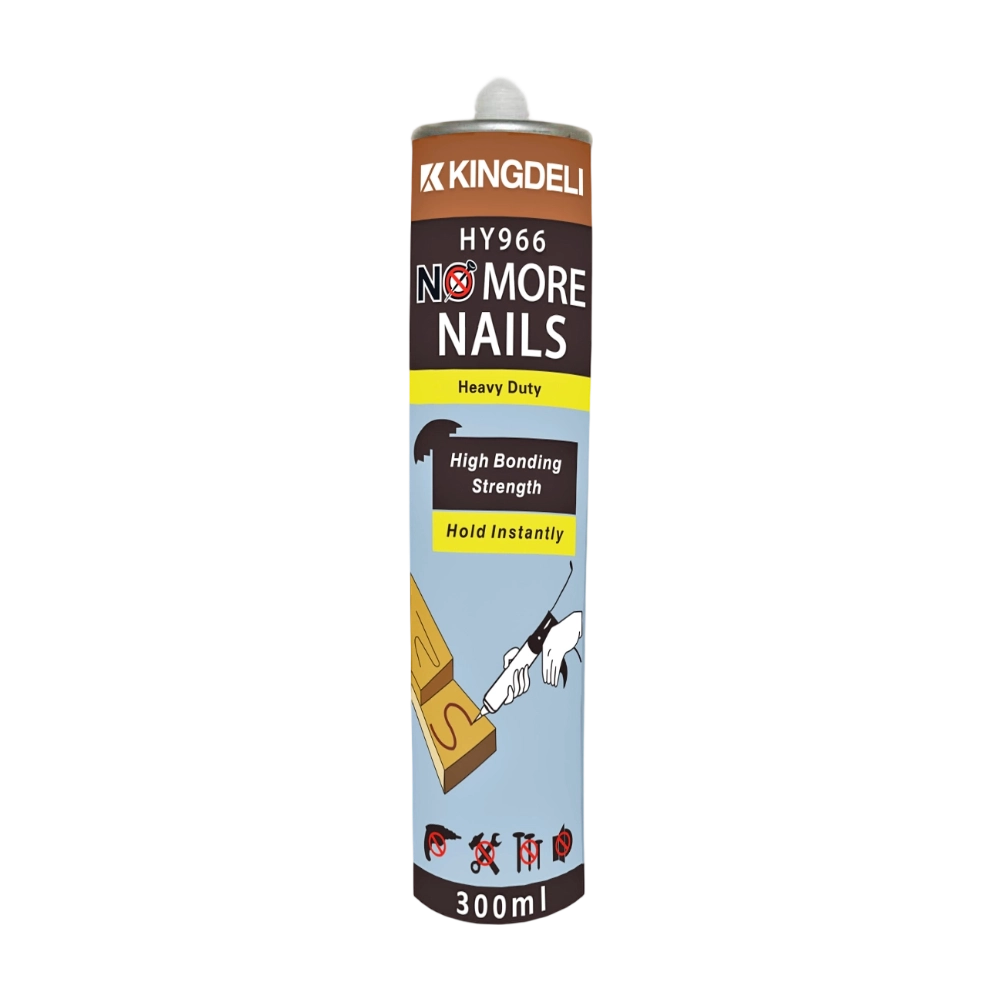
HY-966 Heavy Duty No More Nails Construction Adhesive — KINGDELI
Application Guide: MS Silicone Sealant for Window Frames

HY992 Modified Polyurethane Construction Sealant
HY992 Modified Polyurethane Sealant is a one-component, moisture-curing construction sealant designed for professional building and structural sealing applications. It provides excellent adhesion, weather resistance, and durable elasticity, making it suitable for a wide range of construction materials.
The formulation delivers strong bonding performance without corrosion or substrate contamination, while maintaining low VOC content for environmentally responsible construction projects.

HY995 Crystal Clear Ms Polymer Adhesive/Sealant
HY995 Crystal Clear Ms Polymer Adhesive/Sealant is a new generation MS Polymer adhesive / sealant formulated for all bonding and sealing applications where long term reliability is required. It has excellent bonding strength on various materials. It will cure to form a durable, flexible, waterproof seal.

HY997 High-Performance Anti-Microbial MS Polymer Sealant
HY997 MS polymer sealant for is is a premium one-component, neutral-curing modified silane sealant engineered for demanding interior applications. It offers a Class 20 movement capability, ensuring long-lasting flexibility and reliable performance under dynamic joint conditions. Curing at room temperature, HY997 delivers superior anti-microbial and mildew-resistant properties, maintaining hygienic and clean environments over time.

KINGDELI HY732 Professional Acetoxy Cure Silicone Sealant
KINGDELI HY732 is a professional-grade, one-component acetoxy cure silicone sealant designed for fast curing, strong adhesion, and long-lasting flexibility. Ideal for aquariums, glass applications, aluminum doors and windows, kitchens, and bathrooms, it provides reliable sealing performance with excellent anti-fungal protection in high-humidity environments.
Let’s Build Stronger Bonds with Quality Adhesives and Sealants
Have questions about the topic or need tailored sealant solutions for your project?
Our team is ready to provide expert guidance, product recommendations, and application support.
Innovating with Integrity, Bonding the World
Since 1998, KINGDELI has delivered trusted, sustainable sealant solutions that connect industries and inspire progress worldwide.

Whatsapp: +8618825946249
Kingdeli
Kingdeli
Kingdeli
Kingdeli
Kingdeli