


Cost Analysis: Buying Neutral Silicone Bulk vs Cartridges

- Unit Cost Dynamics: Bulk Compounds vs Pre-Filled Tubes
- Material price per usable litre/ kilogram
- Packaging, filling and logistics costs
- Procurement thresholds and MOQ implications
- Operational Economics: Labor, Waste, and Installation Throughput
- On-site dispensing labor and tooling
- Yield loss, shelf-life and storage
- Quality control and rework costs
- Risk Profile, Compliance & Environmental Considerations
- Health, safety and regulatory compliance
- Traceability, batch control and warranty exposure
- Environmental footprint and VOC management
- Data Comparison: Bulk Supply vs Pre-Filled Cartridges
- KINGDELI Supply & Value Proposition for Cost-Conscious Buyers
- Manufacturing scale, certifications and consistent supply
- Product breadth and technical support
- Cost-to-value: inventory solutions, dispensing partnerships and warranty
- Implementation Checklist for Procurement & Project Managers
- Calculate project break-even
- Specify acceptance and testing criteria
- Plan storage and inventory rotation
- Frequently Asked Questions
- What is the typical break-even volume for choosing bulk drums over cartridges?
- How should opened bulk containers be stored to avoid spoilage?
- Are neutral curing systems safer for sensitive substrates than acid-cure versions?
- How does packaging choice affect compliance and traceability?
- Can KINGDELI supply custom filling (sausage vs cartridge) for hybrid procurement strategies?
Procurement teams evaluating neutral-cure silicone for façade sealing, window glazing, or industrial bonding must weigh more than sticker price: true cost drivers include packaging economics, dispensing efficiency, material waste, shelf stability, on-site labor, and compliance overhead. This analysis compares bulk-supply formats (drums, pails, sausages) against ready-to-use cartridges (pre-filled tubes) across unit cost, logistics, installation productivity, and regulatory risk—providing a decision framework for buyers, contractors, and facility owners to calculate break-even volumes and total cost of ownership. Where applicable, industry standards and safety/regulatory resources such as Wikipedia: Silicone sealant, ISO 9001, ASTM International, and ECHA: REACH inform compliance and material selection.
Unit Cost Dynamics: Bulk Compounds vs Pre-Filled Tubes
Material price per usable litre/ kilogram
Buyers should focus on effective unit pricing after accounting for dispensing waste. Bulk containers (20–200 kg drums or 20–25 kg pails) commonly deliver the lowest raw-material cost per litre, driven by lower packaging overhead and economies of scale. By contrast, single-use cartridges (typically 290–300 mL) command a packaging and filling High Quality; however, cartridges can reduce on-site waste for small, intermittent jobs where opened bulk containers would spoil before use.
Packaging, filling and logistics costs
Packaging contributes 5–25% of the delivered cost for sealants depending on format and origin. Bulk drums and pails optimize palletization and freight per unit volume, lowering transport cost per kilogram. Cartridges add handling complexity at the warehouse (shelf picks, smaller cartons) and increase shipping volume for the same quantity of compound. For precise logistics benchmarking, procurement should request freight-per-kg and volumetric charge examples from freight vendors.
Procurement thresholds and MOQ implications
Project size dictates the optimal purchasing unit. Typical minimum order quantities (MOQ) for drums or pails favor large-scale projects and continuous production lines, while cartridges are preferable for maintenance stock and small installation crews. Calculate the break-even point by comparing total landed cost (material + packaging + storage + waste + labor) for each format over project duration.
Operational Economics: Labor, Waste, and Installation Throughput
On-site dispensing labor and tooling
Dispensing efficiency varies significantly: pneumatic bulk dispensers or cartridge guns influence bead consistency, speed, and labor time. Bulk-feed systems reduce interruptions for high-volume runs and can be integrated with automated bead-laying machinery. For contractors focused on cycle time, consider capital expenditure for dispensing rigs versus ongoing per-cartridge labor savings.
Yield loss, shelf-life and storage
Unopened shelf life for many neutral-curing formulations ranges from 12 to 24 months when stored per manufacturer recommendations. Once opened, bulk containers may experience partial cure at the surface if not properly purged or sealed, increasing wasted material. Single-use cartridges limit exposure after opening but generate more packaging waste. Proper inventory rotation (FIFO) and humidity/temperature-controlled storage reduce spoilage risk.
Quality control and rework costs
Consistency of bead profile and cure behavior ties directly to rework rates. Bulk-fed systems with precise metering reduce human variation for continuous joints and automated lines; cartridges reduce operator variability in smaller applications. Rework cost should be modeled as an expected percentage of installed meters multiplied by labor and material replacement rates to reveal true downstream impact.
Risk Profile, Compliance & Environmental Considerations
Health, safety and regulatory compliance
Neutral-curing systems differ from acetoxy (acid-curing) formulations in terms of substrate compatibility and low-acid emissions. Buyers must verify product safety data sheets (SDS) and ensure compliance with regional chemical regulations such as REACH. Corporate procurement should also check certifications for quality and environmental systems, e.g., ISO 9001 and ISO 14001, and reference testing standards from ASTM International for performance validation.
Traceability, batch control and warranty exposure
Bulk batches offer centralized quality control traces, but once a drum is opened at site, maintaining traceability requires strict lot control processes. Cartridges are easier to track per-job and reduce warranty disputes tied to cross-contamination. Suppliers that provide clear batch coding and certificate-of-analysis (CoA) systems reduce downstream risk.
Environmental footprint and VOC management
Low-VOC neutral chemistries and recyclable packaging reduce life-cycle impact. Bulk supply typically reduces packaging material per unit of sealant, lowering waste volume and potential disposal costs. For projects with sustainability requirements, evaluate supplier lifecycle data and low-VOC formulations as part of total cost calculations.
Data Comparison: Bulk Supply vs Pre-Filled Cartridges
| Metric | Bulk (Drums / Pails / Sausages) | Pre-Filled Cartridges (≈290–300 mL) |
|---|---|---|
| Typical package volumes | 20–25 kg pails, 200 L drums, 600 mL sausages | 290–300 mL cartridges |
| Unit material cost (per L equivalent) | Lowest (best for high-volume, economies of scale) | Higher (packaging/filling High Quality) |
| On-site waste risk (opened) | Medium–High without purging/closed-feed systems | Low (single-use reduces spoilage) |
| Labor & dispensing speed | High speed with bulk dispensers; lower with manual methods | Moderate speed; slower for large-volume continuous runs |
| Logistics efficiency (m3 per tonne) | Higher (bulk optimized for palletization) | Lower (more volume for same material mass) |
| Traceability & batch control | Requires site protocols for opened containers | Better (per-cartridge lot codes, easier job tracking) |
| Sustainability (packaging waste) | Lower packaging waste per unit | Higher packaging waste per unit |
KINGDELI Supply & Value Proposition for Cost-Conscious Buyers
Manufacturing scale, certifications and consistent supply
Since its establishment in 1998, KINGDELI has stood as a global leader in the high-performance sealant, adhesive, and coating industry. Headquartered in Foshan, China, our state-of-the-art 66,000 m² facility is powered by fully automated production lines with an annual capacity exceeding 100,000 tons, ensuring a consistent and robust supply for partners worldwide. Buyers benefit from our stable production scale when negotiating bulk contracts, forecasting lead times, and managing large projects where uninterrupted material flow is critical. Our management systems meet international expectations—refer to ISO 9001 and ISO 14001 frameworks—and our portfolio is engineered to align with recognized test methods from ASTM International.
Product breadth and technical support
Our comprehensive catalogue covers neutral-curing silicone chemistries and related technologies, including neutral silicone sealant,acetic silicone sealant,Acrylic Sealant,silicone glazing sealant,No More Nails adhesive,Polyurethane Sealant,MS polymer Sealant,RTV Gasket Maker,Epoxy Tile Grout,Self-Leveling Sealant. This breadth allows procurement teams to consolidate vendors and standardize materials across trades, simplifying inventory control and compliance checks. KINGDELI offers OEM/ODM packaging flexibility (drums, pails, sausages, cartridges) and on-demand filling services to match project scale and minimize unnecessary packaging costs.
Cost-to-value: inventory solutions, dispensing partnerships and warranty
For large-volume industrial users, our team recommends bulk delivery with closed-loop dispensing to maximize material yield and minimize labor interruptions. For contractors and maintenance teams with mixed-job profiles, we provide pre-filled cartridges and small-format options to reduce spoilage. KINGDELI supports clients with CoAs, SDS documentation, and batch traceability to reduce warranty exposure and ease regulatory audits. Buyers are encouraged to request a site-specific total-cost model from our sales engineers that incorporates freight, expected yield, labor, and waste metrics.
Implementation Checklist for Procurement & Project Managers
Calculate project break-even
Model total cost of ownership for both supply formats by summing: delivered material cost, packaging High Quality, projected waste percentage, labor for dispensing, equipment amortization (if buying dispensers), and disposal fees for packaging. The break-even volume typically favors bulk above a project-specific threshold—run the numbers using actual freight and labor rates.
Specify acceptance and testing criteria
Include acceptance clauses in purchase orders for initial sample verification and batch CoAs. Reference relevant performance standards (adhesion, elongation, tensile strength) and mandate test records for batches used on critical envelope or glazing systems.
Plan storage and inventory rotation
Implement FIFO, climate control where necessary, and purge procedures for opened bulk containers. For multi-site operations, centralize bulk storage and distribute cartridges to satellite teams to balance spoilage risk and handling costs.
Frequently Asked Questions
What is the typical break-even volume for choosing bulk drums over cartridges?
Break-even varies by region and supplier freight economics; buyers should calculate delivered cost per litre including packaging and expected waste—many projects exceed the break-even at medium-to-large continuous application volumes where bulk reduces unit cost by 10–30% compared with cartridges.
How should opened bulk containers be stored to avoid spoilage?
Store in a cool, dry area away from direct sunlight, reseal with inert-gas purge or mechanical covers when possible, and use FIFO. Temperature and humidity controls consistent with product SDS are recommended to preserve shelf life.
Are neutral curing systems safer for sensitive substrates than acid-cure versions?
Neutral-cure formulations generally emit non-acetic byproducts and are less likely to corrode metals or stain sensitive natural stones; however, verify substrate compatibility via adhesion tests and consult SDS for chemical-specific hazards.
How does packaging choice affect compliance and traceability?
Pre-filled cartridges simplify lot tracking and reduce documentation disputes; bulk systems require strict site-level batch control to maintain traceability and meet audit or warranty requirements.
Can KINGDELI supply custom filling (sausage vs cartridge) for hybrid procurement strategies?
Yes. KINGDELI offers OEM/ODM filling and packaging options to align supply units with client project profiles, enabling hybrid strategies that optimize cost, waste, and operational efficiency.
Contact KINGDELI or view our product range to request a site-specific cost model and tailored supply proposal.
Top Self-Leveling Sealants for Pools, Driveways and Roofs
Top 10 rtv gasket maker Manufacturers and Supplier Brands in Hardware and Building Materials
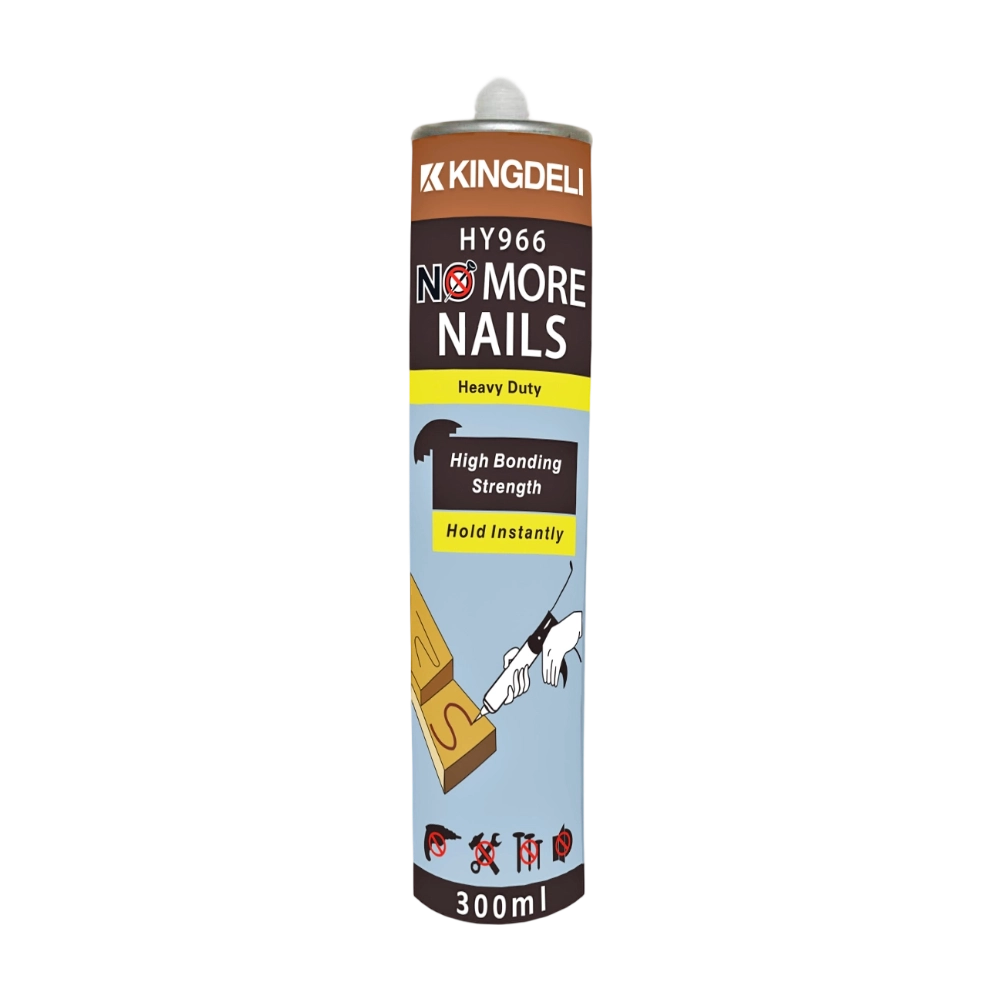
HY-966 Heavy Duty No More Nails Construction Adhesive — KINGDELI
Best Construction Sealants for Distributors, Brands, and Contractors

HY992 Modified Polyurethane Construction Sealant
HY992 Modified Polyurethane Sealant is a one-component, moisture-curing construction sealant designed for professional building and structural sealing applications. It provides excellent adhesion, weather resistance, and durable elasticity, making it suitable for a wide range of construction materials.
The formulation delivers strong bonding performance without corrosion or substrate contamination, while maintaining low VOC content for environmentally responsible construction projects.

HY995 Crystal Clear Ms Polymer Adhesive/Sealant
HY995 Crystal Clear Ms Polymer Adhesive/Sealant is a new generation MS Polymer adhesive / sealant formulated for all bonding and sealing applications where long term reliability is required. It has excellent bonding strength on various materials. It will cure to form a durable, flexible, waterproof seal.

HY997 High-Performance Anti-Microbial MS Polymer Sealant
HY997 MS polymer sealant for is is a premium one-component, neutral-curing modified silane sealant engineered for demanding interior applications. It offers a Class 20 movement capability, ensuring long-lasting flexibility and reliable performance under dynamic joint conditions. Curing at room temperature, HY997 delivers superior anti-microbial and mildew-resistant properties, maintaining hygienic and clean environments over time.

KINGDELI HY732 Professional Acetoxy Cure Silicone Sealant
KINGDELI HY732 is a professional-grade, one-component acetoxy cure silicone sealant designed for fast curing, strong adhesion, and long-lasting flexibility. Ideal for aquariums, glass applications, aluminum doors and windows, kitchens, and bathrooms, it provides reliable sealing performance with excellent anti-fungal protection in high-humidity environments.
Let’s Build Stronger Bonds with Quality Adhesives and Sealants
Have questions about the topic or need tailored sealant solutions for your project?
Our team is ready to provide expert guidance, product recommendations, and application support.
Innovating with Integrity, Bonding the World
Since 1998, KINGDELI has delivered trusted, sustainable sealant solutions that connect industries and inspire progress worldwide.

Whatsapp: +8618825946249
Kingdeli
Kingdeli
Kingdeli
Kingdeli
Kingdeli