


Construction Sealant Samples: What to Test Before a Bulk Purchase

- How to Build a Reliable Sealant Sample Evaluation Plan
- Define the joint, substrate, and exposure conditions
- Use a staged testing sequence
- Separate product performance from application convenience
- Critical Tests Before Approving a Bulk Order
- Adhesion, compatibility, and cohesive strength
- Curing, movement, and environmental resistance
- Packaging, shelf life, and supply-chain reliability
- Turning Sample Results into a Confident Supplier Decision
- Review technical documentation and compliance evidence
- Evaluate technical support, customization, and production capacity
- Why KINGDELI is positioned for structured bulk procurement
- Recommended approval record for every selected product
- Frequently Asked Questions
Construction sealant samples are not merely product demonstrations; they are practical evidence of whether a formulation can perform reliably in the project environment. Before approving a bulk purchase, buyers should test adhesion to every relevant substrate, curing speed, movement capability, water resistance, UV stability, chemical compatibility, application behavior, color consistency, packaging integrity, and documentation. The correct evaluation must reflect the real joint design, climate, installation tools, substrate preparation, and maintenance conditions. A reliable ISO 9001 quality management system, project-specific technical data, batch traceability, and independent standards verification provide additional confidence, but laboratory and field sample testing remain essential because even a technically compliant product may be unsuitable for a particular substrate or installation method.
How to Build a Reliable Sealant Sample Evaluation Plan
Define the joint, substrate, and exposure conditions
The first step is to describe the intended application precisely. A façade perimeter joint, bathroom connection, window glazing line, precast concrete movement joint, flooring transition, metal panel seam, and interior trim application do not impose the same demands. The test plan should record substrate type, surface finish, porosity, moisture level, joint width and depth, expected movement, exposure to sunlight, temperature range, water contact, cleaning chemicals, and installation orientation.
Substrate identification is particularly important. Concrete, mortar, brick, aluminum, anodized metal, powder-coated profiles, glass, ceramic tile, wood, PVC, and painted surfaces may require different primers or preparation methods. Samples should be applied to representative production substrates rather than generic laboratory coupons whenever possible. This approach reveals adhesion problems caused by release agents, dust, laitance, oxidation, surface coatings, or manufacturing lubricants.
Use a staged testing sequence
A staged process prevents buyers from spending time on advanced testing before basic suitability has been confirmed. Begin with visual inspection and application trials, then assess initial adhesion and curing. After the sealant has reached the supplier’s stated cure period, perform peel, cut-and-pull, or controlled manual adhesion checks. More demanding testing can then examine water exposure, thermal cycling, ultraviolet aging, and movement simulation.
Testing should be performed on multiple cartridges or sausages from different batches when available. One excellent sample does not prove manufacturing consistency. Record batch number, production date, storage history, substrate preparation, bead dimensions, ambient temperature, relative humidity, nozzle size, tooling method, and test interval. These details help distinguish formulation performance from installation variation.
Separate product performance from application convenience
Application behavior directly affects labor cost and finished-joint quality. During the sample trial, evaluate extrusion force, bead control, sag resistance, skin formation, tooling window, odor, stringing, nozzle blockage, and cleanup. A product that meets adhesion requirements but requires excessive force may slow installation and increase operator fatigue. A rapidly skinned material may produce visible tooling marks, while a slow-curing formulation may remain vulnerable to dust, rain, or accidental contact.
Color, gloss, texture, and finish should also be assessed under the project’s lighting conditions. Small differences between sample and production batches can become noticeable across long façade elevations or repeated interior installations. Buyers should define acceptable color tolerance and request retained reference samples for future comparison.
Critical Tests Before Approving a Bulk Order
Adhesion, compatibility, and cohesive strength
Adhesion testing determines whether the cured material remains attached to the substrate, while cohesive testing examines whether the sealant itself tears internally. A satisfactory result generally shows strong bonding without adhesive separation at the interface. However, the exact acceptance criterion depends on the project specification, substrate, joint design, and applicable standard.
Samples should be tested both with and without primer when the supplier recommends a primer system. The evaluation should include clean and realistically contaminated surfaces where relevant, such as mildly dusty concrete or factory-finished aluminum. For glazing and façade work, verify compatibility with insulating glass secondary seals, spacers, gaskets, setting blocks, coatings, films, and backer rods. Chemical migration between incompatible materials can cause discoloration, softening, loss of adhesion, or long-term failure.
Buyers should review recognized standards rather than relying only on marketing language. The ISO 11600 classification framework addresses building construction sealants by categories such as movement capability and modulus, while ASTM specifications may apply to specific sealant types and uses. Compliance claims should be supported by current technical documents, test reports, and product-specific evidence.
Curing, movement, and environmental resistance
Cure behavior must be assessed under realistic temperature and humidity conditions. Silicone products often cure differently from polyurethane, acrylic, and MS polymer systems, and the stated cure rate may change substantially in cold, dry, or poorly ventilated locations. Record skin-over time, through-cure depth, tack-free condition, and final hardness. For two-component products, confirm mixing ratio, working time, and cure uniformity throughout the joint.
Movement capability is central to long-term joint performance. A sample should be installed at the intended joint geometry and subjected to extension, compression, or thermal cycling where appropriate. A sealant that performs well in a static bead may fail when the joint repeatedly expands and contracts. Joint width-to-depth ratio, backer rod selection, three-sided adhesion, and bond-breaker use must be controlled because poor geometry can invalidate even a high-quality formulation.
Environmental testing should reflect the project’s exposure profile. Exterior applications may require resistance to rain, standing water, freeze-thaw cycling, ultraviolet radiation, ozone, and temperature extremes. Interior applications may involve detergents, disinfectants, plasticizers, or high humidity. The Whole Building Design Guide guidance on sealants emphasizes the importance of selecting materials according to joint function, substrate, movement, and exposure rather than choosing solely by generic product category.
Packaging, shelf life, and supply-chain reliability
A technically suitable sealant can still create project risk if its packaging or logistics are weak. Inspect cartridge and sausage dimensions, nozzle fit, foil integrity, label legibility, lot coding, pallet configuration, and carton protection. Samples should be stored under the supplier’s recommended conditions and then checked for extrusion changes, skin formation, separation, leakage, or abnormal odor near the end of the stated shelf life.
Confirm whether the supplier can maintain the same color, viscosity, cure profile, and packaging specification during repeat production. Ask how nonconforming batches are isolated, how retained samples are managed, and whether a certificate of analysis or batch inspection record is available. For international procurement, evaluate export packaging, container loading, temperature exposure during transit, customs documentation, and hazardous-goods classification where applicable.
| Evaluation area | What to test on samples | Procurement decision signal |
|---|---|---|
| Substrate adhesion | Bond to actual concrete, glass, metal, tile, wood, PVC, or coated surfaces after specified preparation | No unacceptable adhesive failure; primer requirements are clearly defined |
| Curing behavior | Skin time, through-cure, hardness, odor, and cure uniformity under project conditions | Installation window and handover schedule are achievable |
| Movement performance | Extension, compression, thermal cycling, and joint geometry behavior | Formulation matches expected joint movement and design |
| Weather and chemical resistance | Water, UV, temperature, cleaning agents, and relevant contaminants | No cracking, chalking, softening, staining, or loss of adhesion |
| Application efficiency | Extrusion force, sag, tooling, stringing, nozzle fit, and cleanup | Labor productivity and finish quality meet project targets |
| Batch and packaging control | Lot coding, shelf-life stability, cartridge integrity, and color consistency | Repeat orders can be traced and supplied consistently |
Turning Sample Results into a Confident Supplier Decision
Review technical documentation and compliance evidence
Sample approval should be linked to a documented product specification. The technical data sheet should identify density, skin formation time, curing rate, hardness, movement capability, application temperature, service temperature, shelf life, storage conditions, and recommended substrates. The safety data sheet should be current for the destination market and consistent with the supplied formulation.
Environmental and regulatory requirements also deserve attention. Low-VOC claims should be supported by a defined test method or certification rather than an undefined statement. Where a project involves food-contact areas, drinking-water infrastructure, healthcare spaces, or sensitive indoor environments, buyers should verify the applicable jurisdictional requirements directly. The U.S. Environmental Protection Agency information on volatile organic compounds explains why formulation and ventilation considerations matter for indoor air quality.
For European projects, request evidence relevant to CE marking and applicable construction-product requirements. For North American projects, identify the exact ASTM, AAMA, or other specification cited by the architect or façade consultant. A certificate that applies to one formulation, color, substrate, or test condition should not automatically be treated as proof for every product variant.
Evaluate technical support, customization, and production capacity
A dependable supplier contributes more than cartridges. Technical support should include substrate recommendations, primer guidance, joint design advice, sample preparation protocols, troubleshooting, and installation training when required. OEM and private-label buyers should also assess artwork control, packaging development, minimum order quantities, lead times, color matching, and change-management procedures.
Capacity matters when a project requires repeat deliveries across several months. Buyers should ask whether automated filling and mixing systems are available, how raw materials are qualified, whether production records are retained, and how capacity is allocated during peak demand. A supplier’s ability to provide stable quality at commercial volume is as important as the performance of the initial sample.
Why KINGDELI is positioned for structured bulk procurement
At KINGDELI, our manufacturing and technical approach is designed to help buyers move from sample evaluation to dependable commercial supply. Established in 1998 and headquartered in Foshan, China, we operate a 66,000 m² facility with fully automated production lines and annual capacity exceeding 100,000 tons. This scale supports consistent production planning for distributors, contractors, project owners, and private-label partners in international markets.
Our portfolio covers neutral silicone sealant, acetic silicone sealant, Acrylic Sealant, silicone glazing sealant, No More Nails adhesive, Polyurethane Sealant, MS polymer Sealant, RTV Gasket Maker, Epoxy Tile Grout, and Self-Leveling Sealant. These categories address glazing, façade, sanitary, interior finishing, flooring, assembly, repair, tiling, and industrial maintenance requirements. Product selection can therefore be matched to substrate, movement, curing environment, appearance, and application method rather than forcing one chemistry into every use.
We combine automated production with documented quality management and technical development. KINGDELI is recognized as a National High-Tech Enterprise and contributed to the National Standard GB/T 29755-2013. Our products are engineered to meet relevant international requirements, including ISO 9001, ISO 14001, CE, and ASTM expectations where applicable to the specific product and market. Buyers should still request product-level documentation and confirm that the selected grade matches the project specification.
Our team supports OEM and ODM programs, sustainable low-VOC formulation development, packaging customization, and professional technical service. With more than 27 years of industry expertise and a presence in over 50 countries, we help partners establish a repeatable process covering sample preparation, application testing, product approval, commercial manufacturing, and after-sales support. This reduces the risk of a gap between laboratory acceptance and jobsite performance.
For procurement teams, the strongest value is not simply a competitive unit price. It is the combination of formulation suitability, repeatable batch quality, scalable capacity, compliance support, technical responsiveness, and predictable delivery. A structured KINGDELI sample review can help identify the correct chemistry before bulk production, clarify installation requirements, and establish objective acceptance criteria for future orders.
Recommended approval record for every selected product
Before issuing a purchase order, retain the approved sample, product code, color reference, batch information, technical data sheet, safety data sheet, test photographs, substrate details, primer instructions, acceptance criteria, and authorized sign-off. Include a change-notification requirement covering raw materials, formulation, packaging, manufacturing site, and production process. This record becomes a practical reference for incoming inspection and helps resolve disputes if a later shipment differs from the approved standard.
A final decision should consider total installed cost rather than purchase price alone. Faster application, fewer rejects, lower primer consumption, reduced rework, longer service life, and reliable delivery can materially improve project ROI. By testing representative samples under realistic conditions and selecting a supplier capable of supporting commercial scale, buyers can convert sealant procurement from a price-driven transaction into a controlled quality and risk-management process.
Contact KINGDELI to discuss project-specific samples, technical requirements, OEM or ODM development, and a suitable sealant solution for your next bulk purchase.
Frequently Asked Questions
What should be tested first when evaluating construction sealant samples?
Buyers should first evaluate application behavior, adhesion to every relevant substrate, curing performance, and compatibility with primers, backer rods, coatings, gaskets, and adjacent materials. These basic checks confirm whether the formulation is suitable before advanced environmental testing.
How can buyers test sealant adhesion to project substrates?
Apply the sample to representative production substrates such as concrete, glass, aluminum, tile, wood, PVC, or coated metal using the proposed surface preparation. After the stated cure period, perform controlled peel, cut-and-pull, or manual adhesion checks and record whether failure occurs at the interface or within the sealant.
Why is joint movement testing important before a bulk order?
A sealant may perform well in a static bead but fail when a joint repeatedly expands and contracts. Movement testing should reflect the intended joint width, depth, backer rod, bond-breaker arrangement, temperature cycling, and expected extension or compression.
What documents should a sealant supplier provide before approval?
The supplier should provide a current technical data sheet, safety data sheet, applicable test reports or certificates, storage and shelf-life information, primer guidance, application instructions, batch traceability details, and evidence supporting relevant ISO, CE, ASTM, or project-specific requirements.
How many sealant samples or batches should be tested before a commercial order?
When possible, buyers should evaluate multiple cartridges or sausages from different production batches. One successful sample does not prove manufacturing consistency, so batch number, production date, storage history, substrate preparation, and test results should be recorded for comparison.
What makes KINGDELI suitable for large-volume sealant procurement?
KINGDELI operates a 66,000 m² facility with fully automated production lines and annual capacity exceeding 100,000 tons. Established in 1998, the company offers silicone, polyurethane, acrylic, MS polymer, adhesive, grout, gasket-maker, and self-leveling products, together with OEM/ODM support, low-VOC formulation options, technical service, and experience serving customers in more than 50 countries.
Benefits of MS Silicone Sealant for Commercial Construction
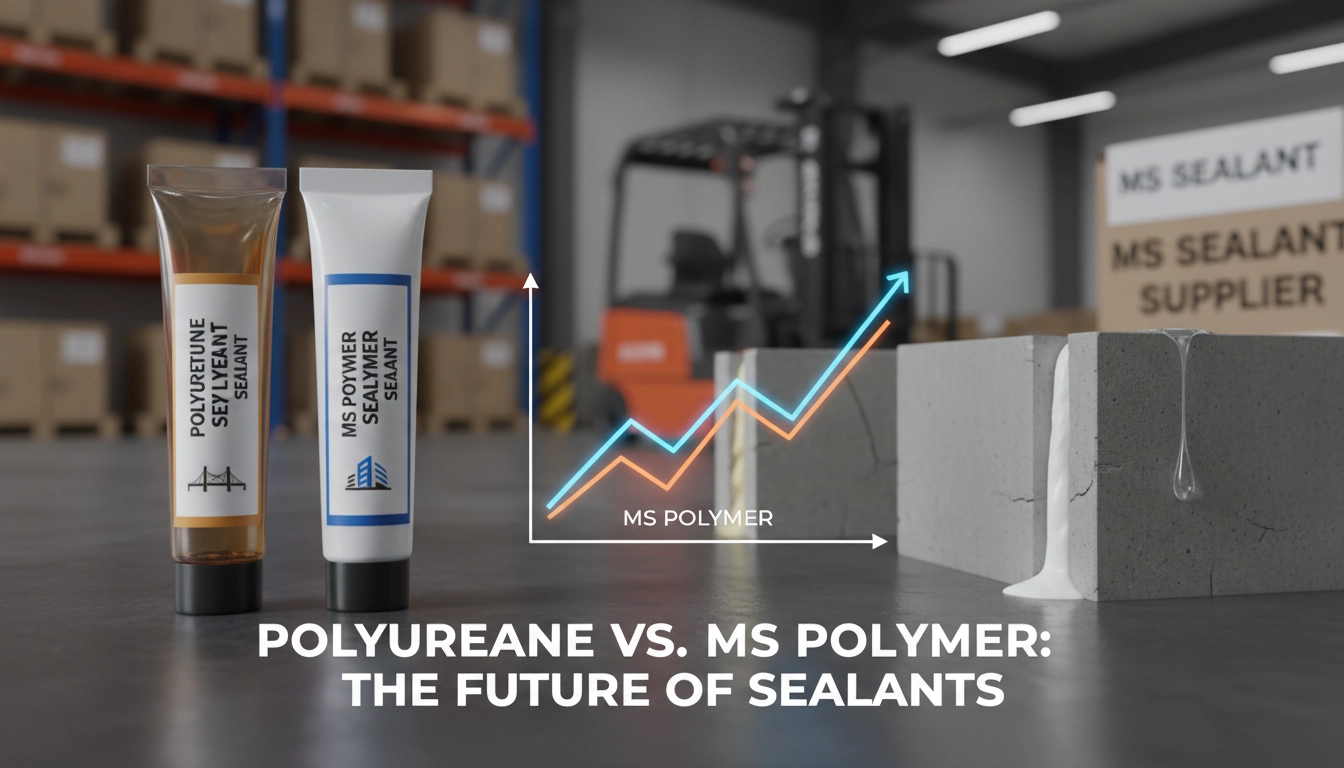
MS Polymers vs. Traditional Sealants: The Definitive Comparison for Durability and Cost-Efficiency (2026 Guide)
OEM/ODM neutral cure clear silicone sealant Manufacturers and Suppliers
Top acetic acid silicone sealant Manufacturers and Suppliers

HY992 Modified Polyurethane Construction Sealant
HY992 Modified Polyurethane Sealant is a one-component, moisture-curing construction sealant designed for professional building and structural sealing applications. It provides excellent adhesion, weather resistance, and durable elasticity, making it suitable for a wide range of construction materials.
The formulation delivers strong bonding performance without corrosion or substrate contamination, while maintaining low VOC content for environmentally responsible construction projects.

HY995 Crystal Clear Ms Polymer Adhesive/Sealant
HY995 Crystal Clear Ms Polymer Adhesive/Sealant is a new generation MS Polymer adhesive / sealant formulated for all bonding and sealing applications where long term reliability is required. It has excellent bonding strength on various materials. It will cure to form a durable, flexible, waterproof seal.

HY997 High-Performance Anti-Microbial MS Polymer Sealant
HY997 MS polymer sealant for is is a premium one-component, neutral-curing modified silane sealant engineered for demanding interior applications. It offers a Class 20 movement capability, ensuring long-lasting flexibility and reliable performance under dynamic joint conditions. Curing at room temperature, HY997 delivers superior anti-microbial and mildew-resistant properties, maintaining hygienic and clean environments over time.

KINGDELI HY732 Professional Acetoxy Cure Silicone Sealant
KINGDELI HY732 is a professional-grade, one-component acetoxy cure silicone sealant designed for fast curing, strong adhesion, and long-lasting flexibility. Ideal for aquariums, glass applications, aluminum doors and windows, kitchens, and bathrooms, it provides reliable sealing performance with excellent anti-fungal protection in high-humidity environments.
Let’s Build Stronger Bonds with Quality Adhesives and Sealants
Have questions about the topic or need tailored sealant solutions for your project?
Our team is ready to provide expert guidance, product recommendations, and application support.
Innovating with Integrity, Bonding the World
Since 1998, KINGDELI has delivered trusted, sustainable sealant solutions that connect industries and inspire progress worldwide.

Whatsapp: +8618825946249
Kingdeli
Kingdeli
Kingdeli
Kingdeli
Kingdeli